


↵Rail Screw Spike Fastening System

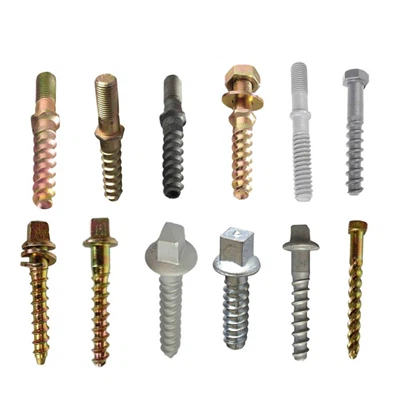
The Railway Screw Spike is a threaded mechanical fastener engineered for high-retention rail fixation on timber sleepers. It comprises a high-strength steel shank with coarse, deep-cutting threads, a forged polygonal head for tool engagement, and a tapered gimlet point. Unlike driven spikes, it creates a calibrated clamping force through torque application, generating both tensile preload in the shank and compressive engagement between rail base, tie plate, and sleeper.
Technical Specifications:
| Feature | Functional & Mechanical Perspective | Production & Engineering Perspective | |
|---|---|---|---|
| Core Principle | Torque-generated tensile clamping & threaded interlock | Cold forging and rolling of timber-specific thread forms | |
| Key Metric | Installed clamping force (kN) / Applied torque (Nm) | Thread root strength, surface hardness after coating | |
| Critical Interface | Thread-to-timber engagement & head-to-tie plate bearing | Die design for thread rolling and point forging | |
| Failure Mode Focus | Thread stripping in wood, fatigue fracture under head | Improper heat treatment leading to brittle threads or soft heads | |
| Tool/Technique | Torque wrench, spike wrench (snail), tie plate gauge | Thread rolling machines, induction hardening, coating baths |

Functional & Engineering Perspective
Torque-to-Tension Conversion: Transforms applied installation torque directly into axial tensile force within the spike shank, creating a precise, quantifiable clamping force on the rail-tie plate-sleeper sandwich.
Enhanced Anti-Loosening Performance: The helical thread form provides continuous engagement with the wood fibers, creating far greater resistance to vibrational back-out compared to the friction-only hold of a dog spike.
Maintenance & Operational Perspective
- Rolled Thread Advantage: Threads are cold-rolled rather than cut, creating continuous grain flow along the thread profile and inducing beneficial compressive surface stresses that enhance fatigue resistance by 30-50% over machined threads.
- Controlled Fiber Orientation: The forging process aligns the steel's grain structure radially from the shank center, maximizing resistance to the multi-directional stresses encountered during installation and service.
- Galvanic Corrosion Mitigation: Hot-dip galvanizing is applied with controlled zinc-iron alloy layer formation to prevent bimetallic corrosion between spike and tie plate while maintaining consistent thread dimensions.
Gnee Professional supplier


Hot Tags: fasteners for rail installation screw spike, China fasteners for rail installation screw spike manufacturers, suppliers, factory, easy install rail spikes, maintenance free rail spikes, railroad spikes installation, railway spikes workshop, strong rail spikes, track spikes workshop


