


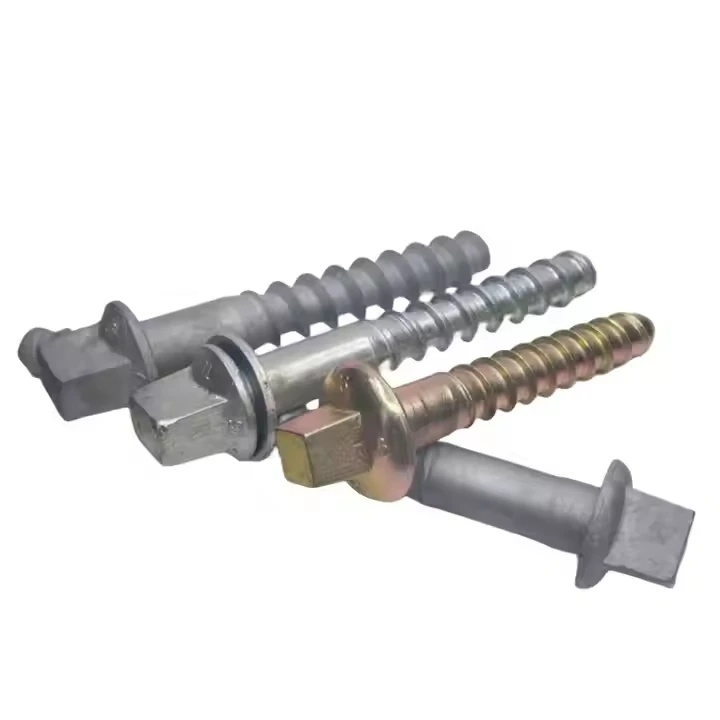

Description
Technical Parameters
Railway Screw Spikes - Technical Specifications & Features
This table outlines the basic specifications, advantages, and disadvantages of screw spikes themselves.
| Aspect | Description |
|---|---|
| Basic Definition | A threaded fastener used to secure rails to wooden or composite sleepers (ties) by being rotated into a pre-drilled hole. |
| Primary Function | To provide a strong, mechanical lock between the rail base and the sleeper. |
| Key Components | • Spike Body: The main threaded shaft. • Head: Typically a square or hexagonal head for tool engagement. |
| Common Materials | • Medium Carbon Steel • Alloy Steel (for higher strength requirements) |
| Surface Treatment | • Hot-Dip Galvanizing (most common for corrosion resistance) • Black (untreated, for indoor or temporary use) |
| Key Advantages | • Superior Holding Power: Resists pull-out and lateral forces better than driven spikes. • Reduced Sleeper Damage: Minimizes splitting of wooden sleepers. • Reusability: Can often be unscrewed and reused. • Ease of Removal: Simplifies track maintenance. |
| Key Disadvantages | • Higher Initial Cost: More expensive than cut spikes. • Slower Installation: Requires drilling and screwing. • Requires Special Equipment: Needs dedicated drilling/spiking machines or powerful impact wrenches. |

Screw Spikes vs. Cut Spikes - A Comparative Analysis
This table provides a direct comparison between screw spikes and the traditional cut (drive) spikes across critical parameters.
| Parameter | Screw Spike | Cut Spike (Traditional) |
|---|---|---|
| Fastening Principle | Threaded engagement via rotation. | Friction and deformation via impact driving. |
| Holding Power | Very High. Superior long-term resistance to loosening under dynamic loads. | Moderate. Can work loose over time due to vibration and wood shrinkage. |
| Impact on Sleeper | Low. Minimizes splitting and internal damage, extending sleeper life. | High. Can cause splitting, crushing, and degradation of wood fibers. |
| Reusability | Good. Can typically be unscrewed and reused multiple times. | Poor. Often bent or deformed during removal; holding power is significantly reduced if reused. |
| Initial Cost | Higher (component + installation). | Lower. |
| Maintenance | Easier for targeted removal and replacement. | Often requires driving new spikes into new locations on the sleeper. |
gnee-professional supplier


Hot Tags: railway steel rail screw spikes, China railway steel rail screw spikes manufacturers, suppliers, factory, sturdy rail spikes, track spikes installation, rail spikes factory, railroad spikes installation, track spikes production, small scale rail spikes production


