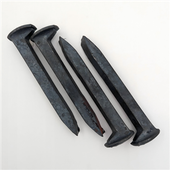
↵Rail Dog spike Fastening System

The Railway Dog Spike is a forged steel fastening implement featuring a square shank and a sharply angled, chisel-shaped head designed to be driven through a rail base plate and directly into a wooden sleeper.
Its holding mechanism relies entirely on the compression and friction created between the square shank and the displaced wood fibers of the sleeper, forming a rigid, non-elastic connection.
Installation is an impact-driven process, historically performed manually with a sledgehammer but now commonly executed with pneumatic or hydraulic spike drivers that deliver controlled impact force.
Technical Specifications:
| Pattern Name | Head Length | Shank Size | Typical Offset Angle | Historical Region/Application | |
|---|---|---|---|---|---|
| Common Pattern | 1.5 inches | 5/8" square | 25-30 degrees | Standard North American mainline (pre-1950) | |
| Southern Pattern | 2.0 inches | 3/4" square | 20-25 degrees | Southern US railways, heavy plate | |
| Pennsylvania Pattern | 1.75 inches | 5/8" square | 30-35 degrees | Northeastern US, sharper hook | |
| Narrow Gauge Pattern | 1.25 inches | 1/2" square | 20 degrees | Light railways, mining, 36" gauge | |
| Bridge Tie Pattern | 2.25 inches | 7/8" square | 15 degrees | Extra-long for thick bridge timbers |

Functional & Engineering Perspective
Heritage and tourist railway preservation projects where maintaining historical accuracy in track construction methods is as important as operational functionality.
Low-volume industrial spurs and loading tracks serving seasonal industries (e.g., agricultural, forestry) where traffic is intermittent and infrastructure investment is minimized.
Track construction in remote locations with limited access to sophisticated equipment or specialized fasteners, where simplicity and reliability of basic components are paramount.
Maintenance & Operational Perspective
- Continuous inspection during seasonal changes is critical, as wood swell/shrink cycles dramatically affect spike holding power, requiring immediate attention after wet/dry transitions.
- Impact-based loosening detection involves regularly tapping spikes with a hammer to identify changes in acoustic response that indicate loss of compression in the wood.
- Corrective maintenance follows immediate identification-loose spikes must be re-driven within days to prevent progressive loosening of adjacent spikes and plate cutting into the sleeper.

Gnee Professional supplier


Hot Tags: steel railroad track dog spike, China steel railroad track dog spike manufacturers, suppliers, factory, strong rail spikes, small scale rail spikes production, cost effective rail spikes, railway spikes factory, track spikes factory, installation friendly rail spikes