


Description
Technical Parameters
Rail Fishplate Fastening System

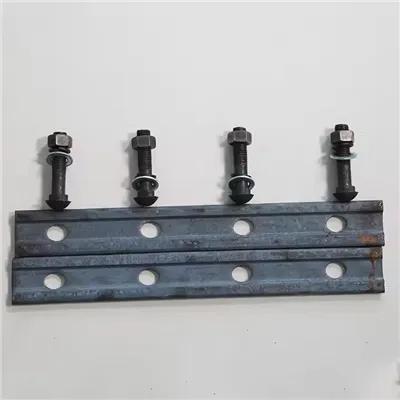
The Railway Fishplate (also known as joint bar or splice bar) is a metal connecting component bolted in pairs to the sides of adjacent rail ends to form a continuous track structure . Manufactured from carbon steel grades including 45# and 50#, these plates feature tapered top and bottom surfaces that wedge against the rail head and foot when bolts are tightened, ensuring secure alignment .
Technical Specifications:
| Failure Type | Primary Cause | Characteristic Features | Prevention Method | Seasonal Pattern |
|---|---|---|---|---|
| Upper-Origin Fatigue | Fretting at top contact surface | Black oxidation zone at crack origin; micro-fissures from surface deformation | Reduce friction coefficient; improve surface finish | Year-round |
| Lower-Origin Fatigue | High tensile stress at 3rd/4th bolt holes | Faster crack propagation; larger plastic zone | Maintain bolt torque; reduce rail gap | Peaks in winter |
| Brittle Fracture | Coarse grain size (ASTM 1-2) | Cleavage facets; minimal plastic deformation; fails at 5-10mm crack | Strict quality control; fine-grain heat treatment | Sudden, no warning |
| Corrosion Fatigue | Coastal/tunnel environments | Multiple crack initiation sites from pitting | Hot-dip galvanizing; stainless steel options | Accelerated in humidity |
| Fretting Wear | Micro-motion between contact surfaces | Surface deformation; oxide debris; friction-induced damage | Increased clamping force; insulation | Continuous progression |

Installation & Maintenance Perspective:
- Fishplate failures account for approximately 50% of railway accidents; 1987 Lanzhou line accident caused by simultaneous fishplate and rail fracture led to derailment, fire, and 20-hour traffic interruption
- Cracks originate from fretting fatigue between fishplate and rail contact surfaces, driven by micro-vibration, friction wear, and clamping force loss-three primary factors: friction coefficient, contact pressure, and slip amplitude
- Winter failures increase significantly due to larger rail gaps creating additional tensile stress at 3rd and 4th bolt holes
Maintenance & Operational Perspective
- Wedge-shaped design: top and bottom surfaces taper inward to create even alignment when bolts are tightened, wedging firmly against rail head bottom and rail foot top
- Reduces peak bending moments at rail joints by up to 40% compared to unjointed sections, distributing dynamic loads across connected rails
- Bolt hole geometry: elliptical counter-sunk holes prevent bolt rotation during tightening; 8.8 grade high-strength bolts feature two raised rings on head for identification, 10.9 grade has flat tapered head
Gnee Professional supplier


Hot Tags: fishplate for light rail fixing, China fishplate for light rail fixing manufacturers, suppliers, factory, compromise splice bar, insulated rail joint types, asce 60 rail dimensions, joggled fish plate specification, asce 85 rail, function of fish plate in railway


