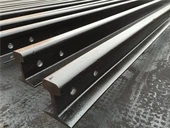
A rail fish plate is a steel joint bar mounted along the rail web to reconnect discontinuous rail ends, enabling the jointed section to carry operational loads as part of the track structure. By restoring continuity, it prevents abrupt stiffness loss at the joint. GNEE RAIL supplies fish plates for UIC50/54/60, GB 8–60 kg/m rails, AREMA/ASCE sections, BS11 profiles, JIS rail types, AS1085 rails, DIN536 A55–A120, and QU70/80/100/120 crane rails, with joint compatibility assessment.

International standard rail joints
Chinese Standard Rail Joint

BS Standard Rail Joint

UIC Railway Rail Joint

DIN Standard Rail Joint

South American Standard Rail Joint

African Standard Rail Joint

AREMA Standard Rail Joint

How to choose the appropriate rail joint specifications?
Choosing appropriate rail joint specifications requires matching fishplate profiles to the specific rail weight (e.g., 52kg, 60kg), rail profile, bolt hole spacing, and operating parameters like axle load, traffic speed, and curvature. Key considerations include selecting high-strength steel (880+ MPa) for heavy haul, using insulated joints for signaling, and ensuring proper expansion gaps.
Key Steps for Selection:
- Identify Rail Profile and Weight: Match the fishplate (or joint bar) profile to the exact rail section (e.g., AREMA, UIC, JIS standards).

| Fishplate for UIC Standard Steel Rail | |||
| Steel Rail Type | Steel Rail Weight (KG/M) | Fishplate Standard | Fishplate Material |
| UIC54 | 54.43 | UIC | 45#,55# |
| UIC60 | 60.34 | ||
| Fishplate for BS Standard Steel Rail | |||
| BS50'O' | 24.833 | BS 47-1 | 55#,45# European Grade 700 |
| BS60A | 30.618 | ||
| BS75R | 37.041 | ||
| BS80A | 39.761 | ||
| BS90A | 45.099 | ||
| BS100A | 50.182 | ||
| BS113A | 56.398 | ||
| Joint Bar for AREMA 2007 Standard Steel Rail | |||
| 100RE(TR50) | 50.35 | AREMA 2007 | 45#,55#,AREMA Grade Steel |
| 115RE | 56.9 | ||
| 115-119RE | |||
| 132RE | 65.31 | ||
| 133RE | 66.1 | ||
| 136RE | 67.41 | ||
| 132-136RE | |||
| Fishplate For Chinese Standard Steel Rail | |||
| GB15KG | 15.2 | YB226-63 | Q235,45# |
| GB18KG | 18.06 | YB225-63 | |
| GB22KG | 22.3 | YB14-63 | |
| GB24KG | 24.46 | ||
| GB30KG | 30.1 | YB351-63 | |
| GB38KG | 38.733 | TB/T 2345-2008 | 45#,55# |
| GB43KG | 44.653 | ||
| GB50KG | 51.514 | ||
- Determine Operating Parameters: Heavy axle loads and high speeds require heavier-duty fishplates with greater strength and stiffness.
- Assess Electrical Needs: Choose insulated rail joints for signal zones to prevent electrical conductivity between rail ends.
- Consider Location Requirements: Bridge approaches, switch components (turnout heels), and special locations require customized joints.
- Match Bolt Hole Patterns: Ensure the joint bar has the correct number and spacing of bolt holes to fit the rail ends.
- Evaluate Material Strength: For mainline tracks, select steel with high tensile strength (880+ MPa).
Select Type:
- Fishplates: Standard, cost-effective connection.
- Joggled Joints: Used for repairing broken/cracked welded rails (provides space for the weld collar).
- Transition Joints: Connect different rail profiles or weights.
- Ensure Proper Expansion: The joint must accommodate thermal contraction and expansion of the rail.

| Classification Category | Type of Rail Joint | Core Definition / Key Characteristics |
| By Position on Track | Square Joint | Joints on parallel rails are aligned opposite each other. Common on straight tracks; simple but causes more impact. |
| Staggered Joint | Joints on one rail are opposite the mid-point of the adjacent rail. Primarily used on curves to reduce forces and improve ride quality. | |
| By Position of Sleepers | Supported Joint | Rail ends rest directly on a single "joint sleeper". Minimizes deflection but creates a rigid, high-maintenance point. |
| Suspended Joint | Rail ends are located between two sleepers. The most common type; offers flexibility but requires more frequent maintenance. | |
| Bridge Joint | Similar to suspended, but uses a metal bridge plate to connect rails on either side of the joint. Not widely used. | |
| By Performance & Application | Ordinary (Bolted) Joint | Standard connection using fishplates and bolts. Cost-effective, allows for thermal expansion. |
| Compromise Joint | Connects two rails of different sizes/profiles. Uses specially shaped fishplates to ensure a smooth transition. | |
| Conductive Joint | Ensures electrical continuity between rail sections for traction current and signaling, using conductive materials. | |
| Insulated Joint (IRJ) | Electrically isolates rail sections for signaling systems. Uses insulating materials between rails and plates. | |
| Welded Joint | Rail ends are fused together (e.g., thermite welding). Creates Continuous Welded Rail (CWR) for a smoother, stronger track. | |
| Frozen Joint | A defective condition where tight or corroded fishplates prevent thermal expansion/contraction, leading to high stress. | |
| Expansion Joint (REJ) | Allows controlled longitudinal rail movement (e.g., on bridges) to prevent buckling or breakage due to temperature changes. |
Founded in 2008, GNEE RAIL is a leading global manufacturer and supplier of railway components, specializing in high-quality rail fish plates (joint bars/splice bars) with strong production capacity and global service capabilities.
Our rail fish plate portfolio is comprehensive and compliant with international standards including UIC, AREMA, BS, DIN, and GB, covering light rail (8kg-30kg), heavy rail (38kg-75kg), and crane rail (QU70-QU120) systems. We offer diverse types such as insulated joint bars, bulged fish plates, and compromise rail joints,with precise specifications (4-hole/6-hole, 24-inch/36-inch), ensuring excellent mechanical performance.We uphold strict quality control supported by ISO 9001:2015 certification, an in-house inspection center, and third-party audits by SGS and BV. Our one-stop service includes customization, production, packaging, and after-sales support, tailored to clients' project needs.
Click here to obtain the detailed product catalog of GNEE RAIL