

Performance Benefits Of 60 Lb ASCE Rail
In industrial rail systems, rail ASCE 60 is widely recognized for delivering a strong balance between structural strength, durability, and cost efficiency. While many buyers focus on ASCE 60 rail dimensions or 60 lbs rail weight per meter, the real value lies in how this profile performs under dynamic loads, harsh environments, and long-term operation.

At GNEE RAIL, we not only supply ASCE 60 rail, but also help customers understand how to maximize its engineering performance in real-world applications-from mining to crane systems.
The Engineering Philosophy Behind The ASCE Standard
The ASCE rail design follows a distinctive engineering principle: rail height equals base width (1:1 ratio). This proportional geometry is not accidental-it is a deliberate design choice to enhance anti-overturning stability.
For rail ASCE 60, this means that even under lateral forces (such as curved track movement or crane wheel side pressure), the rail maintains excellent stability compared to other light rail profiles. This is especially important in applications where track alignment must remain consistent despite uneven subgrades.

👉 For the exact Moment of Inertia and physical dimensions, please view our Rail ASCE 60 Dimensions chart.
GNEE RAIL provide not only standard profiles but also engineering consultation, helping customers evaluate whether the ASCE design philosophy fits their specific load and stability requirements.
Load Capacity And Weight Distribution
One of the most critical performance indicators of 60 lb ASCE rail is its ability to handle load efficiently.
The optimized cross-section provides a strong section modulus, allowing the rail to resist bending stress when subjected to heavy wheel loads. Compared to lighter rails, rail ASCE 60 can sustain higher axle loads without permanent deformation.
asce 60 rail dimensions:
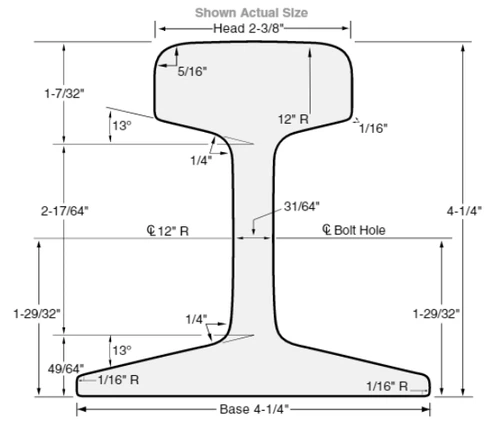
| Type | Head Width(mm) | Rail Height(mm) | Base Width(mm) | Web Thickness(mm) | Weight(kg/m) |
|---|---|---|---|---|---|
| 60 LBS Rail(ASCE 60) | 60.32 | 107.95 | 107.95 | 12.3 | 29.76 |
Additionally, the relatively wide base defined in 60 lb ASCE rail dimensions plays a key role in distributing loads. Instead of concentrating stress on a small area, the load is spread across sleepers (wooden or concrete), reducing pressure on the substructure and preventing track settlement.
This is why 60 pound rail load capacity is often considered the minimum requirement for medium-duty mining and industrial systems.
GNEE RAIL assist clients in load calculation and rail selection, ensuring the chosen ASCE 60 rail matches actual operating conditions rather than relying on generic specifications.
Enhanced Wear Resistance At The Rail Head
The durability of rail ASCE 60 is closely linked to its rail head design and material selection.
A larger wheel-to-rail contact area reduces contact stress, which significantly lowers wear rates. Compared to lighter rails, 60 lb ASCE rail provides a more stable running surface, minimizing surface fatigue and extending service life.

In curved tracks, the rail profile also helps reduce flange wear. When combined with appropriate materials such as high-carbon or manganese steels, wear resistance is further improved.
👉 The wear resistance is further enhanced when choosing high-carbon grades. See our Rail ASCE 60 Steel Grades for details.
GNEE RAIL offer material-grade matching services, helping customers combine optimal geometry (ASCE 60 rail dimensions) with the right steel grade to maximize wear resistance.
60 Lb ASCE Rail vs. 40 Lb: The Performance Gap
From a cost perspective, many buyers initially consider lighter rails such as 40 lb. However, the performance difference is significant.
Although 60 lb ASCE rail is only about 10 kg/m heavier than 40 lb rail, its moment of inertia increases disproportionately, resulting in far greater resistance to bending and deformation.
| Size | Head (mm) | Height (mm) | Base (mm) | Web (mm) | Nominal weight (kg/m) | Material | Length (m) |
|---|---|---|---|---|---|---|---|
| ASCE 25 | 38.1 | 69.85 | 69.85 | 7.54 | 12.4 | 700 | 6-12 |
| ASCE 30 | 42.86 | 79.38 | 79.38 | 8.33 | 14.88 | 700 | 6-12 |
| ASCE 40 | 47.62 | 88.9 | 88.9 | 9.92 | 19.84 | 700 | 6-12 |
| ASCE 50 | 54 | 98.4 | 98.4 | 11.11 | 24.855 | 700 | 6-12 |
| ASCE 60 | 60.32 | 107.95 | 107.95 | 12.3 | 29.76 | 700 | 6-12 |
| ASCE 75 | 62.71 | 122.24 | 122.24 | 13.49 | 37.2 | 900A/1100 | 12-25 |
| ASCE 85 | 65.09 | 131.76 | 131.76 | 14.29 | 42.17 | 900A/1100 | 12-25 |
In practical terms, once axle loads exceed a certain threshold, 40 lb rails tend to develop wave-like deformation (corrugation or bending), while rail ASCE 60 maintains track smoothness and structural integrity.
This makes 60 lb ASCE rail the preferred choice for projects where reliability and long-term stability are critical.
Adaptability In Various Climate Conditions
Another key advantage of rail ASCE 60 is its ability to perform reliably across diverse climates.
The robust cross-section, particularly the web thickness, allows the rail to absorb internal stress caused by temperature variations. This reduces the risk of thermal deformation such as rail buckling (sun kink) in hot climates or brittle fracture in cold environments.

From mining operations in Africa to forestry systems in cold regions, ASCE 60 rail demonstrates consistent performance under extreme conditions.
GNEE RAIL supply climate-adapted material solutions, including high-toughness steels for cold regions and wear-resistant grades for high-temperature or high-load environments.
Why GNEE RAIL Is Your Performance-Oriented Partner?
At GNEE RAIL, we deliver:
- Full range of 60 lb ASCE rail with multiple steel grades
- Engineering support for load calculation and rail selection
- Customized processing (cutting, drilling, bending)
- Global logistics and project-based supply solutions
Contact us for customized solutions for ASCE 60 rail.


