

The rail clip plays an irreplaceable core role in the entire rail fastening system, serving as the essential component that maintains a dynamically stable connection between the rail and the sleeper. Functioning as the "living joint" of the system, the rail clip utilizes its elastic properties to exert a continuous and stable clamping pressure on the rail foot. This force is fundamental in preventing the rail from shifting laterally, creeping longitudinally, or even overturning under the loads imposed by train wheels. This constant restraining force ensures gauge stability and provides a precise rolling path for the train wheels, directly constituting the prerequisite for the long-term stability of the track's fundamental geometry. Without the effective restraint provided by the clips, the entire track structure would rapidly become unstable under dynamic loads.

| Model | Diameter | Weight | Material |
| Type III | Ø18 | 0.80kg/pc | 60Si2MnA |
| E1609 | Ø16 | 0.43 kg/pc | 60Si2MnA |
| E1809 | Ø20 | 0.61kg/pc | 60Si2MnA |
| E1813 | Ø18 | 0.62kg/pc | 60Si2MnA |
| E2001 | Ø20 | 0.80kg/pc | 60Si2MnA |
| E2007 | Ø20 | 0.80kg/pc | 60Si2MnA |
| E2009 | Ø20 | 0.80kg/pc | 60Si2MnA |
| E2039 | Ø20 | 0.80kg/pc | 60Si2MnA |
| E2055 | Ø20 | 0.80kg/pc | 60Si2MnA |
| E2056 | Ø20 | 0.80kg/pc | 60Si2MnA |
| E2063 | Ø20 | 0.80kg/pc | 60Si2MnA |
| PR85 Rail Clip | Ø13 | 0.25kg/pc | 60Si2MnA |
| PR309A | Ø19 | 0.85kg/pc | 60Si2MnA |
| PR401 | Ø20 | 0.97kg/pc | 60Si2MnA |
| PR415 | Ø20 | 0.95kg/pc | 60Si2MnA |
| PR601A | Ø20 | 1.03kg/pc | 38Si7 |
| SKL 1 | Ø13 | 0.48kg/pc | 60Si2CrA |
| SKL 3 | Ø13 | 0.48kg/pc | 60Si2CrA |
| SKL 12 | Ø13 | 0.53kg/pc | 38Si7 |
| SKL 14 | Ø13 | 0.53kg/pc | 60Si2MnA |
| Special Rail Clip | Ø13 | 0.48kg/pc | 60Si2MnA |
| Russia Rail Clip | Ø18 | 0.58kg/pc | 60Si2MnA |
| Deenik Clip | Ø25 | 0.49-0.68kg/pc | 60Si2MnA |
| Single Anti- | Ø20 | 0.25kg/pc | 60Si2MnA |
| Theft |
The second crucial role of the rail clip lies in its exceptional buffering and vibration-damping capacity. When heavy train wheels pass over the rails, they generate immense impact energy and high-frequency vibrations. The rail clip, leveraging the unique deformation capability of its elastic material, effectively absorbs and dissipates this energy, significantly reducing the intensity of vibrations transmitted to the sleepers, ballast bed, and substructure. This function not only substantially reduces the noise generated by train operation but, more importantly, protects brittle components like concrete sleepers from impact damage, while also slowing the degradation and settlement of the ballast. Consequently, it extends the overall service life of the track infrastructure and enhances ride comfort.
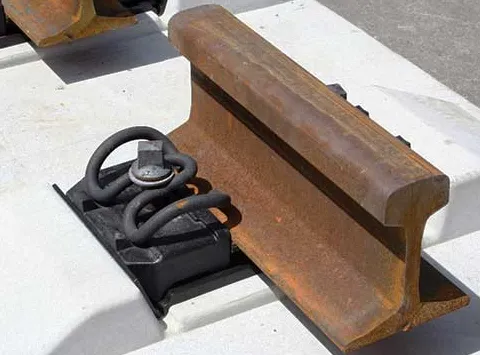
Furthermore, the design of the rail clip endows the track system with an inherent intelligence to cope with temperature variations. Rails expand and contract with ambient temperature changes. The elastic restraint provided by the clips allows the rail to undergo limited, safe longitudinal expansion and contraction, thereby cleverly releasing the immense internal stress that builds up in the rail due to temperature fluctuations. This characteristic is a vital safety mechanism for preventing catastrophic failures such as track buckling (sun kinking) or rail fracture during extreme weather conditions. Thus, although a small component, the rail clip is a strategic element that ensures the safe, stable, and durable operation of the entire track system.

The various high-performance rail clips supplied by GNEE RAIL are designed and manufactured based on a deep understanding of these core functions, ensuring they reliably perform these critical duties under all demanding operating conditions.


