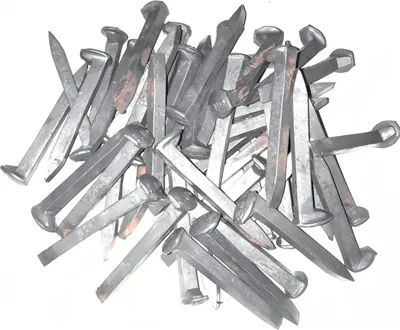
Cost-Effectiveness Depends on the Application
The most cost-effective rail spike is generally a standard cut spike made of low-carbon steel, which is budget-friendly, readily available and suitable for low-to-moderate traffic routes. However, for higher-traffic or harsher conditions, a high-carbon steel spike may be more cost-effective in the long run because of its greater longevity and lower long-term maintenance cost. The overall cost-effectiveness depends on the specific application, because a cheaper spike can become expensive if it must be replaced frequently.
Cut Spikes: Low-Carbon and High-Carbon Options
Low-carbon cut spikes have a low initial cost thanks to their simple design and material. They are best for low-traffic or light-duty applications and are inexpensive, easy to install and widely available. Their main drawback is a lack of the strength and durability needed for heavy-duty or high-speed rail lines.
High-Carbon Steel Spikes
High-carbon steel spikes have a higher initial cost, but they are significantly more durable and resistant to wear and bending, which leads to lower long-term maintenance costs. They are best for high-traffic railway lines, industrial tracks and areas with harsh weather. Current standards define two grades of spike steel: grade 1 soft and grade 2 high carbon. The stronger high-carbon spikes must be marked with the letters HC so that they can be identified in the field.
Manual vs Machine-Made Spikes
Machine-made spikes have lower defect rates and higher efficiency, which can make them more cost-effective in large-scale production even if the initial cost per spike is slightly higher. Manual spikes are cheaper to produce but may show surface convexities, burrs and weight variations. For projects that buy in bulk, machine-made spikes usually deliver the better total value.
Surface Treatments and Screw Spikes
For the cheapest option, blackening plus oiling is popular but offers poor corrosion resistance. Electro-galvanizing is a slightly more expensive option that provides better protection and appearance. Hot-dip galvanizing gives the longest protection and is recommended for humid, coastal or chemically aggressive environments. The right surface treatment reduces replacement frequency and should be included in the life-cycle cost calculation.
Screw spikes are generally more expensive than dog spikes but offer superior holding power, which can be a more cost-effective solution in certain applications by increasing safety and longevity. Typical sleeper screw series include Ss 1/130 in M22 x 130 with a weight of 0.451 kg, Ss 1/150 in M22 x 150 at 0.478 kg, Ss 2/180 in M22 x 180 at 0.595 kg, Ss 5/150 in M24 x 150 at 0.545 kg, Ss 6/150 in M26 x 150 at 0.702 kg, Ss 7/180 in M24 x 180 at 0.636 kg, Ss 8/140 in M24 x 140 at 0.528 kg and Ss 8/150 in M24 x 150 at 0.548 kg, with zinc, plain or black oil finishes and UIC, AREMA, JIS or GB standards.
How to Decide
Calculate the life-cycle cost instead of comparing only the unit price. Include installation labor, expected service life, maintenance frequency and replacement cost. For light traffic and wooden sleepers, low-carbon cut spikes are the economical choice. For heavy traffic, curves and switches, invest in screw spikes or high-carbon spikes marked HC. Always match the spike type to the sleeper material and fastening system, and confirm the corrosion protection level for the local climate.
Frequently Asked Questions
What is the cheapest rail spike option? low-carbon steel cut spike is the cheapest option and suits low-traffic or light-duty lines.
When does a high-carbon spike pay off? On high-traffic or industrial lines, high-carbon spikes last longer and reduce maintenance, making them cheaper over the service life.
What does the HC marking mean? HC marks the stronger grade 2 high-carbon spike, which must be identified in the field for safety.
Which surface treatment is most durable? Hot-dip galvanizing offers the longest corrosion protection, while blackening plus oil is the cheapest but least protective.
Why are screw spikes worth the extra cost? They provide about twice the holding power of dog spikes, improving safety and reducing replacement frequency on demanding sections.