


The 115RE steel rail (also known as TR57 in some markets) is a heavy-duty rail profile manufactured in accordance with AREMA specifications and commonly supplied to ASTM A1 requirements. It is widely used in freight railways, mining lines, and industrial track systems that require high load-bearing capacity and long service life under repeated axle loads.
GNEE RAILWAY RAILWAYL provides 115RE rails together with matching fastening components, ensuring consistent dimensions and reliable material performance for installation in international railway projects.
1. Key Technical Specifications and Dimensions
The geometric design of the 115RE rail profile optimizes the distribution of wheel contact stresses and lateral forces. The standard dimensions and section properties are detailed in the schematic and table below.
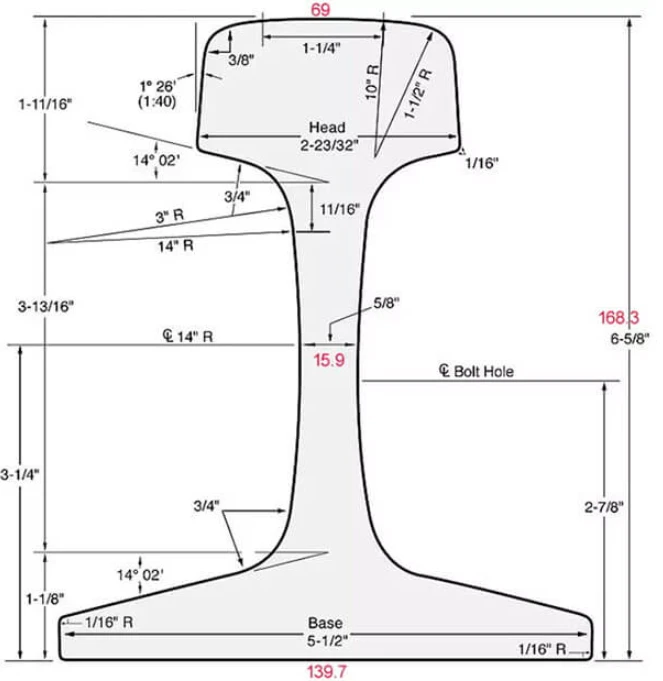
| Type of Rail | Standard | Dimensions mm | Steel Grade | Mass M | |||
| Height | Base Width | Head Width | Web Thickness | kg/m | |||
| 115RE | AREMA | 168.3 | 139.7 | 69 | 15.9 | IS/SS/HH | 56.9 |
For 115RE rail CAD drawings, drilling specifications, or 3D step files, please contact the GNEE RAILWAY RAILWAYL technical team. Technical documentation is available to support project design, procurement evaluation, and system compatibility checks.
2. Standard Rail Fasteners for 115RE Rail Systems
To ensure system compatibility and track stability, the 115RE rail must be integrated with matching fastening components. GNEE RAILWAY RAILWAYL designs and supplies standardized components configured for this specific rail base and web geometry:

- 115RE Joint Bars (Fishplates): Standard 4-hole (24-inch) and 6-hole (36-inch) joint bars manufactured to AREMA specifications, designed to align the rail ends while permitting thermal expansion.
- Tie Plates: Double-shoulder tie plates configured with a 1-in-40 cant to stabilize the rail footprint on timber or concrete ties.
- Rail Clips & Track Spikes: E-type elastic clips (such as E2005 series) and standard 5/8" x 6" cut spikes for mechanical securement.
- Track Bolts & Nuts: Button-head oval-neck track bolts complete with heavy square nuts.
3. Quality Control: Dimensional Compliance and Tolerances
Deviations in rail geometry can lead to localized stress concentrations, premature wear, or track installation challenges. GNEE RAILWAY RAILWAYL implements a dual-stage verification process to ensure all 115RE rails conform to AREMA and ASTM A1 tolerance limits.
A. Straightness Testing
Straightness is verified using multi-axis laser straightness measurement systems alongside mechanical gauge blocks. Tolerance controls include:

- Horizontal Bow: Permissible deviation is restricted to a maximum of 0.8 mm per meter of length.
- Vertical Camber: Limited to less than 0.5 mm per meter to prevent dynamic vertical impacts from rolling stock.
- End Sweep: Strict limits on rail ends (within 1.5 meters of the joint) to ensure seamless welding or mechanical jointing during installation.
B. Sectional Dimension Verification
In-line callipers and template gauges monitor critical sectional dimensions during the hot rolling and cold straightening phases:

- Height Tolerance: ±0.8 mm (±1/32 in) from the nominal dimension of 168.28 mm.
- Base Width Tolerance: ±1.2 mm (±3/64 in) from the nominal 139.70 mm.
- Flange Symmetry: Difference between lateral flange extensions must not exceed 1.0 mm.
4. Metallurgical Grades, Chemical Composition, and Mechanical Properties
The service life of a 115RE rail depends on its microstructure and mechanical properties. We supply rails in carbon and low-alloy steel grades, primarily focusing on the standardized 900A (Standard Carbon) and 1100 (Head Hardened) classifications
A. Chemical Composition
The table below outlines the controlled chemical limits designed to balance wear resistance, weldability, and fracture toughness.
| Grade | C (%) | Mn (%) | Si (%) | P (max, %) | S (max, %) | Al (max, %) |
|---|---|---|---|---|---|---|
| 900A (Standard) | 0.60 - 0.80 | 0.80 - 1.30 | 0.10 - 0.50 | 0.040 | 0.040 | 0.015 |
| 1100 (HH / Alloy) | 0.72 - 0.82 | 0.70 - 1.10 | 0.10 - 0.60 | 0.025 | 0.025 | 0.010 |
B. Mechanical Properties
Thermal treatment (online or offline head hardening) is utilized for the 1100 grade to produce a fine pearlitic structure, providing higher yield strength and surface hardness in high-wear zones like curved tracks.
| Grade Name | Tensile Strength (MPa) | Yield Strength (MPa) | Elongation A5 (%) | Minimum Head Hardness (HBW) |
|---|---|---|---|---|
| 900A Grade | ≥ 880 | ≥ 460 | ≥ 10 | ≥ 260 |
| 1100 Grade (HH) | ≥ 1080 | ≥ 780 | ≥ 10 | 340 - 390 |
5. Packaging, Handling, and Global Logistics
Preventing physical damage and deformation during transit is critical to preserving structural straightness. GNEE RAILWAY RAILWAYL provides tailored logistics and packaging plans based on rail length and final destination:

- Standard Length Options: Available in 12-meter (39 ft), 25-meter (82 ft) sections, or custom-cut lengths as per project requirements.
- Packaging Configurations: Rails are secured in bundles utilizing heavy-duty steel strapping and protective wood separators to avoid steel-to-steel friction. High-strength lifting eye bolts or magnetic crane-lifting setups are utilized during loading.
Logistics and Transport Methods:
- Containerized Shipping: Ideal for 12-meter rails, packed into standard 40-foot Open-Top or Dry-Van containers using customized end-loading frames.
- Bulk Cargo Carriers: Recommended for larger volumes of 12m or 25m rails to optimize freight costs. Rails are systematically stacked and lashed in the ship's hold.
Contact GNEE RAILWAY Sales Representative
If you require pricing for 115RE rails, specific freight forwarding estimates, or matching fastener systems, please contact our logistics and sales desk. Our team will prepare a comprehensive quotation based on your target destination and delivery schedule.
Frequently Asked Questions
Q1: What is the main difference between 115RE and TR57 rails?
The 115RE rail is designed under American AREMA/ASTM specifications, while the TR57 designation is used under European standards.
Q2: Why is the 1100 (Head Hardened) grade preferred for curved tracks?
Curved sections experience high lateral forces and friction from wheel flanges, leading to accelerated wear. The 1100 Head Hardened (HH) grade provides a higher surface hardness range of 340 to 390 HBW compared to the standard 900A grade (≥ 260 HBW). This increased hardness significantly reduces rolling contact fatigue (RCF) and head wear, extending the rail's service life.
Q3: Can GNEE RAILWAY RAILWAYL supply pre-drilled 115RE rails?
Yes. GNEE RAILWAY RAILWAYL can provide 115RE rails pre-drilled at the ends for mechanical joint installations. Standard bolt hole spacing and diameters conform to AREMA guidelines, but custom hole sizes and distances can be machined to meet specific drawing requirements.


