


↵Rail e clip Fastening System

The Railway E Clip, also known as an Elastic Rail Clip or Pandrol™-type clip, is a critical component in modern rail fastening systems. It is a spring steel fastener designed to securely hold the rail to the concrete or steel sleeper (railroad tie). Its unique "E" shape provides a high clamping force through elastic deformation, ensuring longitudinal and lateral rail restraint while allowing for controlled movement due to thermal expansion and dynamic loads. This fastener is essential for maintaining track gauge, stability, and safety.
Technical Specifications:
| Parameter | Technical Detail |
|---|---|
| International Standard | ISO 22265-1, EN 13146-4 |
| Typical Toe Load | 10-15 kN per clip |
| Fatigue Test Standard | Must withstand 5-10 million load cycles at ±2mm deflection without failure |
| Installation Method | Direct hammering, hydraulic tool, or manual lever application |
| Failure Mode | Typically fatigue crack initiation at the inner bend radius; not sudden fracture |
| Reusability Rate | Up to 85% for clips recovered during planned track renewals with proper inspection |

Functional & Engineering Perspective
Isothermal Heat Treatment: Undergoes austempering or controlled martempering processes to achieve superior bainitic microstructure, optimizing fatigue resistance.
Residual Stress Management: Incorporates shot peening and stress coining processes to induce beneficial compressive surface stresses, extending service life.
Dimensional Blockchain: Critical dimensions (leg length, curvature radius, toe angle) are digitally recorded per production batch for complete traceability.
Maintenance & Operational Perspective
- Dynamic Load Distribution: Effectively distributes impact loads from passing wheels across multiple sleepers, reducing localized track damage.
- Quick Installation System: Enables rapid track laying and renewal through hammer-in or hand-tool application without torque-critical bolting.
- Track Circuit Compatibility: Its non-magnetic properties and design allow unimpeded operation of axle-counting and signal block systems.

Gnee Professional supplier


↵Rail Dog Spike Fastening System

The Railway Shoulder is a fundamental load-transfer component in modern rail fastening systems, serving as the rigid structural interface between the elastic rail clip and the sleeper. Engineered as either an integral casting within concrete sleepers or as separate malleable iron/steel inserts, it functions as the fixed abutment against which a clip deforms to generate clamping force. Its precise geometry-including the gauge face, rail seat angle, and clip contact surface-defines the clip's force vector, directly controlling rail restraint in the vertical, lateral, and longitudinal directions.
Technical Specifications:
| Characteristic | Specification / Detail | Primary Importance |
|---|---|---|
| Primary Structural Role | Transfers Lateral & Clip Forces from Rail to Sleeper | Fundamental to Track Gauge & Geometric Stability |
| Critical Wear Parameter | Gauge Face Wear Depth | Direct Indicator of Clamping Force Degradation |
| Material Optimization | Wear-Resistant Surface with Tough, Ductile Core | Balances Longevity & Fracture Resistance |
| System Compatibility | Geometrically Matched to a Specific Clip Type | Ensures Correct Clip Function & Force Vector |
| Failure Consequence | Progressive Gauge Widening & Loss of Rail Restraint | Leads to Rapid Deterioration of Track Geometry |
Functional & Engineering Perspective
Defined Clip Reaction Point: Provides a fixed, unyielding surface that determines the clip's bending radius and deflection limit, thereby defining the magnitude and consistency of the clamping force applied to the rail foot.
Gauge Face and Lateral Restraint: The vertical "gauge face" of the shoulder acts as the primary physical barrier preventing outward rail movement, directly maintaining track gauge under lateral loads from trains, especially on curves.
Maintenance & Operational Perspective
- Crack Detection in High-Stress Zones: Detailed visual and non-destructive inspection (e.g., dye penetrant) of stress concentration areas: the base fillet radius, bolt holes (if present), and the transition zone between the gauge face and the body.
- Shoulder Tightness and Alignment Check: For mechanically attached shoulders, fastener torque and shoulder alignment relative to the rail are verified to prevent movement that would compromise gauge and cant.
- Assessment of Concrete Encasement: For shoulders cast into concrete sleepers, the surrounding concrete is inspected for cracks, spalling, or signs of fretting that indicate excessive load or failure of the bond.
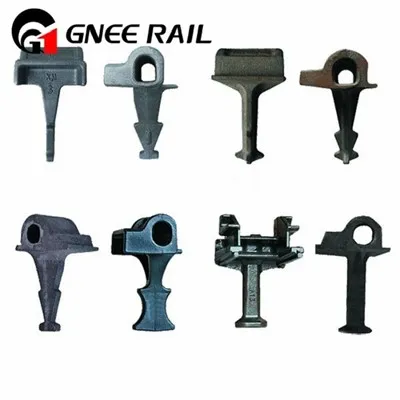
Gnee Professional supplier
Hot Tags: rail track e clips, China rail track e clips manufacturers, suppliers, factory, heavy duty rail clips, rail clip bolting, rail clip surface finish, rail clip plastic coating, rail clip roughness, rail clip alignment


