

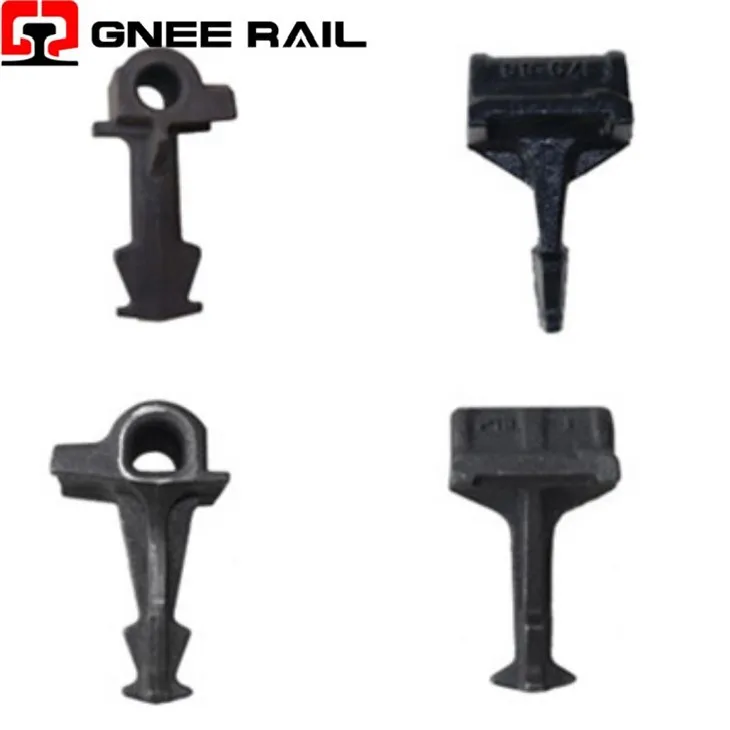


↵Rail Shoulder Fastening System
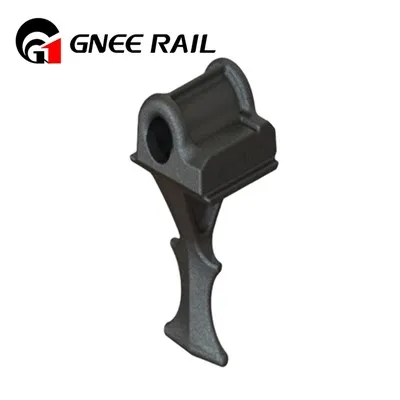
The Railway Shoulder, also commonly called a shoulder or rail shoulder, is a critical load-bearing component in a rail fastening assembly. It is a precisely machined metal block (typically cast or forged) that serves as the anchor point and reaction surface for elastic rail clips. Mounted on the baseplate or directly embedded in the sleeper, its primary function is to transmit and distribute the immense clamping force from the clip to the supporting structure, while also precisely positioning and restraining the clip itself.
Technical Specifications:
| Feature | Utility Perspective | Production Perspective | Maintenance Perspective | |
|---|---|---|---|---|
| Primary Role | Force transfer & clip positioning | Manufacturing of a precise, wear-resistant load block | Preserving geometric and surface integrity | |
| Key Metric | Surface hardness & geometric accuracy | Casting quality (no porosity) & machining tolerances | Wear depth on contact face & absence of cracks | |
| Critical Interface | Shoulder-to-clip contact face | Mold/die design & machining fixture setup | Interface between worn shoulder and new/reused clip | |
| Failure Mode | Wear, plastic deformation, cracking | Shrinkage defects, decarburization, dimensional drift | Progressive wear leading to loss of clip preload | |
| Tool/Technique | Clip force gauge, optical alignment | Spectrometer, hardness tester, CMM (Coordinate Measuring Machine) | Wear depth gauge, crack detection kit, torque wrench for assembly bolts |

Functional & Engineering Perspective
Clip Anchor and Reaction Point: Provides a stable, rigid surface against which the clip's toe or leg presses, enabling the clip to develop its designed clamping force on the rail foot.
Load Transfer and Distribution: Channels the vertical, lateral, and longitudinal forces from the clip into the larger area of the baseplate or sleeper, preventing stress concentration and damage to the underlying material.
Clip Positioning and Anti-Walk Feature: Its machined profile (often with grooves, lips, or pockets) locates the clip precisely and prevents it from "walking" or rotating out of position under vibration.
Maintenance & Operational Perspective
- Heat Treatment and Hardening: The clip contact face and wear surfaces are often locally induction-hardened or the entire shoulder is heat-treated to a specified hardness (e.g., 300-400 HB) to resist deformation and abrasion from the clip.
- Corrosion Protection: Given its exposure, it receives protective coatings such as zinc plating, sherardizing, or epoxy paint to prevent rust, which could lead to clip seizure or reduced friction.
- Dimensional and Dye-Penetrant Inspection: Each batch undergoes rigorous checks for critical dimensions and is often subject to non-destructive testing (like dye penetrant) to identify surface defects in cast or forged units.
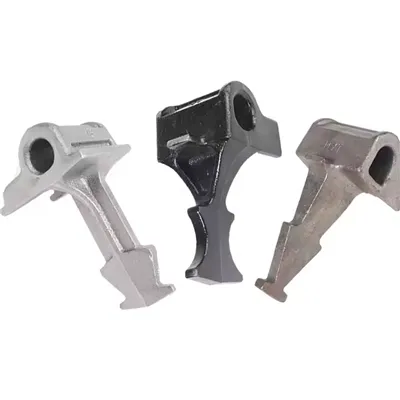
Gnee Professional supplier


Hot Tags: fasteners for rail shoulder, China fasteners for rail shoulder manufacturers, suppliers, factory, railway dog spikes, railroad spike, rail plastic dowel function, Rail Clamp, Rail Plastic Dowel, dog spikes in railway


