


↵Rail Screw Spike Fastening System

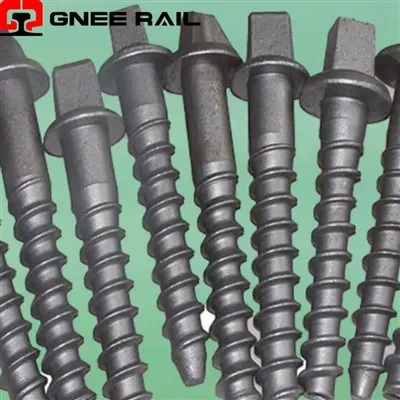
A railway screw spike is a large-format threaded steel fastener that converts torque into tensile preload through a plastic dowel embedded in concrete or timber - unique among all rail fasteners as the only device that generates clamping force through elastic bolt stretch rather than spring deflection, the only fastener whose residual tension cannot be measured by torque wrench after 3 months in service, and the only component where the load-bearing interface is not steel-on-steel but steel-on-polymer (PA66/GF)
Technical Specifications:
|
|---|

Performance Range:
PA66 Thread Form Optimization - Screw spike thread is not standard ISO metric. DIN 7998 / EN 13481-2 specifies: 60° included angle, 0.25–0.35 mm root radius, 0.6–0.8 mm flank clearance. Purpose: distribute shear stress along dowel length, avoid creep rupture at first engaged thread. Standard bolt thread (sharp root) in PA66 dowel → stress concentration factor 4.2 → thread strip at 60% of design torque.
Glass Fiber Orientation Anisotropy - PA66+30%GF dowels are injection-moulded. Fibers orient perpendicular to flow direction at thread roots - parallel to shear plane. This orientation provides maximum thread shear strength (80–90 MPa) . Machined dowels (cut from stock) have random fiber orientation → shear strength 45–55 MPa. Visual identical; performance not equivalent. Procurement error: machined dowels substituted → thread strip at 130 Nm vs 200 Nm spec.
Maintenance & Operational Perspective
- Embedded Corrosion (Invisible) - Concrete is alkaline (pH 12–13). Steel in contact with concrete passivates (0.01 mm/year). BUT: water wicks down thread helix from rail seat. At 20–40 mm depth, pH drops to 9–10 (carbonation). Active corrosion initiates in thread roots. Pitting rate: 0.1–0.2 mm/year. Section loss >20% → torsional shear failure during removal. Detection: impossible; only removal reveals.
- Bending Fatigue at Thread Runout - Rail seat transverse vibration induces alternating bending moment at spike head-shank junction. Maximum bending stress occurs at thread runout (first full thread) . Stress ratio R = −1 (fully reversed). Fatigue limit: grade 8.8 = 70 MPa @ 5M cycles. Track measurement: actual stress 45–95 MPa. 50% exceed fatigue limit. Failure: head separation, no plastic deformation. Detection: torque-angle monitoring; angle increase >40° indicates crack.
Gnee Professional supplier


Hot Tags: carbon steel screw spike, China carbon steel screw spike manufacturers, suppliers, factory, affordable rail spikes, rail spikes manufacturing process, railroad spikes installation, rail spikes factory, simple install rail spikes, rail spikes workshop


