


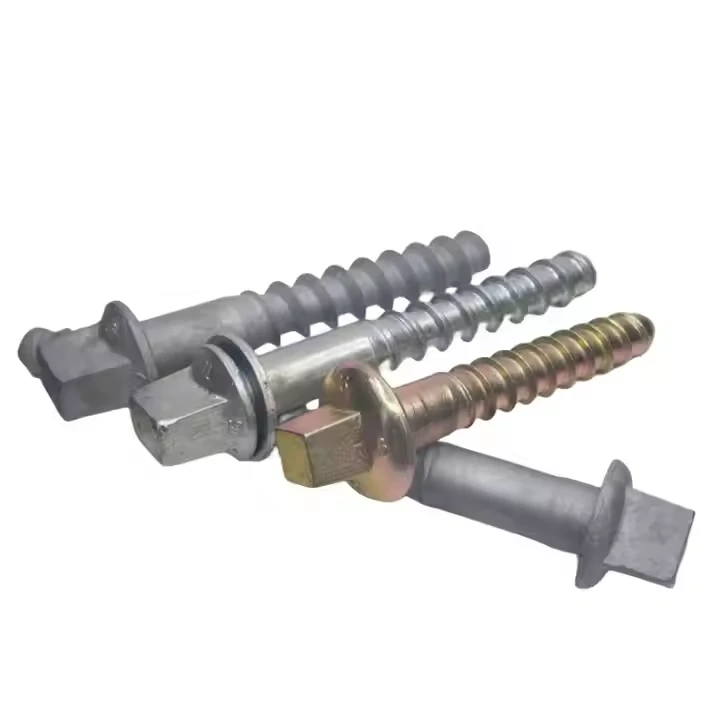
↵Rail Screw Spike Fastening System

The Railway Screw Spike is a robust threaded fastener used to secure rails to timber, steel, or concrete sleepers (ties). It functions by creating a powerful mechanical lock through a threaded connection, offering a more controlled and maintainable clamping force than direct-drive spikes. Typically featuring a square or hexagonal head for tool engagement and a large-diameter, coarse-threaded shank, it is designed to be screwed into a pre-drilled hole in the sleeper. This system provides significant resistance to pull-out forces and rail uplift.
Technical Specifications:
| Characteristic | Specification / Detail | Primary Importance | ||
|---|---|---|---|---|
| Fastening Principle | Mechanical Threaded Interlock | Provides Adjustable, High Tensile Clamping | ||
| Key Installation Tool | Impact Wrench or Manual T-Wrench with Torque Control | Ensures Correct Preload & Prevents Damage | ||
| Primary Sleeper Type | Timber (Historically Primary), also Concrete/Steel Variants | Versatility Across Track Types | ||
| Maintenance Core Action | Periodic Torque Checking & Re-tightening | Counters Vibration-Induced Loosening | ||
| Failure Progression | Loosening → Thread Wear/Stripping → Fracture | Informs Inspection Priority & Replacement Timing |

Functional & Engineering Perspective
Superior Uplift & Creep Resistance: The screw thread creates a powerful mechanical interlock with the sleeper material, offering excellent resistance to vertical uplift and longitudinal rail creep compared to friction-based fasteners.
Enhanced Sleeper Preservation: By using a pre-drilled pilot hole (especially in timber), the screw spike minimizes splitting and structural damage to the sleeper, extending its service life compared to driven spikes.
Foundation for Plate Fastening: Commonly used in conjunction with a malleable iron or steel base plate (tie plate) that sits between the rail and sleeper, distributing load and protecting the sleeper from abrasion.
Maintenance & Operational Perspective
- Thread Rolling: After forging, the shank's threads are created through a cold-rolling process. This displaces rather than cuts the metal, resulting in stronger, smoother threads with superior fatigue resistance.
- Heat Treatment for Strength: The finished spikes undergo quenching and tempering to achieve a uniform hardness and tensile strength, ensuring they can withstand high installation torque and in-service shear stresses without fracturing.
- Corrosion Protection for Longevity: Given their critical load-bearing role, screw spikes receive heavy-duty anti-corrosion coatings. Common methods include hot-dip galvanizing, mechanical galvanizing, or application of a thick epoxy-polyester powder coat.

Gnee Professional supplier


Hot Tags: customized railway screw spike, China customized railway screw spike manufacturers, suppliers, factory, reliable rail spikes, railway spikes manufacturing process, railroad spikes installation, track spikes installation, rail spikes installation, railroad spikes workshop


