

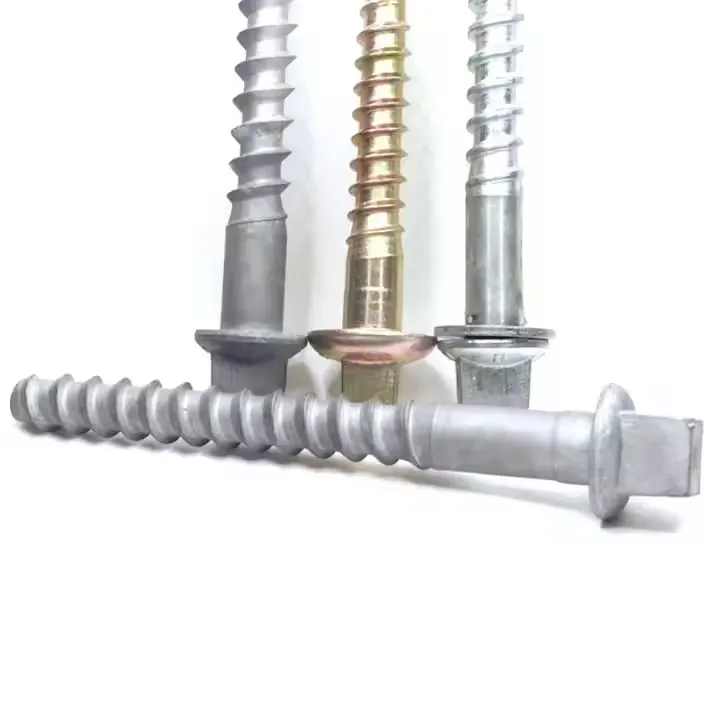


↵Rail Screw Spike Fastening System

The Railway Screw Spike is a threaded mechanical fastener designed to secure rails or base plates to timber, concrete, or steel sleepers. Distinguished by its coarse-threaded shank and square or hexagonal head, it functions by creating a powerful, adjustable tension lock when screwed into a pre-tapped hole or embedded insert. Unlike driven spikes that rely on friction, screw spikes achieve clamping through controlled torque application, providing measurable and maintainable preload.
Technical Specifications:
| Characteristic | Specification / Detail | Primary Importance | ||
|---|---|---|---|---|
| Fastening Mechanism | Threaded Mechanical Engagement with Torque Control | Provides Measurable, Adjustable Clamping Force | ||
| Key Application | Base Plate Fixation to Various Sleeper Types | Versatile Across Timber, Concrete & Steel | ||
| Installation Tool | Impact Wrench with Torque Limiter or Manual Torque Wrench | Ensures Consistent Preload Application | ||
| Maintenance Core Activity | Periodic Torque Verification & Re-tightening | Counters Vibration-Induced Loosening | ||
| Failure Progression | Gradual Loosening → Thread Wear → Complete Pull-out | Allows for Predictive Intervention |

Functional & Engineering Perspective
Combination with Elastic Elements: Modern designs often integrate spring washers or Belleville washers that maintain tension under vibration and provide some resilience, bridging rigid and elastic fastening principles.
Base Plate Security: Primarily used to secure steel or iron base plates to sleepers, which then support the rail, distributing loads and protecting the sleeper from abrasion and crushing.
Reusability and Adjustability: Unlike driven spikes, screw spikes can be removed and reinstalled multiple times without significant loss of holding power, facilitating track maintenance and adjustments.
Maintenance & Operational Perspective
- Roll-Threading Process: Threads are formed through a cold-rolling process that compresses the material rather than cutting it, resulting in stronger threads with improved fatigue resistance and smoother surfaces.
- Heat Treatment for Hardness Gradient: The spikes undergo quenching and tempering to achieve a specific hardness profile-softer core for toughness and harder surface for wear resistance, particularly in the thread and head areas.
- Multi-Layer Corrosion Protection: A combination of metallurgical coatings is often used: a zinc undercoat for cathodic protection, followed by a phosphate layer for paint adhesion, and finished with a polymer topcoat.

Gnee Professional supplier


Hot Tags: customized railway screw spikes, China customized railway screw spikes manufacturers, suppliers, factory, large scale rail spikes production, strong rail spikes, track spikes production, rail spikes manufacturing process, installation friendly rail spikes, efficient rail spikes production


