




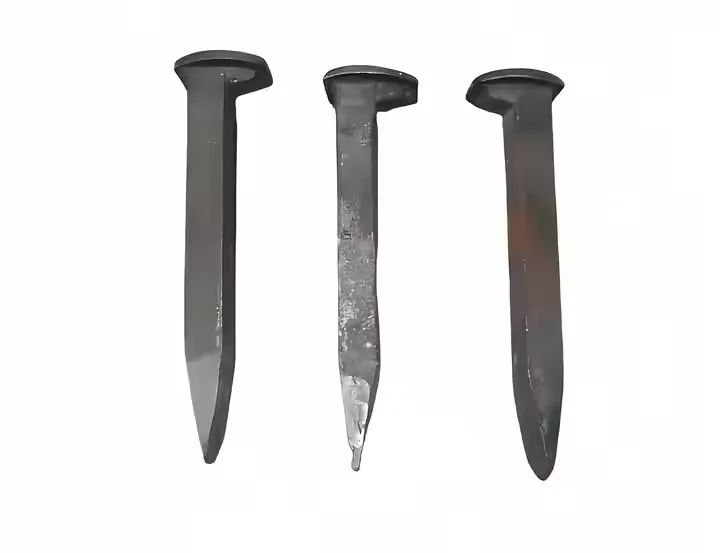
↵Rail Shoulder Fastening System

The Railway Dog Spike represents the foundational mechanical fastening technology of traditional timber-track railways, characterized by its distinctive L-shaped offset head and square tapered shank. This forged steel component functions through direct mechanical interlock rather than elastic tension, with its offset head hooking over the rail foot edge to provide lateral restraint while the square shank generates friction within the timber sleeper.
Technical Specifications:
| Parameter | Category | Specification / Characteristic | |
|---|---|---|---|
| Material Standard | Manufacturing | Typically ASTM A1 (Standard Specification for Carbon Steel Tee Rails) or equivalent | |
| Carbon Content | Material | 0.25-0.35% C (medium-carbon steel for forgeability and strength balance) | |
| Standard Dimensions | Design | 5/8" square shank, 5-1/2" length (varies by rail size and regional standards) | |
| Installation Pattern | Operational | Typically 3-4 spikes per rail seat, spaced 4-6 inches apart depending on rail weight | |
| Holding Power | Performance | 25-35 kN initial pull-out resistance in sound hardwood, degrading 40-60% after 1 MGT traffic | |
| Corrosion Protection | Durability | Hot-dip galvanized (85 μm minimum coating), zinc-aluminum alloys in modern variants | |

Mechanical & Installation Perspective
Pure Frictional Load Transfer: Operates through direct wood-to-steel friction without elastic energy storage, transmitting dynamic forces immediately to the sleeper with minimal damping effect, accelerating timber fatigue and track degradation.
Progressive Loosening Mechanism: Exhibits inherent vibration-induced relaxation as timber fibers compress under cyclic loading, requiring regular re-driving to maintain adequate gauge retention and rail stability.
Stress Concentration Design: The offset head creates asymmetric loading on the rail foot edge, potentially inducing localized plastic deformation in softer rail steels under heavy axle loads.
Installation, Maintenance & System Integration Perspective
- Labor-Intensive Field Processes: Installation requires manual hammering or pneumatic driving through pre-drilled holes, with production rates limited to 80-120 spikes per hour per experienced worker.
- Quality Control Challenges: Field performance heavily depends on timber condition and installer skill, with no practical method to verify or standardize installed tension or holding power.
- Material Efficiency Limitations: Forging process yields significant material waste (15-20% scrap rate) compared to modern wire-formed clips, with each spike containing 200-400% more steel than functionally equivalent elastic fasteners.

Gnee Professional supplier


Hot Tags: dog spike rail fastening system, China dog spike rail fastening system manufacturers, suppliers, factory, rail spikes factory, long lasting rail spikes, maintenance free rail spikes, railway spikes installation, rail spikes installation, railway spikes workshop


