

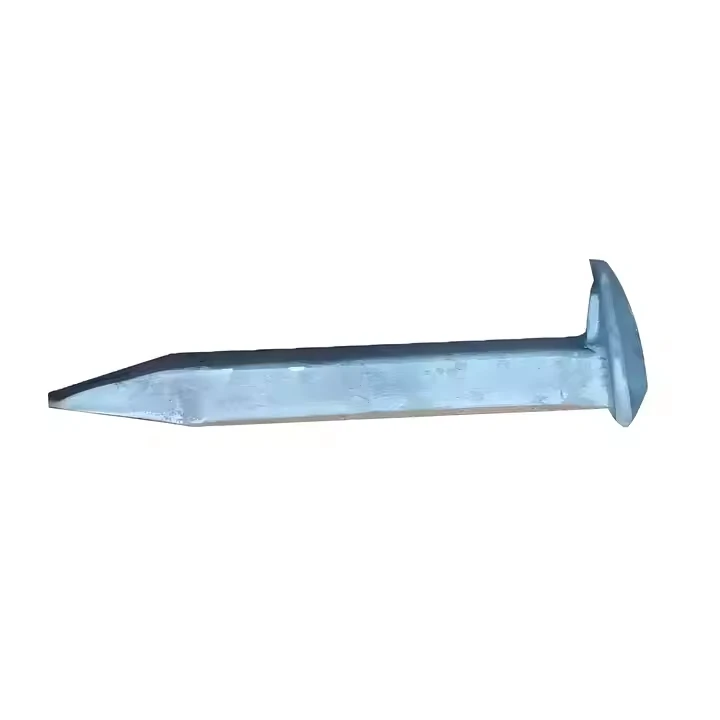


↵Rail Dog Spike Fastening System

The Railway Dog Spike is a traditional, wedge-shaped fastening component historically used to secure flat-bottomed rails to wooden sleepers (ties). Characterized by its distinctive offset head and sharp, square-shanked point, it is driven through pre-drilled holes in the rail base and directly into the wooden sleeper. Unlike elastic clips, the dog spike provides a rigid, friction-based connection with no inherent elasticity.
Technical Specifications:
| Aspect | Dog Spike | Modern Elastic Fastener (e.g., E-Clip) | ||
|---|---|---|---|---|
| Fastening Principle | Rigid, friction-based (wood grip) | Elastic, spring-based (calibrated clamping) | ||
| Primary Sleeper Type | Exclusively wooden sleepers | Concrete, steel, or composite sleepers | ||
| Track Elasticity | None provided at fastener; relies on ballast/sleeper | Provides defined vertical/lateral elasticity at rail seat | ||
| Maintenance Frequency | High (frequent re-tightening required) | Very Low (pre-tensioned, minimal relaxation) | ||
| Installation Skill | Manual skill-dependent (hammering) | Tool-dependent (calibrated wrench/press) | ||
| Impact on Sleeper Life | Degrades wood fiber with each driving cycle | Protects sleeper by damping dynamic forces | ||
| Suitability for Speed | Low-speed only (typically < 40 mph / 65 km/h) | High-speed capable (up to 300+ km/h) | ||
| Signaling Compatibility | Can cause short circuits; requires insulation | Designed with integrated insulation |

Functional & Engineering Perspective
Friction-Based Grip: Relies entirely on the compression and fiber grip between its square shank and the compressed wood of the sleeper to resist rail movement, offering no elastic recovery.
Rigid Connection: Creates a fixed, non-yielding connection that can lead to high dynamic loads being transferred directly to the sleeper, accelerating wood fatigue and track degradation.
Limited Holding Power: Holding capacity is highly dependent on wood condition (species, moisture, decay) and can loosen over time due to wood compression and dynamic loading cycles.
Maintenance & Operational Perspective
- Labor-Intensive Installation: Requires manual hammering (or pneumatic hammering) through the rail base into a pre-drilled pilot hole to prevent wood splitting.
- High Maintenance Demand: Prone to working loose under traffic, necessitating frequent visual inspections and manual re-driving (or replacement) to maintain tightness.
- Sleeper Damage Impact: Repeated driving and re-driving damages the wood fibers, reducing the sleeper's service life and holding capacity at that location.

Gnee Professional supplier


Hot Tags: dog spike railway steel rail, China dog spike railway steel rail manufacturers, suppliers, factory, rail spikes workshop, maintenance free rail spikes, railroad spikes installation, sturdy rail spikes, small scale rail spikes production, reliable rail spikes


