

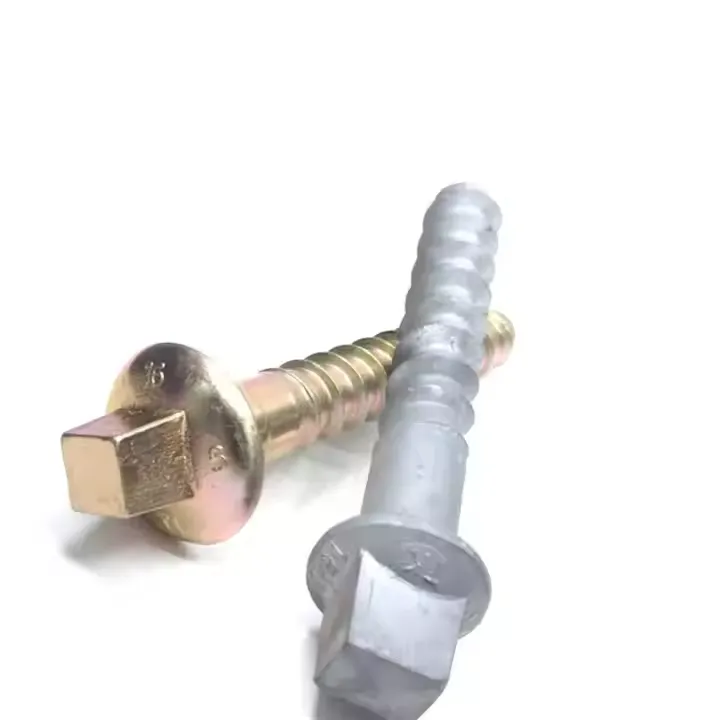


Description
Technical Parameters
Advantages & Disadvantages of Screw Spikes
| Aspect | Description |
|---|---|
| Advantages | |
| Higher Holding Power | The threaded design creates a much stronger grip in the sleeper compared to a driven spike, offering superior resistance to pull-out and lateral forces. |
| Improved Track Stability | Provides a more secure and rigid rail-to-sleeper connection, maintaining gauge alignment and reducing vibration. |
| Reduced Sleeper Damage | Installation via rotation minimizes splitting and fiber damage in wooden sleepers, extending their lifespan. |
| Reusability | Can often be unscrewed and reused, whereas driven spikes typically lose holding power upon removal. |
| Ease of Removal | Can be removed cleanly with the right equipment, simplifying track maintenance and renewal. |
| Disadvantages | |
| Higher Initial Cost | The spike itself and the installation process are more expensive than traditional drive spikes. |
| Slower Installation | The process of drilling a hole and then screwing in the spike is slower than driving a spike with an impact hammer. |
| Requires Special Equipment | Installation requires a dedicated drilling and driving machine or a powerful impact wrench with a socket. |
| Dependent on Pre-drilled Hole | The quality of the pre-drilled hole is critical for achieving the designed holding power. |

Comparison: Screw Spikes vs. Cut Spikes
| Parameter | Screw Spike | Cut Spike (Traditional) |
|---|---|---|
| Fastening Principle | Threaded engagement via rotation. | Friction and deformation via impact driving. |
| Holding Mechanism | Mechanical interlocking of threads with the sleeper fibers. | Friction and compression of the wood fibers. |
| Installation Method | Requires a pre-drilled hole and is installed with a rotary machine or impact wrench. | Driven directly into the sleeper using a heavy-duty impact hammer. |
| Installation Speed | Slower. | Very fast. |
| Holding Power | Very High. Superior resistance to loosening under dynamic loads. | Moderate. Can work loose over time due to vibration and wood shrinkage. |
| Impact on Sleeper | Low. Minimizes splitting and damage. | High. Can cause splitting and crushing of wood fibers. |
| Reusability | Good. Can typically be unscrewed and reused. | Poor. Often bent or damaged during removal, and holding power is compromised. |
| Cost | Higher initial cost for component and installation. | Lower initial cost. |
gnee-professional supplier


Hot Tags: fastening rail screw spike, China fastening rail screw spike manufacturers, suppliers, factory, economical rail spikes, strong rail spikes, simple install rail spikes, rail spikes factory, railway spikes workshop, railway spikes installation


