

↵
Rail Dog Spike Fastening System

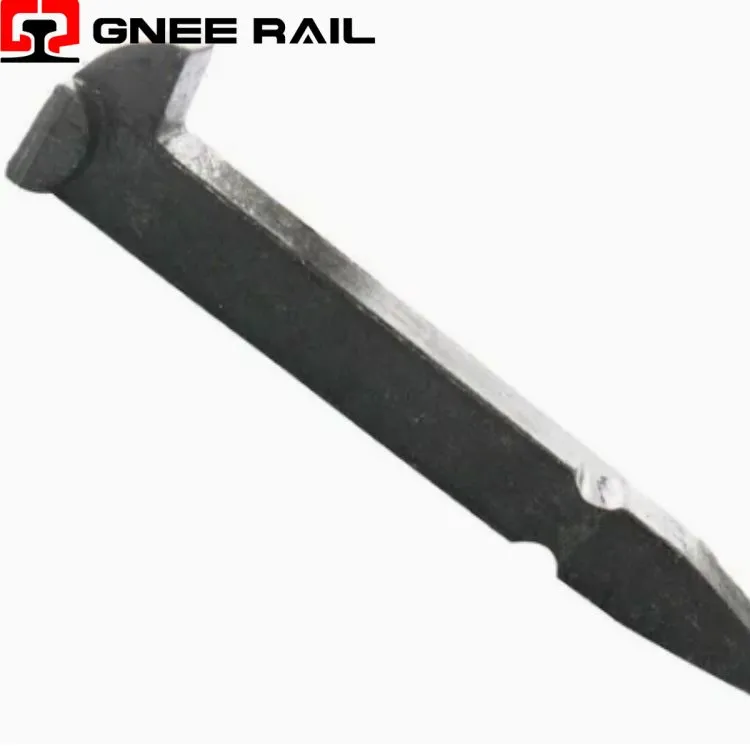
The Railway Dog Spike is a wedge-action drive fastener manufactured from forged mild steel, characterized by its hooked head configuration, rectangular or square shank with pyramidal point, and distinctive L-shaped profile that has remained virtually unchanged since its introduction in the early nineteenth century. Engineered specifically for securing rail to timber sleepers through the principle of wood fiber displacement and elastic recovery, this fastener relies entirely on the compressive stress field created around the driven shank to resist withdrawal forces generated by passing trains.
Technical Specifications:
| Attribute | Technical Detail | Performance Indicator |
|---|---|---|
| Historical Origin | Early 19th century | Wrought iron, hand-forged origins |
| Current Material | Low-carbon or medium-carbon steel | ASTM A65, Grade 2 or 3 |
| Standard Length | 5.5 to 6.5 inches | 140 to 165 mm typical |
| Head Projection | After installation | 0.25 to 0.5 inches above plate |
| Industry Classification | Cut spike | Differentiated from screw spike |

Installation & Maintenance Perspective:
- Pre-Boring Requirements: Hardwood ties require pre-drilled pilot holes to prevent splitting, with hole diameter and depth specified to achieve optimal fiber compression without compromising tie structural integrity.
- Gauge Measurement Integration: The spike driving process is coordinated with gauge measurement, with spikes driven incrementally while track gauge is monitored and adjusted to maintain design specifications.
- Sequence Optimization: Spikes are driven in specific sequence-first the gauge-side spikes to establish rail position, followed by field-side spikes to secure final alignment-to prevent rail movement during installation.
Maintenance & Operational Perspective
- Plate Spike Holes: The tie plate contains pre-formed spike holes positioned to align spikes at the correct angle and distance from the rail base, ensuring consistent installation geometry.
- Spike Cannels: Cast or pressed recesses in the tie plate provide seating for spike heads, distributing clamping forces across the plate surface rather than concentrating them at isolated points.
- Plate-to-Tie Load Transfer: The tie plate distributes rail loads across the tie surface, preventing localized over-compression that would accelerate spike loosening and tie decay.

Gnee Professional supplier


Hot Tags: lowest price dog spikes, China lowest price dog spikes manufacturers, suppliers, factory, railroad spikes factory, long lasting rail spikes, rail spikes manufacturing process, large scale rail spikes production, railroad spikes installation, small scale rail spikes production