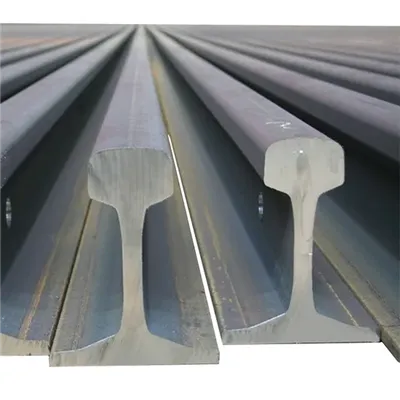
115RE vs 136RE: Which Rail Section is Best for Your Rail Transit Project?
📌 Executive Summary
Choosing between 115RE and 136RE depends on your line's operational demands. The AREMA 115RE Rail is optimized for light-to-medium freight, rapid transit, and industrial tracks under 30-ton axle loads, offering substantial material budget savings. The heavier 136RE profile is designed for heavy-haul Class I mainlines carrying extreme axle loads (>35 tons) and high annual gross tonnage.
To assist engineering and procurement teams in matching operational criteria to the correct profile, we use the following standard decision framework:

| Axle Load (Tons) | Annual Tonnage (MGT) | Minimum Curve Radius | Recommended Profile | Key Engineering Rationale |
| < 25 Tons | < 25 MGT | Any | 115RE (Standard) | Highly cost-effective; reduces excessive track structure weight. |
| 25 – 30 Tons | 25 – 40 MGT | R > 1,200 ft | 115RE (Head Hardened) | Optimal balance of wear life and initial capital investment. |
| 30 – 35 Tons | > 40 MGT | R < 1,000 ft | 136RE (Standard) | Prevents rapid head check and corrugation development. |
| > 35 Tons | Any | Any | 136RE (Premium) | Mandatory for Class I heavy-haul heavy axle load (HAL) corridors. |
Selecting the correct rail profile is one of the most critical decisions in track design and procurement. Under the standards established by the American Railway Engineering and Maintenance-of-Way Association, AREMA rails are classified by their weight per yard and geometry to meet specific operational demands.
Among these, the AREMA 115RE Rail-frequently referred to as TR57 or Section 11522 in mill specifications-and the 136RE (TR68) are two of the most widely specified profiles in North and South America. While both are classified as heavy-duty rail sections, choosing between them involves balancing axle loads, traffic density, and procurement budgets.
This technical guide compares the dimensional differences, load capacities, and application scenarios of these two profiles to help you determine which rail model is best suited for your transit or industrial track project.
Technical Comparison: 115RE vs. 136RE
The 115RE Rail Profile is designed for high bending strength with a lower overall weight than the 136RE, making it highly efficient for standard heavy-haul and transit lines. Below is a side-by-side technical comparison of their physical dimensions and operating parameters:


| Parameter | 115RE (TR57) Railway Rail | 136RE (TR68) Rail |
| Nominal Weight | 114.7 lbs/yd (56.9 kg/m ) | 136.2 lbs/yd (67.5 kg/m ) |
| Rail Height | 168.28 mm (6.625 in) | 185.74 mm (7.3125 in) |
| Base Width | 139.70 mm (5.500 in) | 152.40 mm (6.000 in) |
| Head Width | 69.06 mm (2.719 in) | 74.61 mm (2.9375 in) |
| Web Thickness | 15.88 mm (0.625 in) | 17.46 mm (0.6875 in) |
| Recommended Max Axle Load | 25 – 30 Tons | 35 – 41 Tons |
| Recommended Annual Traffic | < 35 Million Gross Tons (MGT) | ≥ 35 Million Gross Tons (MGT) |
| Typical Design Speed | Up to 80 mph (Transit/Metro) | Up to 85–100+ mph (Class I) |
Note: For projects requiring custom-fabricated rail joints, our engineering department can review your layouts and provide exact CAD matches for 115 lb rail joints and fasteners. If you need compatibility verification or joint bar drawings, please share your system requirements with our engineering desk for support.
Application of 115RE (TR57)
The AREMA 115RE steel rail represents a highly versatile, heavy-duty rail standard. Often ordered under ASTM 115RE standards, this 115lb rail is optimized for light to moderate freight traffic, rapid transit systems, regional passenger lines, and industrial yards.
Key Performance Benefits of the 115RE steel rail:

- Optimized Material Efficiency: Weighing approximately 115 lbs/yd, it provides sufficient stiffness to handle 25-to-30-ton axle loads without the excess material costs associated with heavier sections.
- Standardized Maintenance: As a highly standardized American standard rails profile, sourcing replacement parts, 115 lb rail matching tie plates, and turnout components is simple and cost-effective.
- Versatility in Grades: It is readily available in standard carbon steel as well as head-hardened (HH) variants, making AREMA 115RE rail steel highly adaptable to curves and high-wear areas.
When should you scale up to 136RE?
While the 115RE (TR57) Railway Rail is excellent for municipal transit and regional freight, Class I railroads and heavy mineral corridors typically opt for the 136RE.
The primary reasons to choose 136RE over 115RE include:

- Extremely Heavy Axle Loads: Projects carrying axle loads exceeding 33 to 35 tons.
- High Annual Tonnage: Main lines with high Million Gross Tons (MGT) where rail wear limits dictate a larger head area to extend the grinding life.
- High-stress Curvature: Severe heavy-haul curves where the extra web thickness of 17.46 mm minimizes lateral fatigue and micro-cracking.
Quality Control & Manufacturing Process for 115RE
As a long-established 115RE rail manufacturer, GNEE operates in accordance with strict QA/QC protocols to ensure every batch of 115RE steel rail complies with AREMA 115RE rail steel requirements.
Our testing and validation procedures include:
- Ultrasonic Testing (UT): Every meter of our finished rail undergoes continuous online non-destructive ultrasonic testing to detect and eliminate internal structural voids, hydrogen flakes, or inclusions.
- Geometric & Tolerance Verification: Precise laser measurements ensure that the TR57 rail height, base width, and head profiles match standard 115 lb rail specification dimensions within acceptable tolerances.

Validating metallurgical compliance is essential for risk mitigation. If your project requires certified Mill Test Certificates (MTCs), ultrasonic inspection reports, or chemical composition analyses, our quality assurance team is ready to provide comprehensive documentation packages for your records.
Procurement Factors: Pricing and Logistics
When evaluating your procurement options, working with an experienced manufacturer ensures that your steel meets the rigorous dimensional tolerances and chemical compositions mandated by AREMA and ASTM standards.
The overall 115RE rail price per ton is heavily dependent on several factors:
- Steel Metallurgy: Selecting standard strength vs. head-hardened steel for wear mitigation.
- Fabrication Options: Custom drilling configurations for joint bars, or custom cut lengths to optimize weld layout on site.
- Freight and Delivery: Managing shipping configurations for long, heavy profiles to minimize transit damage.
Sourcing & Logistics Hook:
Steel and freight pricing are subject to market changes and seasonal logistics capacities. If you are preparing a project budget or require an immediate commercial quotation for the 115RE rail price per ton, along with shipping transit estimates to your project site or port of entry, please contact our logistics division for a realistic, non-binding quote.
Get a Quote in 24 Hours
Both the 115RE Rail Model and the 136RE profile are highly engineered components of modern railway infrastructure. For many transit, regional freight, and industrial projects, the 115 RE rail specifications provide the ideal balance of structural capacity and economical weight, keeping your overall project within budget without compromising structural safety.
Whether you need standard 115RE (TR57) Railway Rail sections or complete track system solutions, GNEE RAIL are here to support your procurement journey.