


Can the S18 rail profile be used for cranes?
Yes, the DIN S18 rail profile can be used for cranes, but only under strict load boundaries. It is classified as a European light rail (18.30 kg/m), meaning it is structurally limited to light-duty, low-tonnage crane runways rather than heavy-duty industrial overhead cranes.
When use light rail profiles like the S18 for crane systems, they must account for specific load capacities and wheel configurations to prevent track failure.
1. Safe Crane Application Limits for S18
Because of its slender proportions-a 93.0 mm height and a 82.0 mm base width-the S18 profile is ideal for small-scale lifting applications where heavy-duty crane rails (like the DIN 536 A-series) would be over-engineered and too expensive.

Maximum Axle Load: The absolute safe operating limit for an S18 rail is 5.0 metric tons per wheel/axle.
Typical Crane Capacities: It is widely used for cranes with total lifting capacities ranging from 1 to 3 tons, depending on how the crane's deadweight is distributed across its travel wheels.
Common Deployments:
- Light workshop gantry cranes (manual or light motorized).
- Monorail hoists and material handling workstations.
- Lightweight overhead bridge crane runways with short spans.
- Automated storage stacker crane ground systems (low-payload ASRS units).
2. S18 Light Rail vs. Dedicated Crane Rails (DIN 536)
If your lifting requirements exceed a few tons, substituting an S18 light rail for a dedicated crane rail (like an A45 or A75) introduces structural risks. Their profiles are designed to handle completely different stress patterns:
- The Shape Profile: Dedicated crane rails feature a low, wide, and thick square shape with a massive web to absorb massive vertical loads and intense lateral wheel impacts (crane crabbing). The S18 is tall and slender, which makes it more susceptible to twisting under severe side thrusts.
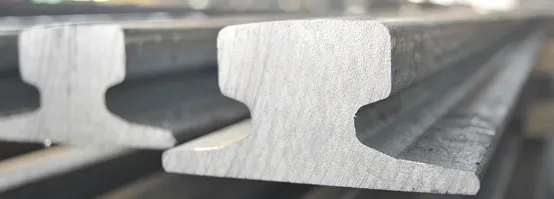
- The Web Strength: Crane rails have extra-thick webs to prevent localized web crippling. The S18 has a 10.0 mm web, which is perfect for distributed loads on sleepers but will deform if subjected to sudden, heavy overloads from massive industrial trolleys.
3. Critical Engineering Rules for Using S18 in Crane Tracks
To successfully implement the S18 profile in a crane runway layout, the track design must follow three technical constraints:
A. Specify R260 (GB U71Mn) Steel Grade
Do not buy standard R200 or structural Q235B steel for crane tracks. Crane wheels exert extreme contact pressure on the narrow 43.0 mm head of the S18 rail. Specifying the R260 grade provides a surface hardness of ≥ 260 HBW and a tensile strength of ≥ 880 MPa, preventing the rail head from flattening out laterally ("mushrooming") under the crane wheels.

| EN 13674-4: R260 Steel Grade Specifications | ||
| Chemical Composition (%) | Carbon (C) | 0.62 – 0.80 |
| Manganese (Mn) | 0.70 – 1.20 | |
| Silicon (Si) | 0.15 – 0.58 | |
| Phosphorus (P) | ≤ 0.025 | |
| Sulfur (S) | ≤ 0.025 | |
| Chromium (Cr) | ≤ 0.15 | |
| Mechanical Properties | Tensile Strength (Rm | ≥ 880 MPa |
| Elongation (A) | ≥ 10% | |
| Running Surface Hardness | 260 – 300HBW | |
B. Narrow the Support Spacing (Sleeper Pitch)
Because the S18 has less vertical bending stiffness than heavier profiles, the space between its bottom structural supports must be tightened. For a 3-ton crane runway, the supporting steel plates or sleepers should be spaced no further than 500 mm to 600 mm apart to prevent the rail from sagging between supports.
C. Check Wheel Flange Clearances
The head of the S18 rail is only 43mm wide. Ensure that the crane end-carriage wheels are double-flanged or single-flanged wheels designed specifically for light rail profiles, and that your fastening clips do not project into the path of the descending wheel flange.
Crane Rail Selection Guideline
| If Your Crane Setup Involves: | Recommended Rail Profile | Technical Rationale |
| Light Workshop Gantry (1–3 Ton Capacity) | DIN S18 (R260 Grade) | Highly economical; easily handles low axle loads when supported properly. |
| High-Cycle ASRS / Lightweight Shuttles | DIN S18 (R260 Grade) | Industry standard for automated logistics lines requiring tight tolerances. |
| Standard Overhead Bridge Crane (5–10 Tons) | DIN S30 Light Rail or A45 Crane Rail | S18 will suffer permanent structural deflection and web deformation. |
| Heavy Industrial / Foundry Crane ($\ge$ 10 Tons) | DIN 536 A65 / A75 / A100 Crane Rail | Requires a dedicated wide-base crane profile to survive intense side thrusts. |
FAQ
- How does the high tensile rating of the 55Q S18 rail profile alter the crane's power efficiency?
The 680 to 880 MPa tensile range limits vertical track deflection between support points, keeping the runway perfectly flat under localized hoist weights. This material stiffness prevents the crane wheel from constantly running uphill on a sagging rail, drastically dropping rolling resistance and power draw for automated crane carts.
- Can the S18 rail profile be connected using splice plates on an overhead gantry system, or is welding mandatory?
While our pre-drilled hole configurations line up cleanly with standard joint fishplates for fast mechanical assembly, field welding is highly recommended for overhead gantry applications. The carbon-manganese composition allows for clean field jointing using thermite or electric arc methods, which eliminates mechanical joint gaps and prevents heavy crane wheel impact shocks from damaging the runway beams.
- Why does the nominal weight of the S18 profile help lower total crane runway construction costs?
The nominal mass of 18.30 kg/m provides a robust structural capacity while remaining light enough for rapid manual maneuvering. This allows installation crews to quickly lift, position, and bolt down track sections onto elevated workshop beams without relying on heavy, expensive high-capacity crane trucks or complex rigging setups.
Get a Quote in 24 Hours
Optimizing light-gauge transit economics depends on sourcing dimensionally uniform profiles backed by extensive transnational supply credentials. GNEE RAIL integrates advanced metallurgical casting with automated rolling mill calibration to distribute high-integrity S18 tracks, complete European-spec hardware configurations, and a versatile selection of global structural steel classifications. Our production framework accommodates bespoke cut-to-length tasks and tailored field joint preparation directly adapted to your unique installation schematics. Connect with our technical advisory office today to receive comprehensive material testing validations, verify structural compatibility limits, and secure a transparent, direct-mill project quotation tailored to your operational budget.


