


What is the optimal container type (20ft or 40ft) for transporting Rail S20?
The optimal container type for transporting DIN 5901 S20 steel rails is entirely determined by the specific cut length of the rail segments required for your project. Because steel rails are highly dense, heavy cargo (19.8 kg/m), they present unique payload constraints that differ from standard commercial freight.
The 20ft Container Choice | Optimized for 6-Meter S20 Rails
For standard 6-meter (6,000 mm) S20 rail bundles, the 20ft standard dry container (20GP) is the most efficient and cost-effective shipping method.

- Perfect Length Alignment: The internal length of a standard 20ft container is approximately 5.89 meters (19.3 feet). By ordering S20 rails cut to standard factory mill lengths of 5.80 to 5.85 meters, the bundles fit perfectly from end to end with just enough clearance for safe loading and unloading.
- Maximizing Weight Capacity: Heavy steel rails will always hit a container's legal weight limit long before filling its physical volumetric space (known as "heavy out"). A standard 20ft container can safely carry a maximum payload of 26 to 28 metric tons depending on shipping line regulations.
- Bundle Optimization: Since a 6-meter S20 rail weighs roughly 118.8 kg, a single 20ft container can hold approximately 220 to 235 individual rails (divided into 5 or 6 tightly bound hexagonal bundles). Paying for a larger 40ft container for 6-meter rails is a structural waste of capital, as you will pay higher freight rates without being allowed to add any extra weight.
The 40ft Container Choice | Mandatory for 10-Meter to 12-Meter Rails
When your track infrastructure design specifies 10-meter or 12-meter continuous S20 rail lengths to minimize the number of fishplate joints, a 40ft standard dry container (40GP) is mandatory.

- Physical Space Requirements: A 40ft container provides an internal length of 12.03 meters, making it the only standard container option capable of housing long-length rail bundles.
- The Weight Distribution Challenge: A common logistical mistake is assuming a 40ft container can carry double the weight of a 20ft container. In reality, the maximum allowable payload for a 40ft container is almost identical-typically 26 to 28.5 metric tons.
- Reduced Piece Count Per Shipment: Because a single 10-meter S20 rail weighs 198 kg (and a 12-meter rail weighs 237.6 kg), a 40ft container will hit its maximum weight capacity with only about 115 to 140 rails inside. The container will look half-empty, but it cannot legally or structurally hold more weight.
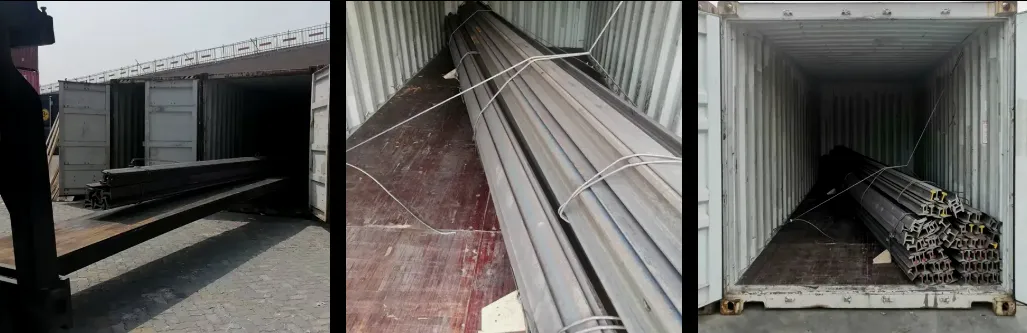
GNEE RAILWAY RAILWAYL Container Loading and Blocking Protocols | Securing Heavy Cargo
Because S20 rails have a narrow 82 mm base and a 100 mm height, unbound or poorly secured rails can tip, shift, or punch through the container walls during ocean transit. GNEE RAILWAY RAILWAYL enforces strict export loading protocols:
- **Timber Dunnage Distribution**: Bundles are never placed directly on the container floor. Thick wooden dunnage blocks are placed underneath the rails to distribute the concentrated weight evenly across the container's structural steel cross-members.
- **Center of Gravity Alignment**: Rail bundles are tightly blocked and braced in the exact center of the container using heavy timber frames and steel strapping anchored to the floor D-rings. This prevents the cargo from sliding forward or backward during heavy seas.
- **Forklift Clearance**: Proper placement of the bottom dunnage ensures sufficient ground clearance so that your destination job-site crew can easily slide forklift tines under the bundles for safe, rapid offloading.
Logistical Advisory: If your project involves a massive volume (e.g., over 100 metric tons of 10-meter or 12-meter rails), GNEE RAILWAY RAILWAYL recommends bypassing container shipping altogether and opting for Breakbulk Cargo (bulk vessel hold shipping) to significantly lower your per-ton ocean freight costs.
FAQ
- What is a "Heavy-Duty" 20ft container, and why is it required for S20 rail shipping?
A standard 20ft container has a payload limit of about 21 to 22 metric tons. A "Heavy-Duty" or "Max-Gross" 20ft container is manufactured with reinforced steel corner posts and thicker floor cross-members, allowing it to safely carry payloads up to 26 to 27 metric tons, which is ideal for dense cargo like S20 steel rails.
- Can 12-meter custom S20 light rails fit inside a standard 40ft container?
Yes, a standard 40ft container has an internal length of 12.03 meters, meaning 12.00-meter custom rail lengths will fit with just centimeters of clearance. Because of this tight fit, our loading crews construct slim, high-strength end-wall cushions to prevent the rail tips from scraping the container doors during transit.
- How does GNEE RAILWAY RAILWAYL prevent moisture and condensation damage inside a sealed 20ft container?
Temperature swings during long ocean voyages can cause "container rain," where condensation drips from the ceiling onto the cargo. To prevent rust, we apply a high-grade anti-corrosion oil film across the entire cross-section of the S20 rails and place industrial-sized silica gel desiccant bags inside the container to absorb airborne moisture.
- What is the maximum number of pieces of S20 rail that can be loaded into one 20ft container?
The 19.80 kg/m S20 rail profile weighs approximately 118.80 kg per 6-meter section. To stay safely under a 26.00 metric ton payload limit, a single 20ft container can hold a maximum of 216 individual 6-meter rail sections, which are typically divided into 9 bundles of 24 pieces each.
Get a Quote in 24 Hours
GNEE RAILWAY RAILWAYL coordinate integrated shipping arrays for our standard 6-meter and 10-meter S20 steel rail inventories, managing all multi-modal transfers from our internal rolling mills to overseas industrial rail junctions. Our dedicated export division prepares fully compliant customs documentation, automated packing specifications, and international traceable marine insurance records matching your local port entry rules. Connect with our logistics team today to lock in fixed-rate ocean shipping fees or to secure a delivery production schedule tailored to your operational timeline.


