


Can S24 Light Steel Rail Be Used for Crane Applications?
Yes, DIN 5901 S24 rail can be considered for light-duty crane and material-handling applications when its section properties and operating conditions meet the project requirements. It may be used for light overhead cranes, monorails, jib-crane systems, and automated transfer carts. With a theoretical mass of approximately 24.43 kg/m and a rail height of 115 mm, S24 provides a relatively compact profile with suitable vertical stiffness for light industrial track systems.
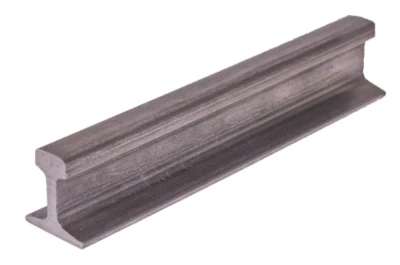
However, the permissible wheel load and crane capacity should be determined from the wheel load, crane duty class, rail span, support spacing, operating speed, and complete runway design, rather than from the rail weight alone.
S24 Rail vs. DIN 536 Crane Rail: How to Choose?
DIN 5901 S24 and DIN 536 A-series crane rails are designed for different track requirements. S24 has a relatively tall and narrow profile, with a height of 115 mm and base width of 90 mm, making it suitable for light industrial tracks and lower-load crane or trolley applications where the complete track structure provides adequate support. DIN 536 A45/A55 crane rails have wider bases and are specifically designed for crane runways, providing greater stability against high wheel loads and lateral forces.

| Technical Criterion | DIN 5901 S24 | DIN 536 A45 | DIN 536 A55 |
|---|---|---|---|
| Linear Mass | 24.43 kg/m | 22.10 kg/m | 31.80 kg/m |
| Height | 115 mm | 55 mm | 65 mm |
| Base Width | 90 mm | 125 mm | 150 mm |
| Head Width | 53 mm | 45 mm | 55 mm |
| Typical Application | Light industrial/crane tracks | Light–medium crane runways | Medium–heavy crane runways |
For light-duty crane and material-handling systems, S24 may be considered when the wheel loads, support spacing, and fastening arrangement are within the allowable design range. Where wheel loads, lateral forces, crane duty cycles, or runway requirements increase, a DIN 536 crane rail or heavier rail profile should be evaluated. Final selection should always be based on the complete crane runway design rather than rail weight alone.
Need Help Choosing the Right Rail Profile? → Send Your Project Details
GNEE RAILWAY RAILWAYL supplies S24 light rail and DIN 536 crane rails for different industrial track requirements, with matching rail clips, fishplates, soleplates, rubber pads, and other fastening components available according to the selected profile.
Frequently Asked Questions (FAQ)
Q1: What is the maximum wheel load for S24 rail?
A: S24 rail is generally suitable for light-duty crane systems with dynamic wheel loads up to approximately 40–45 kN per wheel, subject to rail grade, support spacing, crane duty, and track design. Heavier loads may require S30 or DIN 536 crane rails.
Q2: Can S24 rail be bent for curved crane tracks?
A: Yes. GNEE RAILWAY RAILWAYL can provide factory rail bending to specified horizontal or vertical radii according to project drawings.
Q3: Can S24 replace GB 24 kg/m rail directly?
A: No. Although their weights are similar, their profiles differ. S24 is 115 mm high with a 90 mm base, while GB 24 kg/m is 107 mm high with a 92 mm base, so their fastening components are not directly interchangeable.
Q4: What crane wheels are suitable for S24 rail?
A: Wheel selection should match the 53 mm S24 rail head width, wheel load, flange geometry, and crane operating conditions. Final compatibility should be confirmed with the crane wheel design.


