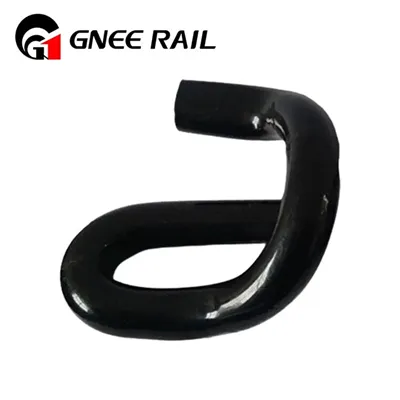
What rail fastening systems are compatible with Rail A75?
The A75 rail profile, characterized by its wide base (200 mm) and low center of gravity, requires a systematic fastening approach rather than individual components. A compatible system must integrate lateral adjustability, vibration damping, and high shear resistance to manage the significant dynamic forces generated by medium-to-heavy duty cranes.

| System Category | Core System Components | Key Functional Characteristics for A75 | Typical Applications |
| Flexible Fastening System | Adjustable Weldable Clips + Reinforced Rubber Pad + Steel Soleplate | Elasticity & Shock Absorption: Uses synthetic rubber pads to reduce vibration and noise; provides ± 10-15mm lateral adjustment for precise alignment. | Ship-to-Shore (STS) cranes, heavy industrial gantries, and high-frequency port terminals. |
| Rigid / Bolted Fastening System | Boltable Clips + High-Strength Anchor Bolts + Leveling Shims | Structural Stability: Secured via bolts to concrete or steel beams without welding; ideal for environments where "hot work" (welding) is prohibited. | Indoor warehouse cranes, automated storage and retrieval systems (AS/RS). |
| Continuous Support System | Continuous Elastic Pad + Continuous Steel Support Plate + Intermittent Clips | Load Distribution: Ensures the 200 mm wide A75 base has 100% contact area, preventing localized stress concentrations and extending rail life. | Heavy-duty steel mill runways and specialized shipyard slipways. |
| Discontinuous Support System | Individual Steel Chairs/Chocks + Fastener Assembly | Customizable Elevation: Allows the rail to be mounted on discrete support points; used when the primary support structure is not continuous. | Elevated rail tracks or specialized bridge-type crane structures. |
GNEE RAILWAY RAILWAYL provides a fully integrated suite of fastening hardware specifically engineered to match the detailed a75 rail material specifications. Our production facility manufactures matching clips/A75 crane rail clips, high-durability pads/rail pads, and precision-machined fishplates that align perfectly with the A75 Rail sizes.
Why should rail fasteners be used in supporting match with Profile A75 rail?
Rail fasteners, specifically designed for the DIN 536 A75 rail profile, must be used to ensure the stability, safety, and longevity of heavy-duty crane systems, particularly under high-load, high-frequency, and lateral-force scenarios. Using matching clips (such as welded M165/M120 or bolted CL-series) ensures proper load distribution, alignment, and vibration damping.

- Secure Attachment & Stability: A75 rails have a wide (20mm) base, and specialized clips are needed to firmly hold the rail in place on the foundation to prevent lateral or vertical displacement, minimizing the risk of derailment.
- Optimal Load Distribution: Matched fastening systems, which often include rubber pads and steel soleplates, ensure the high operational loads (up to 100 tons) are distributed evenly, preventing premature wear on the railhead and stress damage to the foundation.
- Lateral Force Resistance: The A75 rail's asymmetrical, robust design is built for lateral force resistance. Specialized fasteners ensure this rigidity is maintained, preventing the rail from twisting or breaking under the lateral forces exerted by crane operations.
- Vibration and Noise Reduction: Using proper fastening, particularly resilient clips and rubber pads, absorbs vibration and noise. This reduces fatigue on both the rail and the supporting steel structure, extending the service life of the entire system.
- System Maintenance and Adjustability: Specific clips allow for precise, easy installation and maintenance. They allow the rail to be adjusted and secured, allowing for easier maintenance of the alignment and tightening of fasteners without dismantling the entire track.
FAQ
- Are standard railway spikes compatible with A75 crane rails?
No. Because of the A75 rail profile and its 200mm wide base, standard spikes are insufficient. You must use specialized clips/A75 crane rail clips that are designed for the European DIN 536 standard to provide adequate lateral restraint.
- Why is a rubber nose used on A75 rail clips?
The rubber nose provides an elastic connection that accommodates the thermal expansion and vibration of the A75 steel rail. This prevents the bolts from loosening and reduces the wear on the A75 tracks during high-cycle operations.
- Can GNEE RAILWAY RAILWAYL provide pre-drilled rails for fishplate installation?
Yes, we offer Custom Drilling Services and pre-drilling as part of our End Processing & Finishing. This ensures the holes are perfectly aligned with the A75 Rail dimensions for a seamless connection.
- What is the benefit of using reinforced rail pads with A75 profiles?
Reinforced pads/rail pads dampen the dynamic loads from overhead cranes, which protects the A75 runway sections from fatigue and reduces the maintenance costs for both the rail and the building's structural girders.
- Are the sole plates customized for the A75 base width?
Yes. All sole plates and base plates we provide are specifically manufactured to match the 200mm base of the A75 rail profile, ensuring a stable and even mounting surface.
Get a Quote in 24 Hours
Selecting the correct fastening system is as important as the Rail A75 itself for the safety and efficiency of your crane runway. GNEE RAILWAY RAILWAYL provides a complete, factory-direct solution that includes the rails and all necessary clips/A75 crane rail clips, pads/rail pads, and mounting hardware. Our team is dedicated to ensuring your A75 tracks are supported by the most reliable fastening technology available.