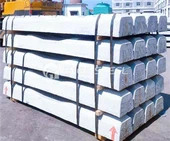
What is the service life of the Profile A75 rail?
The service life of the Profile A75 rail is not defined by a fixed number of years but is measured by the total tonnage of throughput and the degree of wear on the rail head. Under standard operating conditions in medium-duty crane systems, a high-quality DIN 536 A75 rail can last between 10 to 25 years. However, this lifespan is highly dependent on the A75 rail hardness, the accuracy of the installation, and the frequency of maintenance.
Key Factors Affecting A75 Service Life
- Material Strength: Made from high-strength steel (typically 900A grade), A75 rails provide high hardness (≥ 260 HB), reducing wear by roughly 50% compared to conventional rails.

| 900A | |
| Mechanical Property | Chemical Composition (%) |
| Tensile Strength ($R_m$) | ≥ 880 MPa |
| Hardness (HBW) | 260 – 300 |
| Carbon (C) | 0.60 – 0.82% |
| Silicon (Si) | ≤ 0.50% |
| Manganese (Mn) | 0.80 – 1.50% |
| Phosphorus (P) | ≤ 0.045% |
| Sulfur (S) | ≤ 0.045% |
- Hardening Treatments: Head-hardened A75 rails can reach surface hardness levels of 340-380 HB, increasing their lifespan in high-wear environments (like ports) by over 50% compared to standard A75 rails.
- Operating Conditions: In high-frequency, heavy-duty applications-such as port container cranes (STS/RTG), metallurgical plants, or busy warehouses-the rail is subject to high vertical loads (over 100+ tonnes) and significant lateral forces, which can reduce its total lifespan to under 20 years.

- Maintenance: Regular inspection, lubrication, and immediate repairs (e.g., grinding to correct misalignment) are necessary to reach maximum service life.
Following the European DIN 536 standard, the A75 rail profile is considered at the end of its service life when the vertical wear on the head reaches approximately 10-15% of its original height, or when lateral deformation compromises the safety of the overhead cranes.
Can the service life of A75 crane rail be extended by using rail fasteners?
Yes, the service life of A75 crane rail can be extended by using appropriate rail fasteners, such as rail clamp and rubber pads. Proper fastening systems reduce vibration, ensure stable alignment, and minimize stress on the track, which prevents early fatigue and wear in heavy-duty industrial applications.

Key Ways Fasteners and Maintenance Extend A75 Rail Life:
- Resilient Fastening Systems: Using specialized crane rail clips and pad systems absorbs impact, reduces vibration, and helps manage high lateral loads (up to 250 kN), which is essential for maximizing rail longevity.
- Reduced Deflection: Ensuring secure anchoring with proper fasteners prevents rail movement, protecting both the crane and the track from premature failure.
- Proactive Maintenance: Pairing good fasteners with regular inspection, rail lubrication, and grinding-which can restore 80–90% of service life by removing surface defects-greatly extends the overall lifespan of A75 rails.
- Head-Hardening: While not a fastener, choosing head-hardened A75 rail (often up to 340-380HB) provides a 50% increase in wear resistance, working in conjunction with robust fastening to significantly extend lifespan.
For maximum longevity, especially in high-load port or industrial environments, GNEE RAILWAY RAILWAYL recommendations highlight the importance of using high-tensile components and appropriate A75 rail accessories.
FAQ
- What is the average lifespan of A75 rail in a shipyard?
In maritime shipyards, where corrosion and high loads are present, the service life is typically 10-15 years. Using A75 tracks with head-hardening and specialized Surface Treatment can extend this significantly.
- How do I know when it is time to replace my A75 tracks?
You should monitor the A75 rail specifications for vertical wear. Once the head height has decreased by more than 10%, or if you see significant surface cracking (spalling), the A75 runway sections should be replaced.
- Does a higher A75 rail hardness always mean a longer life?
Generally, yes. A higher A75 rail hardness (like R350HT) resists wear and deformation better. However, it must be balanced with toughness to avoid brittle fractures in high-impact heavy assembly workshops.
- Can I extend the life of my DIN 536 A75 rail by welding?
Worn heads can sometimes be built up by welding, but for heavy duty crane rail, this is often a temporary fix. It is usually more cost-effective and safer to replace the A75 profile once it reaches its wear limit.
- How does the rail pad affect the service life of the Rail A75?
Reinforced pads/rail pads are essential. They absorb shocks from overhead cranes, which prevents the A75 steel rail from cracking and protects the sole plates from premature failure.
- Why is installation alignment so critical for A75 rail longevity?
Even a slight misalignment in the A75 runway sections causes the crane wheels to "grind" against the rail head. This lateral friction is the leading cause of premature failure for DIN standard Steel rail systems.
Get a Quote in 24 Hours
GNEE RAILWAY RAILWAYL provides the technical depth and manufacturing precision to ensure your DIN 536 A75 rail system is optimized for longevity from day one. We invite you to Get a Solution and Quote to receive a comprehensive evaluation of your project needs, including DIN 536 A75 Rail Dimensions Drawings, material hardening options, and life-cycle maintenance plans.