

How Much Is the 136RE Rail Weight per Meter?
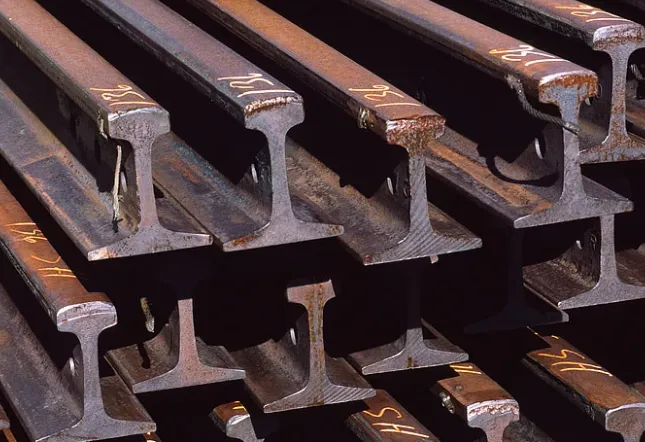
The 136RE rail has a weight of approximately 67.56 kg per meter. This is derived from its standard weight of 136.2 lbs per yard. In the rail industry, this weight is categorized as "heavy-haul," providing the structural mass required for Class I freight railroads and high-tonnage transport.
1. The Conversion Formula
Rail weights in North America are typically expressed as lb/yd (Wlb), while international markets use kg/m (Wkg). The conversion is calculated as follows:
- Wkg=Wlb×0.49606
- For the 136RE profile:136.2×0.49606=67.563 kg/m
2. Physical Basis for the Weight
The weight per meter is a direct result of the rail's cross-sectional geometry. The 136RE is designed with a massive steel profile to handle extreme stresses:
- Cross-Sectional Area: 13.32 in2 (approx. 85.94 cm2).
- Steel Density: Based on the standard density of rail steel (approx. 7,850 kg/m3), the resulting mass is distributed primarily to the head and base for maximum stability.
What are the standard dimensions of a 136RE Rail?
The 136RE (also known as TR68) is an AREMA standard rail profile with a standard height of 185.74 mm, base width of 152.4 mm, head width of 74.61 mm, and a web thickness of 17.46 mm. It weighs approximately 67.41–67.5 kg/m and is commonly used for heavy-duty, high-axle-load tracks.
Key 136RE Rail Dimensions and Specifications (per AREMA standards):

- Rail Height: 185.74 mm (7-5/16 in)
- Base Width: 152.4 mm (6 in)
- Head Width: 74.61 mm (2-15/16 in)
- Web Thickness: 17.46 mm (11/16 in)
- Weight: 67.41–67.5 kg/m (Approx. 136 lb/yd)
- Standard Lengths: Usually 12 to 25 meters, or tailored as required
| Profile | Standard | Dimensions mm | Section S | Mass m | ||||
|---|---|---|---|---|---|---|---|---|
| H | B | C | D | E | cm² | kg/m | ||
| American standard | ||||||||
| 136RE (TR68) | AREMA | 185,70 | 152,40 | 74,60 | 49,20 | 17,50 | 85,90 | 67,50 |
The 136RE rail is engineered for stability and high wear resistance, often utilized in heavy-haul rail lines and freight corridors.
What is the material of a 136 lb rail?
136RE rail is made of high-carbon manganese steel, produced through a "killed steel" process to ensure maximum density and purity. The chemical composition typically includes 0.72% to 0.82% Carbon for hardness and 0.70% to 1.10% Manganese for toughness and wear resistance. Depending on the application, it is available in Standard Strength (SS) or Head Hardened (HH) grades, with the latter undergoing heat treatment to reach a Brinell hardness of 370 to 400 HBW.
Chemical Composition of AREMA Rail Steel:

| AERMA 2019 | Strength Grade | C | Si | Mn | P | S | Ni | Cr | V |
|---|---|---|---|---|---|---|---|---|---|
| Carbon Steel | 0.74–0.86 | 0.10–0.60 | 0.75–1.25 | ≤0.020 | ≤0.020 | ≤0.25 | ≤0.30 | ≤0.010 | |
| Low Alloy Steel | Standard Strength (SS) | 0.72–0.82 | 0.10–0.50 | 0.80–1.10 | ≤0.020 | ≤0.020 | ≤0.15 | 0.25–0.40 | ≤0.010 |
| Intermediate Strength (IS) | 0.72–0.82 | 0.10–1.00 | 0.70–1.25 | ≤0.020 | ≤0.020 | ≤0.15 | 0.40–0.70 | ≤0.010 | |
| High Strength / Head Hardened (HH) | 0.72–0.82 | 0.10–1.00 | 0.70–1.25 | ≤0.020 | ≤0.020 | ≤0.15 | 0.40–0.70 | ≤0.010 |
Mechanical Properties of AREMA Rail Steel:
| AREMA 2019 | Strength Grade | Yield Strength N/mm2 |
Tension Strength N/mm2 |
Elongation % |
Brinell Hardness HBW |
|---|---|---|---|---|---|
| Carbon Steel | Standard Strength (SS) | 511MIN | 983MIN | 10MIN | 310MIN |
| Intermediate Strength (IS) | 724MIN | 1069MIN | 10MIN | 350MIN | |
| High Strength / Head Hardened (HH) | 828MIN | 1179MIN | 10MIN | 370MIN | |
| Low Alloy Steel | Standard Strength (SS) | 511MIN | 983MIN | 10MIN | 310MIN |
| Intermediate Strength (IS) | 552MIN | 1014MIN | 8MIN | 325MIN | |
| High Strength / Head Hardened (HH) | 828MIN | 1179MIN | 10MIN | 370MIN |
Frequently Asked Questions
Q1: What is the exact conversion between 136RE and TR68?
A: TR68 indicates a rail weight of roughly 68 kilograms per meter. Since the 136re rail weight is 67.6 kg/m , the two terms describe the exact same physical rail section, just using different regional measurement systems.
Q2: Does the 136re rail height affect the type of tie plates required?
A: Track height mostly influences vertical clearance and bending stiffness, but the base width (6 inches) dictates the tie plate. You must use standard double-shoulder tie plates designed specifically for a 6-inch base.
Q3: What are standard delivery lengths for metric and imperial markets?
A: Common lengths are 39 feet (11.89 meters), 78 feet, and 80 feet. For ease of international container shipping, 39-foot lengths are universally preferred as they fit perfectly into 40-foot containers.
Q4: Do I need specialized joint bars for the 136re rail section?
A: Yes, standard flat fishplates will not work. You need specifically forged or rolled joint bars that match the exact fishing angles of the 136re rail section to ensure a secure, flush fit.
Q5: Can you pre-drill the rails before delivery?
A: Yes. GNEE RAILWAY RAILWAYL operate precision CNC multi-spindle drilling machines to drill the required bolt holes at the rail ends according to your project's specific engineering drawings.
When selecting the 136RE heavy rail, understanding the detailed 136re rail dimensions, 136re rail profile, and weight per meter is essential for achieving long-term track performance. With extensive experience in railway products, GNEE RAILWAY RAILWAYL can support your project with optimized rail solutions. By operating our own steel rolling lines, CNC drilling centers, and physical testing laboratories, we maintain strict control over chemical compositions and dimensional tolerances. This allows us to provide uncompromised product quality, precise processing, and reliable delivery for your track construction or renewal programs.
For detailed drawings, technical consultation, or project-based recommendations, you can contact us to obtain customized rail solutions and professional support tailored to your needs.


