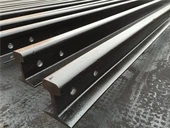
A rail fish plate is a steel joint bar used to reconnect two rail ends so that the track can continue to function as a load-carrying structure across a mechanical joint. By restoring continuity of bending and shear resistance, it prevents sudden load interruption at rail gaps. GNEE RAILWAY RAILWAYL supplies fish plates for GB 8–60 kg/m rails, UIC50/UIC54/UIC60, DIN536 A55–A120 crane rails, QU70–QU120, JIS rail profiles, AS1085 rails, BS11 sections, and AREMA/ASCE rail standards, with complete fastening sets.
What is the fish plate for 52 kg railroad?
A 52 kg fish plate (or splice bar) is a high-strength steel component designed to join 52 kg/m rail sections, typically featuring 4 or 6 bolt holes for secure, aligned connections. Common types include standard, insulated, and joggled plates (e.g., T-5848/T-5551) used to protect welded joints, with lengths ranging from 300 mm to 600 mm.

- Weight: 52 kg (approximately 114.6 lbs)
- Material: Typically made from high-strength steel, ensuring durability and resistance to wear.
- Dimensions:
Length: Standard lengths usually range from 300 mm to 600 mm, depending on design and application.
Width: Common widths range from 100 mm to 150 mm.
Thickness: Typically around 20 mm to 25 mm.

| Standard | Material | Size(kg) | Tensile strength Rm | Yield strength | Elongation A | Reduction of Area Z | Brinell Hardness | Cold Bend d=3a |
|---|---|---|---|---|---|---|---|---|
| TB/T2345-2008 | Chinese steel grade 55# | 43, 52, 60, 75 | ≥ 785Mpa | ≥ 520Mpa | ≥ 9% | ≥ 20% | HBW 227-388 | 30 degree, no crack |
- Usage: Suitable for joining lighter rail sections, primarily used in light rail applications and specific regional rail networks.
- Fastening: Usually secured with bolts and nuts, which may require specific installation tools for proper tightening.
Three using types of railway fish plates
Railway fish plates (also known as joint bars) are critical components in rail track systems, designed to connect two steel rails end-to-end. In practical applications, three primary types are commonly used:
- Bolted Joints: These are standard connections, typically used to join rails before permanent welding or in sections where welded rail is not feasible.

- Compromise Joints: Specifically engineered to connect two rails of differing profiles or sections (e.g., UIC 54 to UIC 60).

- Insulated Joints: Employ non-conductive materials to create an electrical break in the track for signaling purposes, available in both bonded and non-bonded designs.

While each type serves a distinct function, they share two key operational characteristics: all utilize bolts and bars to form the mechanical link, and each creates a inherent discontinuity in the rail's running surface. This discontinuity results in dynamic impact as train wheels pass over it, which contributes to accelerated wear and damage in the joint area, a primary factor in ongoing track maintenance.
Founded in 2008, GNEE RAILWAY RAILWAYL is a leading global manufacturer and supplier of railway components, specializing in high-quality rail fish plates (joint bars/splice bars) with strong production capacity and global service capabilities.
Our rail fish plate portfolio is comprehensive and compliant with international standards including UIC, AREMA, BS, DIN, and GB, covering light rail (8kg-30kg), heavy rail (38kg-75kg), and crane rail (QU70-QU120) systems. We offer diverse types such as insulated joint bars, bulged fish plates, and compromise rail joints,with precise specifications (4-hole/6-hole, 24-inch/36-inch), ensuring excellent mechanical performance.We uphold strict quality control supported by ISO 9001:2015 certification, an in-house inspection center, and third-party audits by SGS and BV. Our one-stop service includes customization, production, packaging, and after-sales support, tailored to clients' project needs.
Click here to obtain the detailed product catalog of GNEE RAILWAY RAILWAYL.