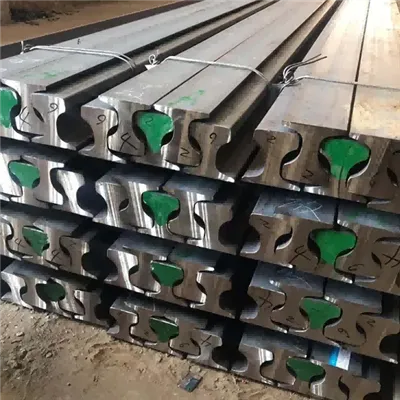
Since 2008, GNEE RAILWAY RAILWAYL has been supplying steel rails of different grades for more than 18 years, steel rails from GNEE RAILWAY is highly recommened in China and abroad.Wtih cutting edge equipment, GNEE RAILWAY produces high quality steel rails that meet with requirements of most countries. Standard rail, head hardened rail, heavy rail,light rail,crane rail and other types are all available here, as one of the China main rail supplier, GNEE RAILWAY RAILWAYL has been working on supplying economical green railway products all over the world.

| Classification | Height(mm) | Head (mm) | Bottom (mm) | Thick(mm) | Weight (kg/m) | |
| Light Rail | 8 KG/M | 65 | 25 | 54 | 7 | 8.42 |
| 9 KG/M | 63.5 | 32.1 | 63.5 | 5.9 | 8.94 | |
| 12 KG/M | 69.85 | 38.1 | 69.85 | 7.54 | 12.2 | |
| 15 KG/M | 79.37 | 42.86 | 79.37 | 8.33 | 15.2 | |
| 18 KG/M | 80 | 40 | 80 | 10 | 18.06 | |
| 22 KG/M | 93.66 | 50.8 | 93.66 | 10.72 | 22.3 | |
| 24 KG/M | 107 | 51 | 90 | 10.9 | 24.46 | |
| 30 KG/M | 107.95 | 60.33 | 107.95 | 12.3 | 30.1 | |
| Heavy Rail | 38 KG/M | 134 | 68 | 114 | 13 | 38.733 |
| 43 KG/M | 140 | 70 | 114 | 14.5 | 44.653 | |
| 45 KG/M | 145 | 67 | 126 | 14.5 | 45.546 | |
| 50 KG/M | 152 | 70 | 132 | 15.5 | 51.514 | |
| 60 KG/M | 176 | 73 | 150 | 16.5 | 60.64 | |
| Crane Rail | QU 70 | 120 | 70 | 120 | 28 | 52.8 |
| QU 80 | 130 | 80 | 130 | 32 | 63.69 | |
| QU 100 | 150 | 100 | 150 | 38 | 88.96 | |
| QU 120 | 170 | 120 | 170 | 44 | 118.1 | |
The railroad metal, commonly known as train track steel, is special steel in metallurgical products mainly used for railroad tracks. The rail bears the weight and dynamic load of the train. Its surface wears, and the head is impacted. The rail is subject to large bending stress, too. The complicated press and long-term service bring out damages to the rails.
What metal is used for rails?
Railroad tracks are primarily made from high-quality steel, specifically high-carbon steel or alloy steels with added manganese, chromium, or vanadium for superior hardness, strength, and wear resistance needed to withstand heavy loads and friction from trains. Different grades (like R260, R350HT) and heat treatments create specialized rails for curves, high-speed lines, and switches, ensuring durability and safety.

| Q235B | Mechanical property | Chemical composition(%) | |||||||||
| Yield strength | Tensile strength | Elongation | Hardness | C | Si | Mn | S | P | |||
| MPa | kg/mm² | MPa | kg/mm² | min | HB | ≤ | ≤ | ≤ | |||
| ≥ | ≥ | ||||||||||
| 235 | 24 | 375-460 | 38-47 | 26% | 0.12-0.22 | 0.35 | 0.30-0.70 | 0.045 | 0.045 | ||
| 55Q | Mechanical property | Chemical composition(%) | |||||||||
| Yield strength | Tensile strength | Elongation | Hardness | C | Si | Mn | S | P | |||
| MPa | kg/mm² | MPa | kg/mm² | min | HBW | ≤ | ≤ | ||||
| ≥ | ≥ | ≥ | ≥ | ≥ | |||||||
| 685 | 69 | 197 | 0.50-0.60 | 0.15-0.35 | 0.60-0.90 | 0.04 | 0.04 | ||||
| Steel Grade | C(%) | Si | Mn | Cr | V | P | S | Tensile Strength (Rm/MPa) |
| U71Mn | 0.65~0.76 | 0.15~0.58 | 0.70~1.40 | – | – | ≤0.035 | ≤0.030 | ≥880 |
| U75V | 0.71~0.80 | 0.50~0.80 | 0.75~1.05 | – | 0.04~0.12 | ≤0.035 | ≤0.030 | ≥980 |
| U78CrV | 0.72~0.82 | 0.50~0.80 | 0.70~1.05 | 0.30~0.50 | 0.04~0.12 | ≤0.035 | ≤0.030 | ≥1080 |
| U77MnCr | 0.72~0.82 | 0.10~0.50 | 0.80~1.10 | 0.25~0.40 | – | ≤0.035 | ≤0.025 | ≥980 |
| U76CrRE | 0.71~0.81 | 0.50~0.80 | 0.80~1.10 | 0.25~0.35 | 0.04~0.08 | ≤0.035 | ≤0.025 | ≥1080 |
The mechanical property of railway track metal
Strength
The ability of the rail to resist deformation and damage under load. It is often expressed in terms of strength limit, yield limit, and other indicators. The strength limit (tensile strength) means the metal material resists the tensile load and the maximum stress that can not be destroyed. The yield limit (yield strength) refers to the stress when the metal material can still produce significant plastic deformation without increasing the load. The unit is Mpa.
Plasticity
The metal material underwent significant deformation without damage under the load and can maintain the deformed shape after the load is canceled. It is often expressed in terms of elongation and shrinkage. Elongation is the percentage of the ratio of the calibrated length to the original calibrated length after the sample is broken. Section shrinkage is the percentage of the ratio of the reduction in the fracture area of the sample to the original enthalpy area.

Hardness
The ability of a metal material to resist the pressing of another harder object (material) into its surface. According to different measurement methods, it can be divided into Brinell hardness (HB) and Rockwell hardness (HRC).
The practice has proved that there is a certain correspondence between hardness and strength, which can be approximated according to the Brinell hardness value.
Calculate the tensile strength of the material. Such as low carbon steel 6b≈0.36HB, high carbon steel 6b≈0.34HB.

Resilience
The ability of metal materials to resist impact loads without damage. The toughness of metal materials can be measured by the impact test and expressed by impact toughness value αk in kJ/m2.
Fatigue strength
Under the action of alternating load, the material fractures. The ability of metal materials to resist fatigue is measured by fatigue strength. Fatigue strength is the maximum stress of a metal material under repeated alternating loads without failure.
At GNEE RAILWAY RAILWAYL, we specialize in providing a full range of rail components, including heavy rail,light rail, crane rail and rail fastening, as well as matching high-performance rail clips and fastening solutions. Backed by strict quality control and industry certifications, our products are engineered to meet international standards and diverse project demands.