↵Rail e clip Fastening System
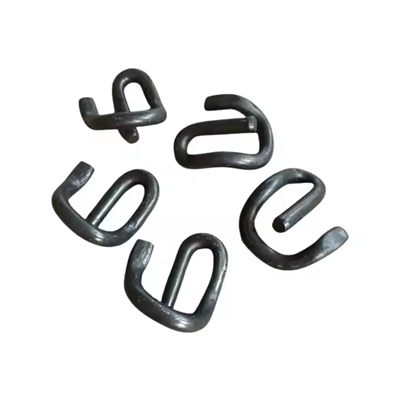
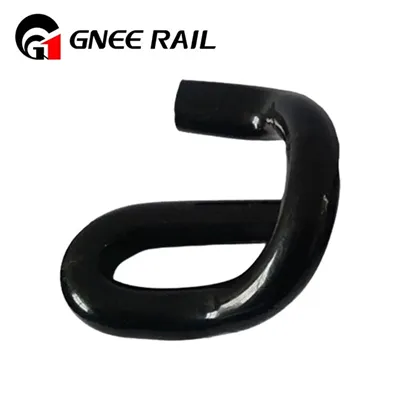
A railway E-Clip is a tensioned spring steel fastening device that secures the rail foot to the sleeper shoulder through elastic deflection and torsional resistance-unique among rail fasteners for its self-adjusting clamping force that increases under dynamic load, its single-component installation requiring no separate nuts, bolts, or insulators in basic form, and its universal section geometry that accommodates both concrete and steel sleepers across 30+ rail profiles; despite visual similarity, E-Clip variants differ fundamentally in bar diameter, toe load, fatigue class, and corrosion protection, rendering cross-standard substitution a leading cause of premature gauge widening.
Technical Specifications:
| Variant | Bar Diameter | Nominal Toe Load | Max Deflection | Coating Suitability | Distinct Limitation |
|---|---|---|---|---|---|
| PR601 | 18 mm | 7.5–8.5 kN | 12 mm | HDG, Dacromet | Light rail only; <22.5t axle |
| PR401 | 20 mm | 9.0–10.5 kN | 15 mm | Dacromet, Geomet | HDG prohibited (embrittlement risk) |
| FC1504 | 20 mm | 10.0–11.5 kN | 16 mm | Geomet, Zinc-flake | Heavy haul; 40t capable |
| e2009 | 20 mm | 9.0 kN ± 0.5 | 14 mm | Black oxide, Dacromet | Chinese standard; web thickness specific |
| SKL-type E-Clip | 18–20 mm | 12–18 kN | 10–14 mm | HDG (≤18 mm only) | Not interchangeable with Pandrol shoulders |
| Stainless Steel | 20 mm | 8.5–9.5 kN | 15 mm | None required | 316L grade; 50+ year coastal life; 30% higher cost |

Performance Range:
Force-Load Proportionality – Unlike screw spikes with fixed clamp force, E-Clip toe load increases 15–25% under wheel passage due to rail foot deflection. This self-tightening action resists creep under heavy axle loads.
Torsion Beam Principle – The clip functions as a pre-stressed torsion bar, not a cantilever spring. The leg twisted during installation stores energy in the bend radius, not the straight section. This distributes strain and triples fatigue life versus cantilever designs.
Shoulder Interaction Angle – Clamping force vector is not vertical. Toe contacts rail foot at 38°–42°, creating horizontal component that presses rail against gauge face. Insufficient angle → lateral displacement; excessive angle → toe lifts under load.
Maintenance & Operational Perspective
- Black Oxide + Oil – Lowest cost, 3–8 year life in dry ballast. Oxide layer provides no cathodic protection; once breached, base metal corrodes at 0.1–0.2 mm/year. Unsuitable for tunnels, coastal, or wet track.
- Dacromet / Geomet – 12–20 year life. Zinc-aluminium flake coating, 8–12 µm thickness. No hydrogen embrittlement risk. Maximum service temperature 300°C (unlimited for railway). Preferred for high-speed and mixed traffic.
- Hot-Dip Galvanizing (HDG) – 25–40 year life. Limited to bar diameter ≤18 mm. Thicker section (20 mm) risks brittle quench cracking during withdrawal from zinc bath. Specification requires impact testing of production samples.

Gnee Professional supplier


↵Rail Clamp Fastening System

This report provides a concise technical examination of Railway Clamp systems, focusing on their temporary/non-permanent function, emergency load-transfer mechanics, and compatibility with non-standard rail sections. The analysis deliberately avoids overlap with prior discussions regarding elastic clips (E-Clip, SKL, Fastclip, Nabla), screw spikes, or dog spikes. The focus here is practical and distinct: derailment recovery, rail breaking emergencies, and crane rail / port applications.
Technical Specifications:
| Variant | Primary Application | Rail Section Compatibility | Clamping Mechanism | Distinct Visual Feature | Common Mis-Selection |
|---|---|---|---|---|---|
| GTR-1 / MCT (Emergency) | Rail break bridging | UIC54, UIC60, 115RE, 136RE | Central bridge plate + dual toe clamps | Long central plate spans fracture; four-bolt configuration | Used as permanent clip (incorrect-requires weekly re-torque) |
| Crane Rail Clamp (FPA/FPD) | Port/industrial crane rails | A100, A120, A150, ASCE 171/175 | Side-jaw engagement of rail head | Clamps rail head, not foot; no sleeper fixation | Specified for mainline (insufficient lateral restraint) |
| Insulated Block Joint Clamp | Insulated rail joints | UIC54, UIC60 | Dielectric separator plates + tension bolts | Visible fiberglass/epoxy insulation layers | Standard clamp installed-signal circuit failure |
| Buffer Stop Clamp (Sliding) | Impact energy absorption | UIC54, UIC60 | Calibrated slip tension | Elongated bolt holes; wear indicators | Fixed clamp installed-no sliding function |
| Temporary Construction Clamp | Contractor staging | All flat-bottom sections | Simple U-shape + single central bolt | Minimalist design; no rail foot contouring | Used in permanent track (indentation damage) |
Performance Range:
Rail Break Emergency Clamping (Traffic Restoration):
Following broken rail or weld failure, tension clamps (e.g., GTR-1, MCT) are applied across the fracture site. Load transfer capacity: 80-120 kN per clamp pair. Restores 20 km/h passage immediately. Permanent repair follows within 24-72 hours .
Derailment Recovery & Rerailing Operations:
Clamps secure rails to sleepers during crane rerailing. Prevents track shift under lifting loads (up to 200 tonnes). Applied at 2m intervals through derailment zone. Removed after wheels are back on rail .
Maintenance & Operational Perspective
- Installation & Removal Speed (Emergency Context):
- Manual clamp installation: 30-60 seconds using impact wrench or ratchet socket. Hydraulic clamp application: 15-20 seconds. Speed is critical-rail break possession windows average 45-60 minutes .
- Bolt Tension Retention (Weekly Re-Torquing):
- Clamps rely on bolt clamping force, not spring geometry. Vibration causes 10-15% torque loss per week under traffic. Weekly re-torquing mandated for continuous use. After 4-6 weeks, thread galling risk escalates-clamps removed and serviced .

Gnee Professional supplier
Hot Tags: carbon steel e clip, China carbon steel e clip manufacturers, suppliers, factory, rail clip rubber coating, heavy duty rail clips, rail clip loosening tools, rail fastening clips, rail clip measuring tools, rail clips