

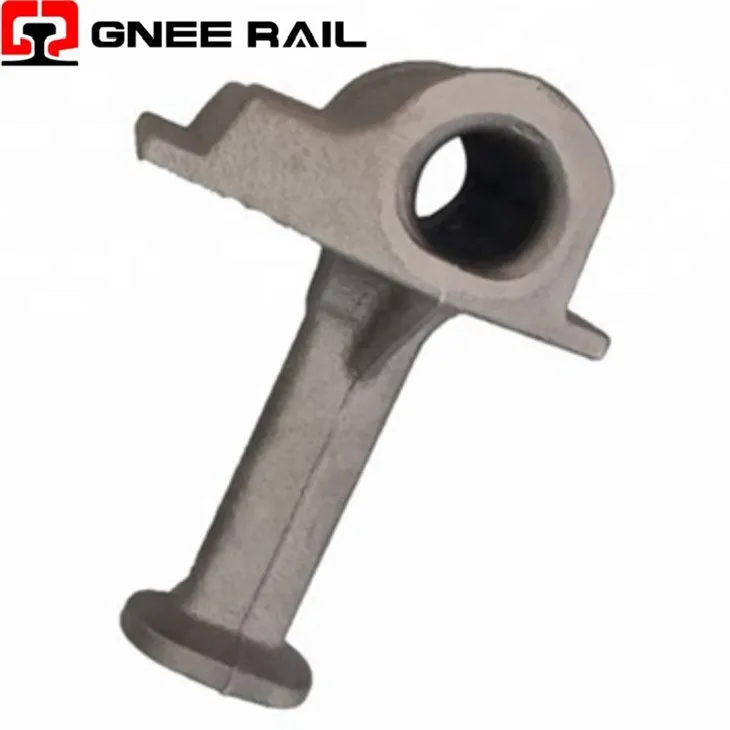


↵Rail Shoulder Fastening System
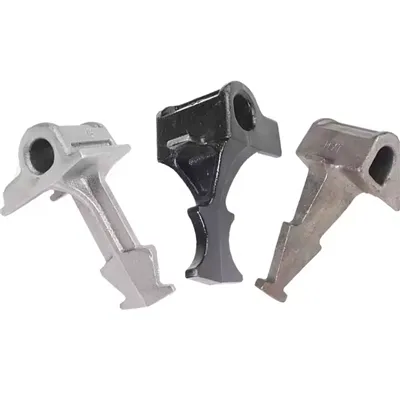
A Railway Shoulder is a critical load-bearing component in a rail fastening assembly, acting as the rigid abutment against which an elastic rail clip (such as an E Clip, Nabla Clip, or SKL type) applies its lateral clamping force to secure the rail. It is specifically designed to resist the immense lateral and torsional forces transmitted from the rail through the clip, thereby maintaining the track gauge and ensuring vertical alignment.
Technical Specifications:
| Characteristic | Specification / Detail | Primary Importance | ||
|---|---|---|---|---|
| Core Function | Lateral Abutment for Rail Clip & Gauge Retention | Absolute Foundation for Track Geometry Stability | ||
| Common Material Types | Malleable Cast Iron, Forged Steel, Reinforced Polymer | Balances Strength, Durability & Cost | ||
| Critical Inspection Parameter | Wear Depth on Gauge Face | Direct Indicator of Clamping Force Loss | ||
| Interface Specificity | Precisely Engineered to Match a Specific Clip Type | Ensures Correct Clip Function & System Integrity | ||
| Failure Consequence | Gauge Widening, Clip Detensioning, Asymmetric Rail Load | Leads to Rapid Track Geometry Degradation |

Functional & Engineering Perspective
Vertical Rail Support Alignment: Many shoulders incorporate a specific profile or are paired with an insulator that defines the correct rail cant (inward tilt), which is crucial for proper wheel-rail contact and even wear.
Load Distribution: It helps distribute concentrated lateral loads from the clip over a larger area of the sleeper, reducing point stresses and preventing localized damage to the sleeper material.
System-Specific Interface: Its design is inseparable from the clip it is paired with; for example, a shoulder for an SKL clip has a locking groove, while one for a Nabla clip provides specific curved contact faces.
Maintenance & Operational Perspective
- Corrosion & Wear Protection: Metal shoulders are protected with coatings like hot-dip galvanizing, sherardizing, or advanced epoxy paints. Wear-resistant inserts or hardened surfaces are sometimes applied to high-abrasion contact points.
- Dimensional & Quality Control: Rigorous inspection checks include critical dimensions (height, gauge face distance, angles), material hardness (for metal), tensile strength (for polymer), and for cast parts, absence of voids or cracks via non-destructive testing.
- Integrated vs. Discrete Manufacturing: For concrete sleepers, shoulders are often produced as separate components and then precisely positioned and cast into the sleeper during its production, requiring exact fixturing in the sleeper mold.
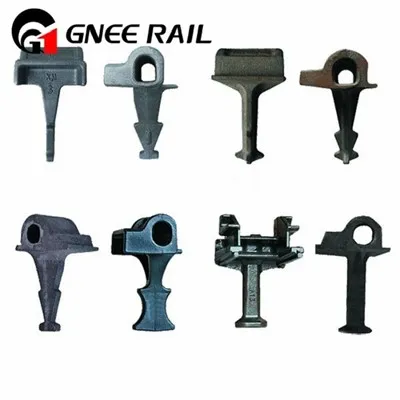
Gnee Professional supplier


Hot Tags: customized railway shoulder, China customized railway shoulder manufacturers, suppliers, factory, casting tie plates, fish bolt in railway, double shoulder tie plate, railroad tie plate dimensions, rubber pad types, railroad spike definition


