

100 lb ARA Type A
The ARA (American Railway Association) standard is one of the most widely recognized rail standards in the world, particularly in North and South America.
The 100 lb designation refers to its nominal weight of 100 pounds per yard (approximately 49.6 kg/m). The Type A indicates a standard symmetrical I-beam section. Unlike specialized crane rails, this standard profile ensures compatibility with a wide range of standard track components, including joint bars and fastening systems.
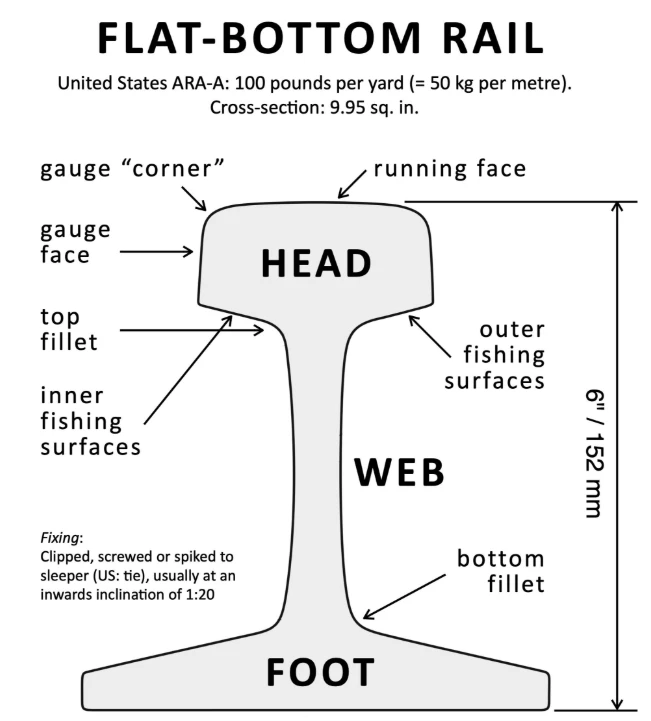
| Parameter | Specification (Typical) | Tolerance |
|---|---|---|
| Weight | 100 lbs/yd (49.6 kg/m) | ± 1.5% |
| Rail Height (H) | 5.75 in (146.0 mm) | ± 0.5 mm |
| Head Width (W) | 2.625 in (66.7 mm) | ± 0.5 mm |
| Base Width (B) | 5.5 in (139.7 mm) | ± 1.0 mm |
| Web Thickness (t) | 0.63 in (16.0 mm) | ± 0.5 mm |
This profile is a workhorse. It sits comfortably between light industrial tracks and heavy mainline rails, making it ideal for factory floor tracks, medium-duty mining lines, and heavy gantry cranes.
What Makes "HH" Different?
Standard rails (usually U71Mn or 900A grade) have a relatively uniform hardness of around 260-300 HBW. Under high pressure and abrasive conditions, the rail head undergoes rapid plastic deformation and wear.
Head Hardened (HH) rails are subjected to an offline or online heat treatment process (often using induction heating followed by compressed air quenching). This creates a specific microstructure-typically fine pearlite or bainite-in the rail head.
Key Technical Metrics for HH Rails:
Surface Hardness: Typically 340 - 390 HBW (up to 400 HBW for premium grades).
Hardened Depth: The hardened layer usually extends 25 mm to 30 mm below the running surface. This ensures that the rail retains its wear resistance even after multiple grinding cycles.
Tensile Strength: Generally exceeds 1,200 MPa, compared to ~900 MPa for standard rails.
The Engineering Value:
In high-curve or heavy-haul applications, an HH rail can extend service life by 2 to 4 times compared to a standard rail. This directly reduces track downtime, labor costs for replacement, and the risk of derailment due to severe gauge widening.
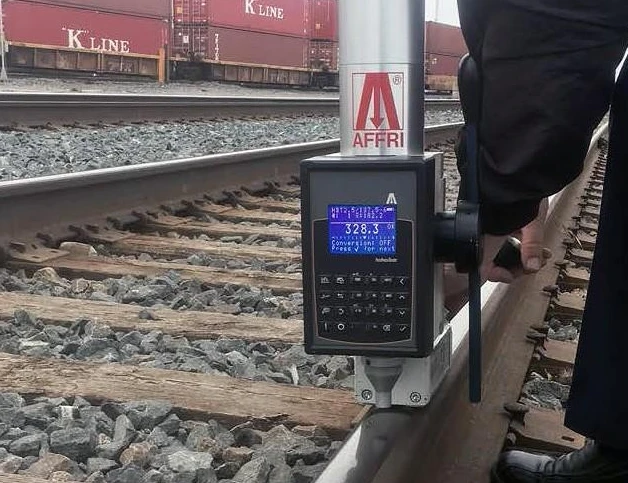
Brinell hardness testing on the rail head ensures the HH layer meets specifications
Get a Quote for Head Hardened Rails
Drilled vs. Undrilled Rails: How to Choose for Your Project
When specifying steel rails, the end condition (drilled or undrilled) is a key decision that affects both installation efficiency and long-term track performance. There is no "better" option-only the right option for your specific track design.
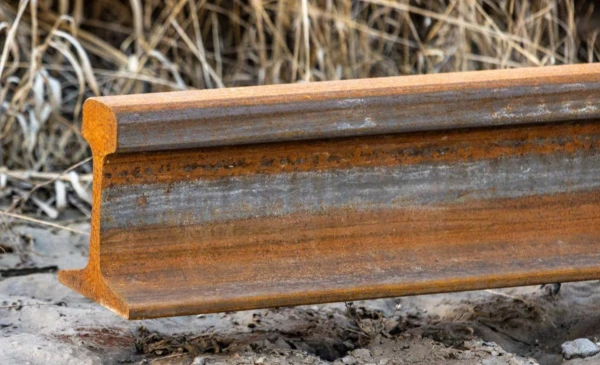
Undrilled Rails
Drilled Rails
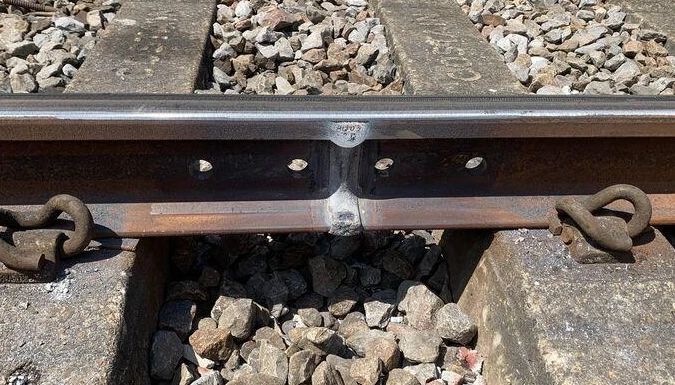
When should you specify Undrilled (Plain End) Rails?
For Continuous Welded Rail (CWR): If your track will be joined using aluminothermic (thermit) welding or flash-butt welding, undrilled rails are essential. Pre-drilled holes at the ends can interfere with the welding process and create stress concentrations that may lead to premature failure.
When Using Customized Joint Bars: Some heavy industrial or crane rail systems use non-standard fishplates or clamping systems. Undrilled rails give your site engineers the flexibility to drill the exact hole spacing and diameter required on-site.
For Crane Rail Clamping: In many port gantry crane or steel mill applications, rails are simply clamped to the girder without mechanical joints. Drilled holes are unnecessary here and can act as stress risers.
When should you specify Drilled Rails?
For Standard Bolted Joints: If your project uses standard fishplates and you want to minimize on-site fabrication time, factory-drilled rails (with standard hole patterns) are the most efficient choice.
For Temporary or Light-Duty Tracks: Where welding equipment isn't available, pre-drilled rails allow for quick assembly using track bolts.
A Practical Note: If you are uncertain about your final joint configuration, ordering undrilled rails and drilling them later (either on-site or at a local fabrication shop) often provides the most flexibility. Just ensure you have the appropriate rail drilling equipment available.
Get a Quote for Undrilled or Drilled Rails (CIF/FOB)
Selection Matrix for 100 lb HH Rails
Choosing the right 100 lb ARA Type A rail is not just about the profile-it's about matching the hardness (HH/IH) and end condition (Drilled/Undrilled) to your specific operational demands.
| Application Scenario | Recommended Hardness | Recommended End Condition | Key Selection Rationale |
|---|---|---|---|
| Mining Railways (High axle loads, abrasive dust, tight curves) |
HH (Head Hardened) Target: 360-390 HBW |
Undrilled (For thermit/flash-butt welding) |
Maximum surface hardness resists severe side wear on curves. Undrilled ends allow for seamless continuous welding to reduce impact. |
| Port & Shipyard Cranes (Extreme point loads, straight track, high frequency) |
IH (Intermediate Hardened) Target: 300-340 HBW |
Undrilled (For continuous clamping) |
IH is usually cost-effective and sufficient for straight, clamped tracks. Undrilled rails avoid stress risers where crane clips are mounted. |
| Steel Mills & Foundries (High ambient heat, heavy ladle cars) |
HH (Head Hardened) Requires thermal stability |
Undrilled (Welded on-site) |
HH maintains hardness even at elevated temperatures. Welding eliminates joint gaps where molten slag could accumulate. |
| General Industrial Logistics (Moderate loads, standard speeds) |
IH or Standard Carbon | Drilled (Standard bolt pattern) |
Standard carbon or IH offers cost savings. Factory-drilled ends allow for rapid assembly with standard fishplates, saving on-site labor. |
Quick Rule of Thumb:
Curved + Heavy Load → HH + Undrilled (for welding)
Straight + Crane Load → IH + Undrilled (for clamping)
Quick Assembly Needed → Drilled (for standard joint bars)
Unsure which configuration fits your project? Get a free selection consultation from our engineers.
Quality Assurance & Inspection Protocol
For HH rails, quality is not just about dimensions. We implement the following inspection protocol before shipment:
Chemical Composition Analysis: Verifying carbon, manganese, and alloying elements.
Brinell Hardness Test: Sampling the rail head surface to confirm HH specs (e.g., >340 HBW).
Ultrasonic Testing (UT): Scanning the web and head for internal defects or inclusions.
Dimensional Check: Verifying height, width, and straightness (camber).
Visual Inspection: Checking for surface defects, rolling marks, or rust.
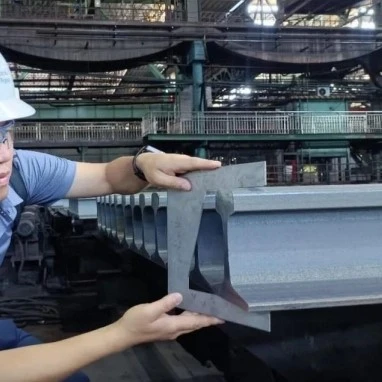
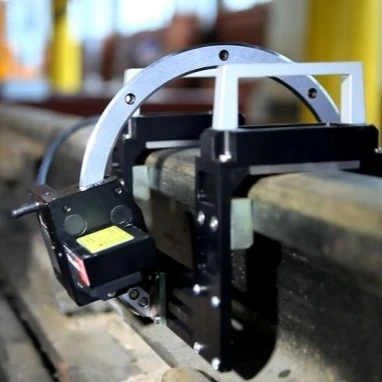
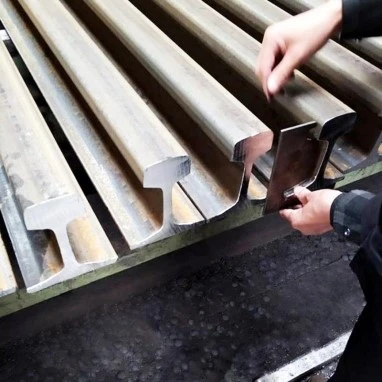
All shipments are accompanied by a Mill Test Certificate (MTC) and a Third-Party Inspection Report (if requested).
Discuss Your Specific Inspection Requirements
Our Product Range
We supply a comprehensive suite of track materials to support your entire rail project, from the rail itself to the fastening systems.
| Product Category | Key Items Available |
|---|---|
| Steel Rails | Light rails (GB, DIN, ASCE), Heavy rails (ARA, AREMA, UIC), Crane rails. HH & standard grades. |
| Fishplates (Joint Bars) | Standard and customized fishplates to match all rail profiles, complete with bolts and nuts. |
| Fastening Systems | Elastic rail clips, base plates, tie plates, rail pads, and anti-vibration pads. |
| Fasteners | Track spikes, hex bolts, rail screws, and high-strength nuts. |
FAQ
Q: 1. What is the difference between 100 lb ARA Type A and 100RE?
A: Both weigh 100 lbs per yard, but 100RE is the newer AREMA standard with refined dimensions (especially in the head and base). 100 lb ARA Type A is based on the older ARA standard. For industrial applications, they are often interchangeable, but we recommend checking the exact dimensions of your existing track before ordering.
Q: 2. Can you supply Intermediate Hardened (IH) rails instead of HH?
A: Yes. While HH offers maximum wear resistance, IH (Intermediate Hardened) rails (typically 300-340 HBW) offer a balance between hardness and toughness. They are suitable for moderate curves where shock loads are a concern.
Q: 3. Are the 39 ft rails suitable for container shipping?
A: Yes. 39 ft (11.88m) rails are an excellent fit for 40 ft Flat Rack containers, making them cost-effective to ship. We use steel straps and anti-rust oil to secure them during transit.
Q: 4. How deep is the hardened layer on your HH rails?
A: Our HH rails typically feature a hardened depth of 25-30 mm below the running surface. This ensures the rail remains wear-resistant even after multiple grinding passes.
Q: 5. Can you drill the bolt holes according to my drawing?
A: Absolutely. We can supply rails in a drilled condition (with holes according to your specific fishplate pattern) or as undrilled. Please provide a drawing with hole diameter, spacing, and edge distance.
Q: 6. What welding method is best for undrilled rails?
A: For undrilled rails, aluminothermic (thermit) welding is the most common field method for joining. For high-volume pre-assembly, flash-butt welding in a fixed plant is recommended.
Q: 7. What is your minimum order quantity (MOQ) for 100 lb HH rails?
A: Our MOQ is typically one 20ft or 40ft container load (approximately 20-25 metric tons), which corresponds to roughly 40-50 lengths of 39ft rails. However, we can discuss smaller trial orders.
Q: 8. Do you provide third-party inspection?
A: Yes. We welcome third-party inspections (SGS, BV, Intertek) at our mill or warehouse before shipment. We can also provide high-resolution photos and videos of the production process.


