

Track maintenance is one of the highest recurring costs in heavy-haul and industrial rail operations. If your rails are wearing out prematurely on curves or under heavy crane loads, the issue often isn't the rail profile itself-it's the surface hardness.
When upgrading from standard, as-rolled rails, buyers are usually presented with two options: Head Hardened (HH) and Intermediate Hardened (IH). This guide breaks down the metallurgy, performance data, and selection criteria for both.
How Are Hardened Rails Made?
It is a common misconception that all rails come out of the mill with extreme hardness.
Standard rails are hot-rolled and air-cooled, offering a uniform surface hardness of around 260-300 HBW. They are perfectly fine for straight, low-traffic industrial tracks.
Hardened rails (HH & IH) undergo a secondary heat treatment process-typically induction heating followed by compressed air quenching. This process refines the microstructure of the rail head into a fine pearlite structure, creating a hardened layer that resists plastic deformation and abrasive wear.
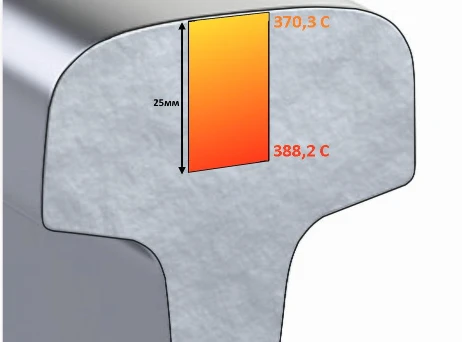
The heat-treated zone is localized to the rail head, where wheel contact occurs.
Head-to-Head: HH vs. IH Core Specifications
The difference between HH and IH lies in the intensity of the heat treatment, which directly affects hardness, toughness, and cost.
Here is the technical comparison for heavy industrial profiles (like the 100 lb ARA Type A):
| Parameter | HH (Head Hardened) | IH (Intermediate Hardened) |
|---|---|---|
| Surface Hardness | 340 - 390 HBW (Up to 400 HBW) | 300 - 340 HBW |
| Hardened Depth | 25 - 30 mm below surface | 20 - 25 mm below surface |
| Tensile Strength | Typically > 1,200 MPa | Typically ~ 1,100 MPa |
| Wear Resistance | Excellent (2-4x standard rail life) | Good (1.5-2x standard rail life) |
| Impact Toughness | Moderate (slightly lower ductility) | High (better resistance to shock loads) |
| Relative Cost | High | Medium |
Pros & Cons: The Engineering Trade-off
Choosing the hardest rail on the market is not always the best engineering decision. You must balance wear resistance with impact toughness.
The Reality of HH (Head Hardened) Rails:
The Advantage: HH rails are the ultimate solution for severe side-wear and heavy axle loads. In tight curves, the extreme surface hardness significantly delays gauge widening.
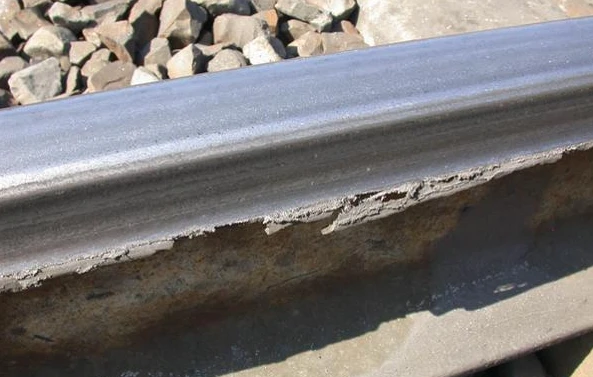
The Limitation: Because the surface is so hard, HH rails are more sensitive to trackbed imperfections. If the track support is uneven, the brittle hardened layer can experience head checks or spalling (surface cracking).
The Reality of IH (Intermediate Hardened) Rails:
The Advantage: IH rails offer a cost-effective balance. The slightly lower hardness provides better impact toughness, making them ideal for tracks with joint gaps, uneven subgrades, or varying load types.
The Limitation: On extremely sharp curves with heavy loads, IH rails will wear faster than HH, requiring more frequent grinding or replacement.
Consult Our Engineers on HH vs. IH Selection
Selection Guide: Matching Hardness to Your Application
| Application Scenario | Recommended Grade | Key Engineering Reason |
|---|---|---|
| Mining Railways (Tight curves, heavy axle loads, abrasive ore) |
HH | Maximum surface hardness is mandatory to resist severe grinding and side wear. |
| Port Gantry Cranes (Straight track, extreme point loads) |
IH | Straight tracks don't suffer from curve wear. IH provides sufficient strength with better cost-efficiency. |
| Steel Mill Tracks (High heat, heavy ladle cars, shock loads) |
HH | Heat-treated rails maintain hardness better at elevated temperatures. |
| General Plant Logistics (Moderate loads, mixed curves and straights) |
IH or Standard | Avoids over-specifying. Standard or IH is highly cost-effective for moderate, mixed traffic. |
Quick Decision Rule:
Sharp Curves + Heavy Load → Choose HH.
Straight Tracks + Crane Loads → Choose IH.
Mixed Traffic + Budget Constraints → Choose IH.
Severe Curve Wear
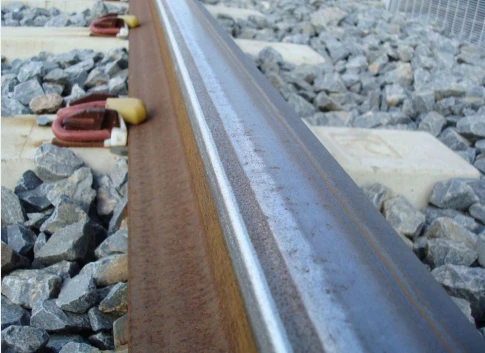
Smooth, Maintained Rail
Common Misconceptions to Avoid
Misconception 1: "Higher hardness always means a better rail."
Reality: A rail that is too hard for the application (e.g., using HH on a poorly supported track) can crack rather than wear. Matching hardness to the track's support conditions is critical.
Misconception 2: "Hardened rails require zero maintenance."
Reality: HH and IH rails still require profile grinding. Regular grinding removes surface fatigue cracks and maintains the optimal wheel-rail contact geometry.
Misconception 3: "I can buy standard rails and just weld hard metal on top."
Reality: Factory-controlled heat treatment ensures a consistent hardened depth. Field welding cannot replicate the uniform microstructure of a mill-treated HH or IH rail.
Request a Custom Rail Wear Analysis for Your Track
Our Product Range
Beyond HH and IH rails, we supply a complete ecosystem of track materials to ensure your project runs smoothly.
| Product Category | Key Items Available |
|---|---|
| Steel Rails | Light rails (GB, DIN, ASCE), Heavy rails (ARA, AREMA, UIC), Crane rails. HH & standard grades. |
| Fishplates (Joint Bars) | Standard and customized fishplates to match all rail profiles, complete with bolts and nuts. |
| Fastening Systems | Elastic rail clips, base plates, tie plates, rail pads, and anti-vibration pads. |
| Fasteners | Track spikes, hex bolts, rail screws, and high-strength nuts. |
FAQ
Q: 1. Can I visually tell the difference between an HH rail and a standard rail?
A: No. The heat treatment process does not significantly change the external appearance of the rail. You must rely on the Mill Test Certificate (MTC) and Brinell hardness test reports provided by the manufacturer.
Q: 2. What is the exact hardened depth of your HH rails?
A: Our standard HH rails typically feature a hardened depth of 25-30 mm below the running surface. This ensures the rail remains wear-resistant even after multiple grinding passes.
Q: 3. Can you supply Intermediate Hardened (IH) rails in the 100 lb ARA profile?
A: Yes. We can supply the 100 lb ARA Type A in both HH and IH grades, depending on your track's curve radius and axle load requirements.
Q: 4. Will HH rails break if used on a poorly supported track?
A: HH rails have lower impact toughness than standard rails. If the trackbed has soft spots or severe joint impacts, the hardened layer is prone to spalling. Proper track support is mandatory for HH rails.
Q: 5. Do your HH rails come with bolt holes?
A: We can supply rails in both Drilled and Undrilled (Plain Ends) conditions. For continuous welded rail (CWR) projects, undrilled is recommended to facilitate thermit or flash-butt welding.
Q: 6. How much longer will an HH rail last compared to a standard rail?
A: In high-wear scenarios (like sharp curves), an HH rail can last 2 to 4 times longer than a standard rail. In straight, low-traffic tracks, the lifespan difference is much smaller.
Q: 7. Can you provide third-party inspection for hardness?
A: Yes. We welcome third-party inspection (SGS, BV, Intertek) at our mill or warehouse. We can also provide high-resolution photos and videos of the Brinell hardness testing process before shipment.
Q: 8. What is your MOQ for HH/IH rails?
A: Our MOQ is typically one 20ft or 40ft container load (about 20-25 metric tons). We can discuss smaller trial orders for specific projects.


