

What Is 60E1 Railway Rail?
60E1 is a flat-bottom railway rail profile defined by its cross-sectional geometry and technical requirements. The profile is commonly associated with the designation UIC 60 and is covered by EN 13674-1, the European standard for vignole railway rails weighing 46 kg/m and above.
The designation 60E1 identifies a specific rail profile; it does not, by itself, specify the steel grade, rail length, heat treatment or every requirement for a particular project.
Rail profile: 60E1
Applicable standard: EN 13674-1, including the required edition
Steel grade: As specified by the railway project
Rail length: Required length per piece
Dimensional and straightness classes: As required by the purchase specification
Rail ends: Drilled or undrilled, as applicable
Inspection documents: Material test certificate and required inspection records
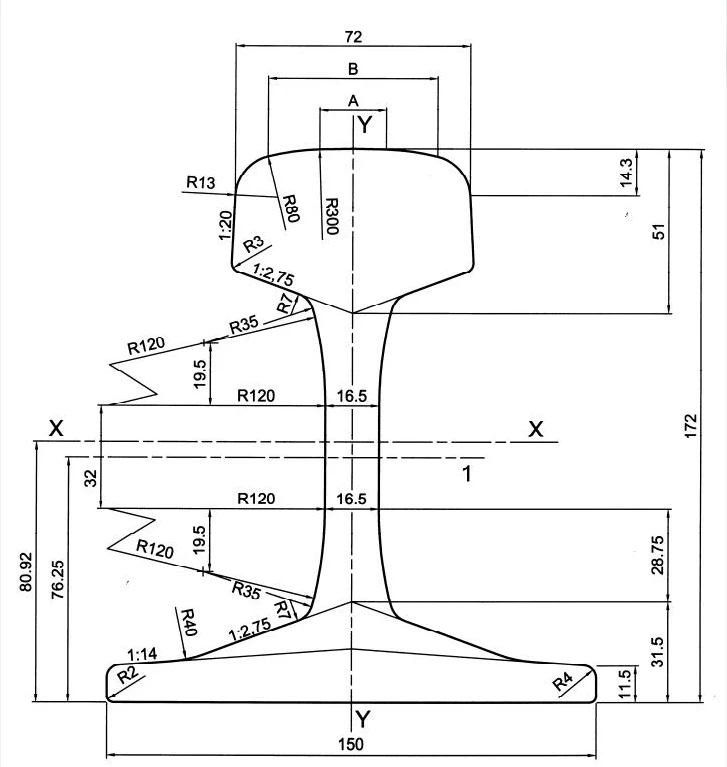
60E1 Railway Rail Profile and Main Cross-Section Dimensions
60E1 Rail Dimensions and Specifications
The dimensions of 60E1 rail determine its cross-sectional geometry and are important when checking compatibility with the specified rail fastening system, sleepers, track components and engineering drawings.
The nominal dimensions must be checked against the specified 60E1 profile, rather than estimated from the rail's weight or appearance.
Main Dimensional Parameters
| Dimension | Symbol | Nominal Value |
|---|---|---|
| Total rail height | H | 172 mm |
| Head width | C | 72 mm |
| Foot width | B | 150 mm |
| Web thickness | E | 16.5 mm |
| Cross-sectional area | - | 76.70 cm² |
| Theoretical mass per meter | - | 60.21 kg/m |
60E1 Rail Weight
The theoretical mass of 60E1 rail is 60.21 kg per meter. This value can be used to estimate the total rail mass for transport planning and preliminary project calculations.
The calculation is:
Total theoretical mass = Unit mass × Rail length × Number of rails
For example, an order for 100 rails, each 12 meters long, has a total rail length of 1,200 meters.
| Calculation Item | Value |
|---|---|
| Theoretical mass per meter | 60.21 kg |
| Length per rail | 12 m |
| Number of rails | 100 pcs |
| Total rail length | 1,200 m |
| Total theoretical mass | 72,252 kg (72.252 tonnes) |
Dimensional Tolerances and Straightness
Nominal dimensions are not the only criteria for rail acceptance. The applicable standard and purchase specification may also define dimensional tolerances, profile requirements and straightness classes.
Before placing an order, buyers should confirm:
Profile dimensions and applicable tolerances
Rail straightness requirements
Rail length tolerances
Surface and end-face condition
Requirements for drilled or undrilled rail ends
For projects requiring detailed technical approval, request an approved dimensional drawing and the relevant inspection criteria.
60E1 Rail Steel Grades
The rail profile and the steel grade are two separate specification items. A 60E1 rail designation defines the profile, while the steel grade establishes the applicable material requirements.
The required grade depends on the railway authority's specification, traffic conditions, wear requirements and other project-specific factors.
Common Steel Grades
The EN 13674-1 framework includes several rail steel grades. Examples found in relevant standard editions and manufacturer product ranges include:
| Steel Grade | General Description | Buyer Considerations |
|---|---|---|
| R200 | Non-heat-treated rail steel grade | Confirm suitability under the applicable specification |
| R220 | Non-heat-treated rail steel grade | Verify permitted applications and the specified standard edition |
| R260 | Non-heat-treated rail steel grade | Commonly specified for conventional rail applications |
| R260Mn | Manganese-alloyed rail steel grade | Confirm the applicable edition and material requirements |
| R320Cr | Alloy rail steel grade | Verify specified hardness and mechanical properties |
| R350HT | Heat-treated rail steel grade | Consider when the project specifies enhanced hardness and wear performance |
| R350LHT | Heat-treated rail steel grade | Confirm availability and project acceptance requirements |
How to Select a Steel Grade for 60E1 Rail
When selecting a grade, buyers should consider the operating environment and the requirements of the railway project.
Important factors include:
Traffic volume and axle loads
Operating speed and service conditions
Rail head wear requirements
Curve radius and contact conditions
Maintenance strategy and expected service life
Applicable railway authority specifications
Higher hardness or a higher grade designation should not automatically be treated as the best choice for every project. The selected grade must meet the project's technical requirements and be approved by the responsible engineering team.
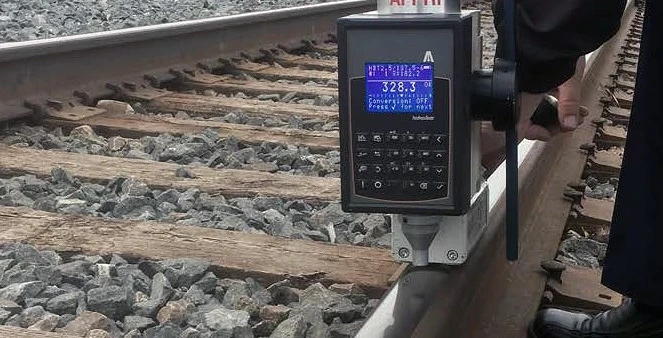
Rail Steel Quality Control and Hardness Testing
Applications of 60E1 Railway Rail
60E1 is used in railway track systems where its profile and material properties meet the engineering design requirements. The suitability of a particular 60E1 rail depends on the complete track design, specified steel grade, fastening arrangement and operating conditions.
| Application | Key Technical Considerations |
|---|---|
| Mainline railway | Traffic loading, track design and railway authority requirements |
| Passenger railway | Operating speed, track geometry and maintenance requirements |
| Freight railway | Axle loads, traffic conditions and rail wear |
| Railway renewal projects | Compatibility with the existing track design and components |
| Railway infrastructure projects | Approved drawings, rail grade and applicable standards |
A rail profile should not be selected on the basis of unit weight alone. Confirm the profile, steel grade and fastening compatibility against the engineering documents for the intended track system.
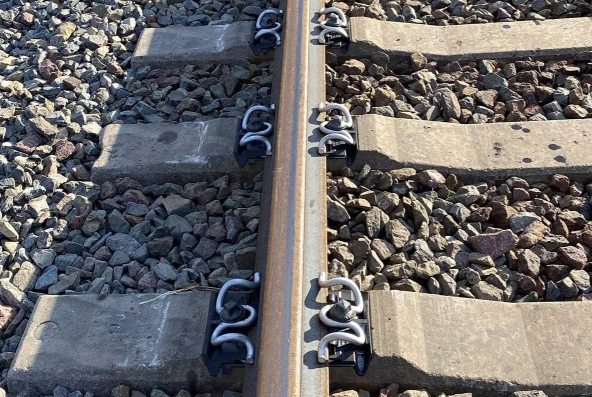
60E1-Type Flat-Bottom Rail in Railway Track Infrastructure
60E1 vs. Other Rail Profiles
Different rail profiles can have similar weights or appearances while having different dimensions and technical requirements. Buyers should compare the full profile designation and applicable standard before considering an alternative.
60E1 vs. 54E1
60E1 and 54E1 are European rail profiles associated with EN 13674-1. They differ in height, width, cross-sectional area and theoretical mass.
| Parameter | 60E1 | 54E1 |
|---|---|---|
| Common designation | UIC 60 | UIC 54 |
| Rail height | 172 mm | 159 mm |
| Head width | 72 mm | 70 mm |
| Foot width | 150 mm | 140 mm |
| Web thickness | 16.5 mm | 16 mm |
| Theoretical mass | 60.21 kg/m | 54.77 kg/m |
The greater height and mass of 60E1 do not, by themselves, establish that it is a suitable replacement for 54E1. Track design, fastening components, rail-seat geometry and project approval must also be considered.
60E1 vs. 50E2
Although 60E1 and 50E2 are both flat-bottom rail profiles, their nominal dimensions and masses differ.
| Parameter | 60E1 | 50E2 |
|---|---|---|
| Rail height | 172 mm | 151 mm |
| Head width | 72 mm | 72 mm |
| Foot width | 150 mm | 140 mm |
| Web thickness | 16.5 mm | 15 mm |
| Theoretical mass | 60.21 kg/m | 49.97 kg/m |
60E1 and 50E2 should not be considered interchangeable simply because both are flat-bottom rails. Buyers must check the engineering design, applicable standards, fastening system and railway authority requirements.
Ask Our Team to Review Your Rail Specifications
60E1 Rail Lengths, Marking and Supply Options
Rail length and end configuration should be stated clearly in the purchase inquiry. The available lengths depend on the manufacturer's production range, order requirements and logistics arrangements.
Rail Lengths
The required length should be specified in the inquiry or purchase order. Depending on the project and supply arrangement, rails may be ordered in standard production lengths or other agreed lengths.
For longer rails, buyers should consider transport restrictions, unloading arrangements and the installation method. Do not assume a particular length is available without confirmation from the supplier.
Rail Marking and Traceability
Rail identification requirements help buyers verify that the supplied material corresponds to the order and applicable specification.
Where required, confirm the marking format, location and information to be included, along with the relationship between rail markings and the material documentation.
Drilled and Undrilled Rail Ends
60E1 rails may be specified with undrilled ends or with drilled holes where required by the project design.
For drilled rails, buyers should provide or approve the relevant details, including:
Number of holes at each end
Hole diameter
Hole spacing and position
Distance from the rail end
Applicable drawing and tolerances
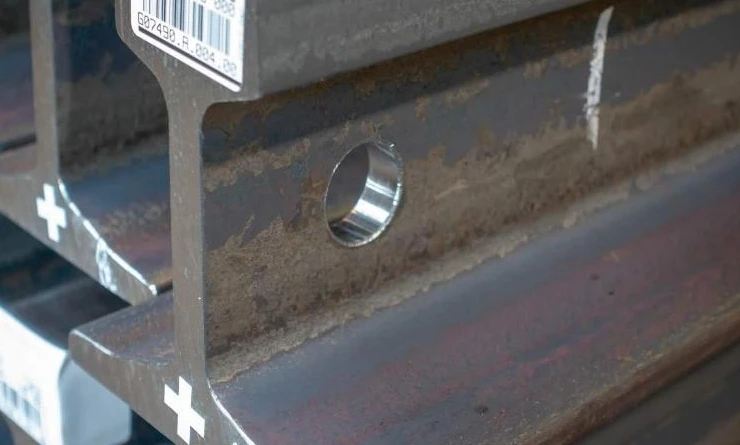
60E1 Rail End Options: Undrilled and Drilled Configurations
How to Specify 60E1 Rails for a Project
A clear technical inquiry helps the supplier confirm the product, review availability and prepare a quotation that matches the project requirements.
Buyer Specification Checklist
| Required Information | Details to Provide |
|---|---|
| Rail profile | 60E1 |
| Applicable standard | EN 13674-1 and the required edition |
| Steel grade | Exact grade required by the project |
| Rail length | Length per piece |
| Quantity | Number of pieces and total length |
| Rail ends | Drilled or undrilled |
| Dimensional requirements | Applicable tolerances and straightness class |
| Technical documents | Datasheet, drawing and MTC requirements |
| Delivery destination | City, country and delivery point |
| Commercial terms | Requested Incoterm, currency and delivery deadline |
Technical Approval Before Ordering
For projects requiring engineering approval, the buyer should review the proposed rail datasheet and technical drawing before confirming the order.
The review should establish that the profile, steel grade, dimensions, tolerances and end configuration meet the specified requirements. Any deviations should be identified and approved before supply.
A complete inquiry should define both the rail profile and the required steel grade.
FAQ
Q: What is the standard for 60E1 rail?
A: 60E1 railway rail is specified under EN 13674-1. Buyers should confirm the edition applicable to their project and the associated technical requirements.
Q: What is the weight of 60E1 rail per meter?
A: The commonly published theoretical mass is 60.21 kg/m. Actual shipment weight should be confirmed with the supplier where required.
Q: Is 60E1 the same as UIC 60?
A: 60E1 is commonly designated UIC 60 in manufacturer and railway technical documentation. Buyers should still verify the exact profile and applicable standard in their project documents.
Q: Which steel grades are available for 60E1 rail?
A: The required grade depends on the applicable standard edition, manufacturer's approved range and project specification. Confirm the exact grade when requesting a quotation.
Q: Can 60E1 rail be supplied in customized lengths?
A: Length availability depends on production capability, stock and order requirements. State the required length and quantity so the supplier can confirm feasibility.
Q: Can 60E1 replace 54E1 or 50E2?
A: Not automatically. The profiles have different dimensions and masses. Any substitution requires a technical compatibility review and approval by the responsible project authority.
Request a Quote for 60E1 Railway Rail
For an accurate quotation, provide the required steel grade, rail length, quantity, applicable standard, rail-end configuration and delivery destination.
Our team can review your requirements and confirm the applicable product specifications, documentation and delivery arrangements.


