

Products Description
As a key component of the track structure, the specifications and dimensions of railway spikes directly affect the stability and safety of the track system. Depending on the usage scenario and track type, the size parameters of the spikes are significantly different. The length of common spikes on ordinary railways is between 85mm and 120mm, the diameter is 16mm to 22mm, and it is suitable for rails of 43kg/m to 60kg/m. High-speed railways have higher requirements for spike specifications, and the length is generally above 150mm and the diameter is not less than 24mm to cope with the lateral force generated when running at 350km/h. Heavy-duty railway spikes need to withstand loads of more than 30 tons of axle weight. The head is designed as a trapezoidal structure to increase the contact area with the sleeper, and the bottom thread adopts a double-line design to improve the pull-out resistance.
Special structure spikes include anti-loosening spikes and adjustable spikes. Anti-loosening spikes are set with wedge-shaped locking grooves at the end of the thread to produce a self-locking effect through elastic deformation. Adjustable spikes are equipped with height adjustment gaskets with an adjustment range of ±6mm, which are suitable for repairing track settlement sections. The insulating spikes used in the electrified section are made of glass fiber reinforced nylon material, and the insulation resistance value must reach 1x10^12Q·cm. The failure mode analysis of the spikes shows that 70% of the failures are caused by thread wear. It is recommended to replace them systematically every 5 years on heavy-load lines.
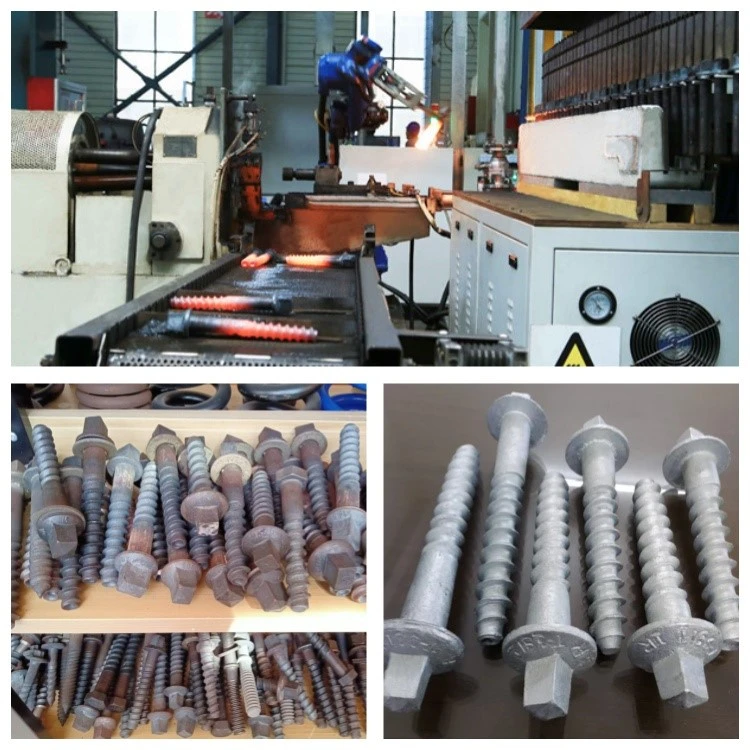
In terms of detection technology, ultrasonic flaw detection can detect cracks inside the spikes, and the probe frequency is selected to be 2.5MHz. Magnetic particle detection is used for surface defect inspection, and the magnetization current is controlled within the range of 5-10A. The digital monitoring system monitors the stress state of the spikes in real time by installing strain sensors, and the sampling frequency is not less than 100Hz. Laboratory test data shows that the fatigue life of high-quality spikes can reach 2 million cycles, which is equivalent to a 15-year operating cycle. With the development of intelligent rails, some lines have begun to try out intelligent spikes with RFID chips implanted, which can store information such as installation time and maintenance records.
The selection of spike specifications needs to take into account the material of the sleeper. It is recommended to use large-diameter spikes for concrete sleepers and fine-grained spikes for wooden sleepers. The density of road spikes should be increased in curved sections. In curved sections with a radius of less than 800m, the spacing between road spikes should be shortened to 80% of the standard value. In areas with high humidity in tunnels, the surface of road spikes needs to be sprayed with a moisture-proof coating. When installing road spikes at expansion joints of bridges, a 2-3mm expansion gap needs to be reserved. During winter construction, road spikes must be preheated to above 5°C before installation to avoid low-temperature brittle fracture. The operating unit should establish a full life cycle file for road spikes, recording parameters such as torque value and corrosion status for each maintenance.


