

What Is the 136RE Rail Cross Section Area?
The cross-sectional area of the 136RE rail is 13.32 square inches (13.32 in²), which is approximately 85.94 square centimeters (85.94 cm²). This area is distributed across the rail head, web, and base to provide a high Moment of Inertia (94.9 in⁴), making it the standard choice for heavy-haul Class I railroads in North America.
Detailed 136RE Rail Dimensions & Profile
The 136re rail profile is meticulously designed to balance wear resistance and structural integrity. Below are the key 136re rail dimensions:
- 136re rail height: 7 5/16 inches (185.74 mm)
- Base Width: 6 inches (152.40 mm)
- Head Width: 2 15/16 inches (74.61 mm)
- Web Thickness: 11/16 inch (17.46 mm)
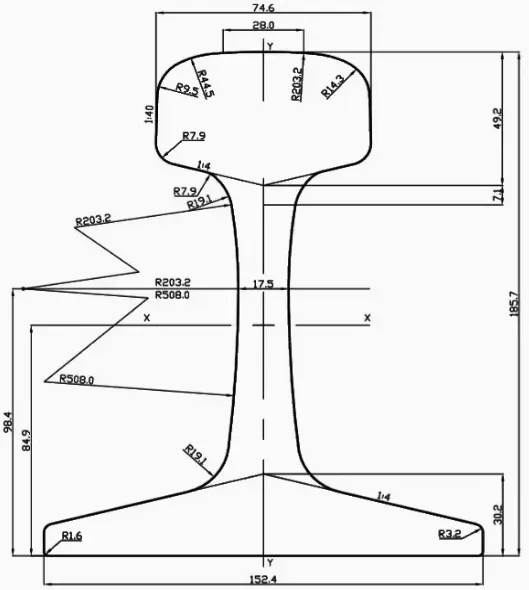
| Profile | Standard | Dimensions mm | Section S | Mass m | ||||
|---|---|---|---|---|---|---|---|---|
| H | B | C | D | E | cm² | kg/m | ||
| American standard | ||||||||
| 136RE (TR68) | AREMA | 185,70 | 152,40 | 74,60 | 49,20 | 17,50 | 85,90 | 67,50 |
GNEE RAIL provides reliable 136RE steel rail with precise 136RE rail dimensions, consistent cross section area, and stable mechanical performance, helping customers ensure long-term track safety and efficiency.
What Does Cross Section Area Mean for 136RE Rail?
For 136RE rail (a standard T-section rail defined by AREMA in North America), Cross Section Area refers to the total area of the steel profile when you slice the rail straight across perpendicular to its length.
This single number dictates three critical physical properties of the rail:
A. Weight per Yard (The "136" in the Name)
Calculation: Area (in²) × 0.2833 lbs/in³ (steel density) × 36 inches = 136 lbs per yard.
B. Axial Stiffness (Stretching/Compression)

- Significance: This area is used to calculate how much force is required to stretch or compress the rail due to thermal expansion (Rail Neutral Temperature management).
- Formula: Force = Area × Modulus of Elasticity × Thermal Strain.
- Reality: The larger this area, the higher the buckling resistance in extreme heat, but also the higher the pull-apart force in extreme cold.
C. Wear Life & Grinding Allowance
- Significance: While strength comes from the shape (Moment of Inertia), the cross-sectional area of the head (top part) tells you how much metal is available to be worn away by train wheels before the rail must be replaced.
- 136RE Rail: Compared to lighter rail like 115RE (11.68 in²), 136RE has a significantly thicker head section, providing roughly 15-20% longer wear life in heavy-haul curves.
Frequently Asked Questions
Q: What is the difference between 136RE and 132RE rail?
A: While both share a similar base width (6 inches), the 136RE has a slightly taller head and a larger cross-section area. This extra material in the head gives the 136RE a longer lifespan before rail grinding or replacement is necessary.
Q: Can the 136RE rail be used for Continuous Welded Rail (CWR) tracks?
A: Yes. The material properties of our 136RE rails make them highly suitable for flash-butt welding or aluminothermic welding, creating seamless, long-lasting CWR tracks.
Q: What are the standard delivery lengths available?
A: Standard lengths include 39 ft, 40 ft, and 80 ft. However, depending on shipping constraints and project requirements, custom lengths can be cut and delivered.
Q: Which fastening systems are compatible with the TR68 / 136RE rail?
A: This profile is fully compatible with standard AREMA tie plates, E-clip fastening systems, SKL tension clamps, and standard heavy-duty joint bars (fishplates) designed for a 6-inch base and 11/16-inch web.
GNEE RAIL supports these requirements with more than just standard products. Each batch of AREMA 136RE rail is supplied with clear dimensional data and inspection records, ensuring the 136RE rail weight, profile accuracy, and tolerance control meet project expectations. For projects that require on-site installation efficiency, rails can be delivered with pre-drilling, precise cutting lengths, and marking according to drawing requirements, helping reduce adjustment work during installation.
In addition, for projects involving mixed standards or upgrades, GNEE RAIL can assist in confirming compatibility between 136 lb rail, fastening systems, and other rail types, avoiding common issues such as mismatched dimensions or installation delays.
If you are working on a railway project and need reliable data, drawings, or processing details, you can contact GNEE RAIL to get practical solutions and technical support tailored to your project conditions.


