

What is UIC54 Steel rail?
The uic54 rail, also classified as 54E1 rail, is a heavy-duty steel profile designed for mainlines, providing a balance of 54.77 kg per meter to support heavy passenger and freight traffic. It is widely recognized for its high fatigue resistance and structural stability, making it a cornerstone of modern railway infrastructure.
uic54 rail specification:
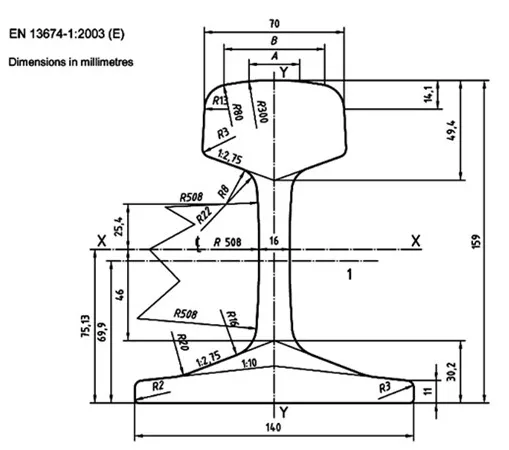
| Type of Rail | Standard | Dimensions (mm) | Section S | Mass m | ||||
| H | B | C | D | E | cm² | kg/m | ||
| European standard EN 13674-1 | ||||||||
| 54E1 (UIC54) | EN 13674 - 1 | 159,00 | 140,00 | 70,00 | 49,40 | 16,00 | 68,77 | 54,77 |
GNEE RAILWAY RAILWAYL produces uic54 rail profile and 54e1 rail with strict control of rolling precision and dimensional tolerance, ensuring stable load distribution and reliable track performance even under extreme stress. Our facility focuses on metallurgical consistency across all batches, supporting long-term stability and reduced maintenance costs for large-scale engineering projects.
What is the Maximum Load Capacity of UIC54 Steel Rail?
The load capacity of a rail is primarily measured by the "axle load," which refers to the maximum weight a single pair of wheels can exert on the track. For the uic54 rail specification, the standard allowable axle load typically falls between 22.5 tons and 25 tons, depending on the specific track design and speed requirements. This capacity allows the rail 54e1 to handle everything from standard passenger carriages to heavy-load freight wagons without risking permanent deformation.
The physical geometry of the uic54 rail dimensions is a major factor in how it manages and distributes weight across the track bed. With a height of 159 mm and a base width of 140 mm, the profile is specifically engineered to resist vertical bending and lateral tipping. A wider base ensures that the pressure from a 25-ton axle load is spread over a larger surface area on the sleeper, preventing localized crushing or instability.
The technical design of the 54e1 rail profile includes several critical measurements that contribute to its strength:

- Head Width: The 70 mm head provides an optimal contact patch for wheels, reducing the "hertzian" contact stress that causes metal fatigue.
- Web Thickness: A 16 mm web provides the vertical stiffness necessary to support heavy loads without buckling under pressure.
- Section Modulus: This geometric value determines how well the uic54 resists bending; the UIC54 profile offers a high section modulus relative to its weight.
- Inertia Moment: The distribution of steel in the profile ensures that the rail 54e1 can bridge the gap between sleepers while maintaining a flat, level running surface.
Impact of Steel Grades on Load Performance
While the shape of the uic54 provides the framework, the actual load-bearing "limit" is often determined by the grade of steel used in the manufacturing process. According to the uic54 rail specification, different grades like R260, R320Cr, or heat-treated R350HT offer varying levels of hardness and tensile strength. A higher steel grade allows the rail to endure more "load cycles" before microscopic cracks begin to form, extending the service life of the track.
Choosing the right grade for your 54e1 rail profile depends on the expected traffic density:
- R260 Grade: The standard grade for most passenger and general freight lines, providing excellent weldability and sufficient strength for standard axle loads.
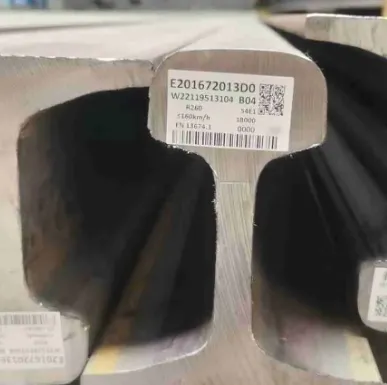
| R260 | Mechanical Property | Chemical Composition | |||||||||||
| Yield strength | Tensile strength | Elongation | Hardness | C | Si | Mn | S | P | H ppm | O ppm | |||
| MPa | kg/mm² | MPa | kg/mm² | min | HB | ≤ | ≤ | ≤ | ≤ | ||||
| ≥880 | 10% | 260-300 | 0.62-0.80 | 0.15-0.58 | 0.70-1.20 | 0.025 | 0.025 | 2.5 | 20 | ||||
- R350HT (Heat Treated): Used in heavy-haul sections or sharp curves where the uic54 rail dimensions are subjected to extreme wear and higher-than-average pressure.
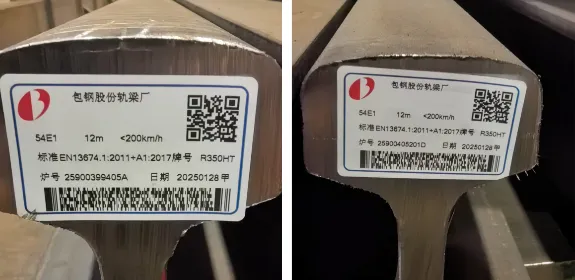
| R350HT | Mechanical Property | Chemical Composition | |||||||||||
| Yield strength | Tensile strength | Elongation | Hardness | C | Si | Mn | S | P | H ppm | O ppm | |||
| MPa | kg/mm² | MPa | kg/mm² | min | HB | ≤ | ≤ | ≤ | ≤ | ||||
| ≥1175 | 9% | 350-390 | 0.72-0.80 | 0.15-0.58 | 0.70-1.20 | 0.025 | 0.020 | 2.5 | 20 | ||||
- Hardness Levels: Higher Brinell hardness (HBW) in premium grades prevents the rail head from "mushrooming" or flattening under the weight of heavy freight.
- Fatigue Resistance: Specialized alloys can be added to the rail 54e1 to improve resistance to rolling contact fatigue (RCF), which is common in high-traffic corridors.
Safety Margins and Environmental Factors
In real-world applications, the maximum load capacity of the uic54 rail is also influenced by environmental conditions and maintenance standards. Temperature fluctuations can cause the steel to expand or contract, creating internal stresses that subtract from the rail's ability to carry external loads. Furthermore, a well-maintained track with precise alignment ensures that the load is always centered on the uic54 rail profile, preventing uneven wear that could lead to premature failure.
Reliable load performance requires a holistic approach to the uic54 rail specification:
- Temperature Neutralization: Using rail anchors and tensioning techniques ensures that the rail 54e1 does not buckle during extreme summer heat or snap in winter cold.
- Corrosion Protection: In coastal or industrial areas, corrosion can thin the web of the uic54, reducing its load-bearing cross-section over time.
- Regular Grinding: Maintaining the correct 54e1 rail profile through rail grinding ensures that wheel contact remains optimal, preventing stress concentrations.
- Ultrasonic Testing: Regular inspections allow operators to find internal defects before they reach a critical size that would compromise the load capacity.
GNEE RAILWAY RAILWAYL produces UIC54 rail and 54E1 rail profile with strict control of rolling precision and dimensional tolerance, ensuring stable load distribution and reliable track performance. With flexible production and processing capabilities, we help meet different project requirements, whether you need standard R260 grades or high-strength heat-treated options. Because we operate as a dedicated manufacturer, we can guarantee that the metallurgical properties of every 54e1 rail are optimized for the specific environmental and load conditions of your project.
If you need technical details or application support regarding load limits, you can contact us to get UIC54 rail solutions, and we will provide the right options based on your project conditions.


