

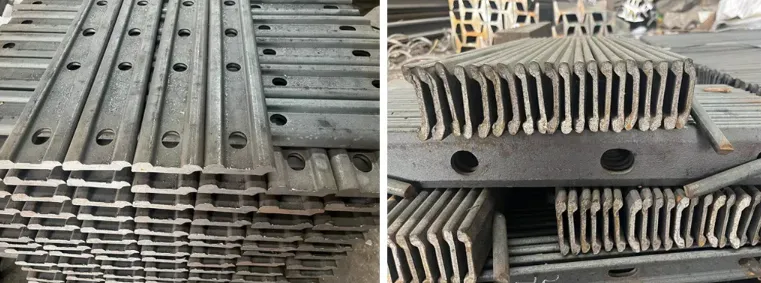
A rail fish plate is a joint reinforcement device that prevents differential movement between adjacent rail sections, ensuring consistent track stiffness and reliable wheel–rail interaction. GNEE RAILWAY RAILWAYL provides fish plates for GB light and heavy rails, UIC rails, DIN536 and QU crane rails, JIS rail profiles, AS1085 rails, BS11 standards, and AREMA/ASCE rails, with dimensional verification before shipment.
What is the size of a FishPlate?
Fishplates (or joint bars) vary in size based on the rail type, typically ranging from 600mm to 1000mm in length, with 4 or 6 bolt holes for securing railway tracks. Standard sizes often fit specific rail profiles, such as 305mm x 127mm x 38mm for certain railway lines, or 406.4mm for specific 75A-80A rail types.
Common Railway Fishplate Sizes and Types
- Lengths: Commonly 600mm to 1000mm, though specialized or shorter, robust versions exist (e.g., 300mm to 406mm).
- Weights/Rail Match: Fishplates are matched to rail weight, such as 43kg, 50kg, 60kg, or 75kg rails.
- Holes: Usually 4 or 6 holes for bolts, with diameters around22mm−25mmfor standard rail gauges.
| Standard | Type | Length/Diameter | Weight /Material | |
|---|---|---|---|---|
| AREMA 2007 | 115RE | 4 hole-24" | 17.04Kg | 45# chemical |
| 115RE | 6 hole-36" | 25.56Kg | composition(%): | |
| 132-136RE | 4 hole-24" | 17.75Kg | C: 0.42-0.50 | |
| 132-136RE | 6 hole-36" | 26.63Kg | Mn: 0.50-0.80 | |
| UIC864 | UIC60 | 4 hole-630/Φ26 | 18.07Kg | Si: 0.17-0.37 |
| UIC60 | 4 hole-600/Φ28 | 17.47Kg | Cr: ≤0.25 | |
| UIC60 | 4 hole-630/Φ25 | 18.1Kg | P: ≤0.035 | |
| UIC54 | 4 hole | 14.34Kg | S: ≤0.035 | |
| UIC54 | 6 hole-800 | 19.94Kg | ||
| BS 47-1 | BS75R | 4 hole | 6.56Kg | |
| BS60A | 4 hole | 5.61Kg | ||
| BS80A | 4 hole | 6.5Kg | ||
| BS90A | 685.8/Φ26 | 13.23Kg | 50# chemical | |
| BS90A | 792.9/Φ26.2 | 15.34Kg | composition(%): | |
| BS100A | 4 hole | C: 0.62-0.70 | ||
| 90/91LB | 4 hole | 18.08Kg | Mn: 0.50-0.80 | |
| 90/91LB | 6 hole | 19.9Kg | Si: 0.17-0.37 | |
| AS | 50kg | 4 hole | 14.3Kg | Cr: ≤0.25 |
| 50kg | 6 hole | 19.5Kg | P: ≤0.035 | |
| S49 | 4 hole | 9.71Kg | S: ≤0.035 |
What is the difference between a 4-hole and a 6-hole rail joint?
4-hole and 6-hole rail joints (fishplates) differ primarily in length, strength, and application. 4-hole joints (typically 24 inches) are shorter, lighter, and used for standard or lighter loads. 6-hole joints (typically 36 inches) are longer, providing greater vertical stability, higher clamping force, and are preferred for heavy-duty, high-speed, or continuous welded rail (CWR).

- Length: 4-hole plates are shorter (usually 24 inches), while 6-hole plates are longer (usually 36 inches).
- Strength & Stability: 6-hole plates offer increased stability, better vertical support, and improved clamping force, making them more durable.
- Application: 4-hole joints are used for standard or lighter loads. 6-hole joints are used for heavy-duty or high-speed traffic.
- Usage in CWR: 6-hole joints are often required for temporary joints in Continuous Welded Rail (CWR) to meet safety standards.
- Weight: 6-hole joints are heavier; for example, 50kg rail joints with 6 holes weigh 19.5 kg compared to 14.3 kg for 4-hole joints.
What is the function of a rail joint bar?
A rail joint bar (or fishplate) connects two rail ends, ensuring structural continuity, proper alignment, and stability for safe train operations. It acts as a bridge that supports the load, reduces impact forces from wheels at joints, and allows for expansion/contraction due to temperature changes.

- Structural Connection: Securely bolts rail ends together to form a continuous track.
- Load Distribution: Distributes the weight of trains across the joints to minimize stress on individual rail ends.
- Alignment Maintenance: Keeps rails aligned vertically and horizontally, reducing wheel impact, noise, and vibration.
- Expansion Allowance: Allows necessary movement for thermal expansion and contraction, preventing track buckling.
- Safety Assurance: Prevents rail separation, crucial for both light and heavy rail infrastructure stability.
Founded in 2008, GNEE RAILWAY RAILWAYL is a leading global manufacturer and supplier of railway components, specializing in high-quality rail fish plates (joint bars/splice bars) with strong production capacity and global service capabilities.
Our rail fish plate portfolio is comprehensive and compliant with international standards including UIC, AREMA, BS, DIN, and GB, covering light rail (8kg-30kg), heavy rail (38kg-75kg), and crane rail (QU70-QU120) systems. We offer diverse types such as insulated joint bars, bulged fish plates, and compromise rail joints,with precise specifications (4-hole/6-hole, 24-inch/36-inch), ensuring excellent mechanical performance.We uphold strict quality control supported by ISO 9001:2015 certification, an in-house inspection center, and third-party audits by SGS and BV. Our one-stop service includes customization, production, packaging, and after-sales support, tailored to clients' project needs.
Click here to obtain the detailed product catalog of GNEE RAILWAY RAILWAYL.


