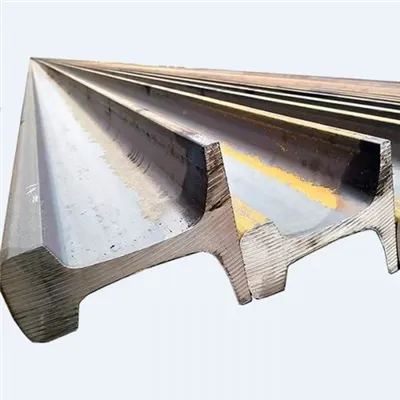
Standard Definition & Scope: Industrial DIN (Deutsches Institut für Normung) steel track standards specify heavy-load crane rails (DIN 536-1) and vignole-type light/transit tracks (DIN 5901).
Heavy-duty DIN track products are categorized as follows:
DIN 536 Crane Rails (A-Series): Special wide-base, thick-web profiles engineered for high wheel loads from overhead cranes, gantry systems, and port container spreaders (A45, A55, A65, A75, A100, A120, A150). The numeric designation represents the rail head width in millimeters.
DIN 5901 Steel & Light Rails (S-Series): Flat-bottom (Vignole) profiles designed for industrial haulage, mining tracks, automated warehousing (AS/RS), and ground transfer cars (S10, S14, S18, S20, S24, S30, S33, S49). The numeric designation denotes the nominal calculated mass in kilograms per meter (kg/m).
1. Overview of DIN Steel Rail Standards: DIN 536 vs. DIN 5901
German DIN standards define the profile geometry, dimensions, tolerances, and technical requirements of steel rails. DIN 536 is commonly associated with crane rails for crane runways and heavy-duty material handling, while DIN 5901 covers light rail profiles for industrial track applications.

| Technical Parameter | DIN 536-1 Crane Rail (A-Series) | DIN 5901 Steel/Light Rail (S-Series) |
|---|---|---|
| Profile Geometry | Squat cross-section, low center of gravity, extra-thick web, wide flat head, massive base flange. | Tall Vignole (T-section) profile, slender web, crown-radiused head, standard base width. |
| Primary Load Dynamic | High static & dynamic vertical wheel loads combined with high lateral side-thrust forces. | Continuous vertical rolling loads with longitudinal tractive forces; lower lateral shock loads. |
| Target Application | Overhead traveling (EOT) cranes, container STS/RMG cranes, shipyard gantry cranes, heavy launch tracks. | Underground mine haulage, industrial plant sidings, light railway transit, AS/RS automated shuttle tracks. |
| Key Dimension Standard | Designated by Head Width (in mm): e.g., A100 = 100 mm head width. | Designated by Linear Mass (in kg/m): e.g., S30 = 30.03 kg/m. |
The two standards should not be treated as interchangeable. When selecting a DIN steel rail, buyers should confirm the standard, rail profile, dimensions, weight per metre, steel grade, and application requirements.
Important: "DIN rail" can also refer to DIN EN 60715 electrical mounting rails, such as 35 mm top-hat rails used in control cabinets. These are completely different from DIN 536 and DIN 5901 steel rails.
Get a DIN Rail Quote from GNEE RAILWAY RAILWAYL
GNEE RAILWAY RAILWAYL supplies DIN 536 crane rails and DIN 5901 light rails, with different profiles, steel grades, lengths, and processing options available for crane runway and industrial track projects. Rail fastening components, inspection documents, customized packaging, and export shipping can also be provided as part of a complete rail solution.
2. DIN 536 Crane Rail Sizes & Dimensions (A-Series: A45 to A150)
DIN 536 crane rails are standardized flat-bottom rail profiles commonly designated from A45 to A150. The A-number identifies the rail profile and is closely related to its nominal dimensions and weight per metre.
For procurement, the key dimensions include:
- Head width (k): Width of the rail running surface in contact with the crane wheel.
- Total height (h): Overall height from the rail base to the top of the rail head.
- Base width (b): Width of the rail foot that transfers wheel loads to the supporting structure.
- Web thickness (s): Thickness of the vertical web between the rail head and base.
Complete DIN 536-1 Dimension & Weight Chart

| Profile | Head Width [mm] |
Total Height [mm] |
Base Width [mm] |
Web Thick [mm] |
Head Depth [mm] |
Base Thick [mm] |
Linear Mass [kg/m] |
I_x [cm⁴] |
W_x [cm³] |
|---|---|---|---|---|---|---|---|---|---|
| A45 | 45.0 | 55.0 | 125.0 | 24.0 | 24.0 | 11.0 | 22.10 | 90.3 | 25.5 |
| A55 | 55.0 | 65.0 | 150.0 | 31.0 | 28.5 | 12.5 | 31.80 | 178.0 | 42.7 |
| A65 | 65.0 | 75.0 | 175.0 | 38.0 | 34.0 | 14.0 | 43.10 | 326.0 | 67.1 |
| A75 | 75.0 | 85.0 | 200.0 | 45.0 | 39.5 | 15.5 | 56.20 | 572.0 | 105.0 |
| A100 | 100.0 | 95.0 | 200.0 | 60.0 | 45.5 | 16.5 | 74.30 | 894.0 | 165.0 |
| A120 | 120.0 | 105.0 | 220.0 | 72.0 | 55.5 | 20.0 | 100.00 | 1360.0 | 246.0 |
| A150 | 150.0 | 150.0 | 220.0 | 80.0 | 65.5 | 25.0 | 150.30 | 3660.0 | 488.0 |
3. DIN 5901 Light & Railway Rail Sizes (S-Series)
DIN 5901 covers light rail profiles used for industrial track and material-handling applications. The S-series includes profiles such as S10, S14, S18, S20, S24, and S30, with each designation corresponding to a specific rail profile and nominal weight.
Complete DIN 5901 Dimension & Specification Table

| Profile Name | Total Height [mm] |
Base Width [mm] |
Head Width [mm] |
Web Thickness [mm] |
Calculated Mass [kg/m] |
Standard Supply Lengths [m] |
|---|---|---|---|---|---|---|
| S10 | 70.0 | 58.0 | 32.0 | 6.0 | 10.00 | 6.0 / 8.0 |
| S14 | 80.0 | 70.0 | 38.0 | 7.0 | 14.00 | 6.0 / 8.0 / 10.0 |
| S18 | 93.0 | 82.0 | 43.0 | 8.0 | 18.30 | 8.0 / 10.0 / 12.0 |
| S20 | 100.0 | 82.0 | 44.0 | 7.0 | 19.80 | 8.0 / 10.0 / 12.0 |
| S24 | 115.0 | 90.0 | 53.0 | 10.0 | 24.40 | 8.0 / 10.0 / 12.0 |
| S30 | 108.0 | 100.0 | 60.3 | 12.3 | 30.03 | 10.0 / 12.0 / 12.5 |
| S33 | 134.0 | 105.0 | 58.0 | 11.0 | 33.47 | 10.0 / 12.0 / 12.5 |
| S49 (49E1) | 149.0 | 125.0 | 67.0 | 14.0 | 49.43 | 12.0 / 18.0 / 24.0 |
4. How to Select the Right DIN Rail Size for Your Project
The right DIN rail size depends on the applicable standard, wheel load, wheel diameter, operating conditions, and rail support configuration. For DIN 536 crane rails, profiles from A45 to A150 are selected according to load requirements and project design.
Support conditions, rail spacing, fastening method, and allowable deflection should also be considered. GNEE RAILWAY RAILWAYL can provide DIN rail profiles with the required steel grade, length, quantity, support configuration, and joint or welding requirements for different industrial and crane applications.
5. GNEE RAILWAY RAILWAYL: Complete DIN Rail Supply and Quality Assurance
GNEE RAILWAY RAILWAYL provides complete rail and fastening solutions for DIN 536 and DIN 5901 applications, covering crane rails, light rails, rail clips, elastic rail pads, fishplates, bolts, and related accessories. Matching rail profiles and fastening components can be supplied as a complete package to simplify project sourcing and ensure compatibility.


GNEE RAILWAY RAILWAYL supports customized requirements for rail profile, steel grade, length, fastening configuration, surface treatment, packaging, and inspection. Quality control covers chemical composition, mechanical properties, dimensional inspection, surface condition, and internal quality according to the applicable product and project requirements.


For international projects, EN 10204 3.1 inspection certificates and third-party inspection by organizations such as SGS, BV, TÜV, or Intertek can be arranged when required. GNEE RAILWAY RAILWAYL also provides export packaging, corrosion protection, container loading, and breakbulk shipping solutions for both standard and project-length rails.
With integrated DIN rail manufacturing, fastening supply, quality inspection, and export logistics, GNEE RAILWAY RAILWAYL provides a complete solution for crane runway, industrial track, and material-handling projects.
7. Frequently Asked Questions (FAQ)
Q1: What does A100 mean in DIN crane rails?
A: A100 is a DIN 536 crane rail profile designation, referring to a rail profile with a nominal head width of about 100 mm.
Q2: What is the difference between DIN 536 and UIC60 rails?
A: DIN 536 rails are designed mainly for crane runways, while UIC60 is a railway rail profile for railway track systems.
Q3: Can DIN 5901 rails be used for cranes?
A: DIN 5901 light rails can suit light-duty industrial applications. DIN 536 profiles are generally used for heavier crane runway applications.
Q4: Which steel grade is suitable for heavy-duty cranes?
A: The required steel grade depends on wheel load, operating frequency, wear requirements, and project specifications.
Q5: Can GNEE RAILWAY RAILWAYL supply custom-length DIN rails?
A: Yes. GNEE RAILWAY RAILWAYL provides custom-length cutting, drilling, inspection documents, packaging, and export shipping according to project requirements.