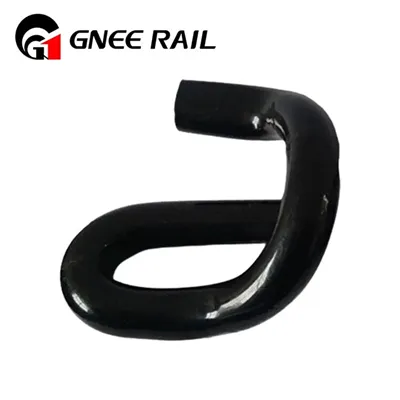
What are the two types of rail spikes?
The two main types of rail spikes are dog spikes and screw spikes, both of which are used to fasten rails to railway sleepers. Dog spikes have a distinctive "dog's head" shape with two lugs, while screw spikes feature a threaded body for a more secure grip.
- Dog spikes: These are the traditional and most common type of rail spike. They have a pointed, chisel-shaped tip and a flat-edged head with two lugs on either side, which resembles a dog's head.

| Specification | Material | Surface | Standard |
|---|---|---|---|
| 5/8×6 '' | A3,Q235, 45#,55#, etc | According to customer needs. | According to customer's drawings or samples. |
| 9/16×5-1/2 '' | |||
| 3/8''×3-1/2 '' | |||
| 1/2×3-1/2 | |||
| Other kinds |
- Screw spikes: Also called rail screw spikes, these are used for greater holding power. They have a threaded body that is screwed into the wooden sleepers for a more secure fastening than a dog spike, which is hammered in.

| the types of Ss Series Sleeper Screw | Product Name | Specification | Material | Surface | Standard | |
| 1 | Fishtail Bolt | M8-M64 | Q235,45#,55#,etc | Zinc,Plain, Black Oil | UIC,AREMA,JIS,GB or according to your requests. | |
| 2 | Screw Spike | Square Head Screw Spike | M16-M22 *145-200 | |||
| Hexagon Head Screw Spike | ||||||
| Other Types | ||||||
| Type | Specification | Weight/kg | Surface | Standard | ||
| 3 | Sleeper Screw | Ss 1/130 | M22*130 | 0.451 | Zinc,Plain, Black Oil | UIC,AREMA,JIS,GB or according to your requests. |
| Ss 1/150 | M22*150 | 0.478 | ||||
| Ss 2/180 | M22*180 | 0.595 | ||||
| Ss 5/150 | M24*150 | 0.545 | ||||
| Ss 6/130 | M26*130 | 0.658 | ||||
| Ss 6/150 | M26*150 | 0.702 | ||||
| Ss 6/170 | M26*170 | 0.385 | ||||
| Ss 7/180 | M24*180 | 0.636 | ||||
| Ss 8/140 | M24*140 | 0.528 | ||||
| Ss 8/150 | M24*150 | 0.548 | ||||
| Ss 8/160 | M24*160 | 0.568 | ||||
| Ss 23/160 | M23*160 | 0.645 | ||||
| Ss 24/165 | M24*165 | 0.59 | ||||
| Ss 25/165 | M25*165 | 0.625 | ||||
Comparison of dog spikes and screw spikes
- Surface:The screw spikes are the railroad spikes with the screw thread on the surface. But as to the dog spikes, it has a pointed penetrating head with a smooth suface.

- Power:As to the holding power, the screw spikes can provide more than twice of the power than the dog spikes.
- Cost:Because of the greater fixing power and the feature that can be combined with spring washers, the cost of manufacture of the screw spike is higher than the dog spikes or dog nails.
Frequently Asked Questions
Why are rail spikes driven at specific angles?
Rail spikes are driven perpendicular to wood grain and slightly angled inward toward the rail to maximize holding power. This orientation prevents splitting along grain lines while creating mechanical resistance against outward rail forces during thermal expansion and train passage.

How many spikes are typically used per rail tie?
Standard practice uses four spikes per tie on tangent (straight) track-two per rail on alternating sides. Curved sections may require six to eight spikes per tie to resist additional lateral forces, with extra spikes on the outside rail where forces are greatest.

What is the holding power of a properly installed rail spike?
A correctly installed rail spike in sound timber provides approximately 5,000-7,000 pounds of withdrawal resistance. This holding power decreases over time due to wood degradation, spike loosening from vibration, and seasonal wood expansion and contraction cycles.
GNEE RAILWAY RAILWAYL offers different kinds of railway fasteners to meet client's requirements, such as Elastic Rail Clip and Clamp, Rail Screw Spike, Plastic Dowel, High Tensile Track Bolt with Nut, Rail Base(Tie) Plate, Rail Fish Plate, Railway Shoulder(Insert), Fish Bolt, Railroad Rubber and EVA Pad, etc. Samples and drawings provided by customer, we will manufacture qualified products accordingly.