

A rail fish plate is a joint component designed to prevent excessive stress concentration at rail ends by spreading loads over a longer effective length of rail. GNEE RAILWAY RAILWAYL manufactures fish plates for GB rails, UIC rails, DIN536 and QU crane rails, JIS profiles, AS1085 rail types, BS11 standards, and AREMA/ASCE systems, providing customized drilling and coating options.

| Standard | Type | Length/Diameter | Weight /Material | |
| AREMA 2007 | 115RE | 4 hole-24" | 17.04Kg | 45# chemical |
| 115RE | 6 hole-36" | 25.56Kg | composition(%): | |
| 132-136RE | 4 hole-24" | 17.75Kg | C: 0.42-0.50 | |
| 132-136RE | 6 hole-36" | 26.63Kg | Mn: 0.50-0.80 | |
| UIC864 | UIC60 | 4 hole-630/Φ26 | 18.07Kg | Si: 0.17-0.37 |
| UIC60 | 4 hole-600/Φ28 | 17.47Kg | Cr: ≤0.25 | |
| UIC60 | 4 hole-630/Φ25 | 18.1Kg | P: ≤0.035 | |
| UIC54 | 4 hole | 14.34Kg | S: ≤0.035 | |
| UIC54 | 6 hole-800 | 19.94Kg | ||
| BS 47-1 | BS75R | 4 hole | 6.56Kg | |
| BS60A | 4 hole | 5.61Kg | ||
| BS80A | 4 hole | 6.5Kg | ||
| BS90A | 685.8/Φ26 | 13.23Kg | 50# chemical | |
| BS90A | 792.9/Φ26.2 | 15.34Kg | composition(%): | |
| BS100A | 4 hole | C: 0.62-0.70 | ||
| 90/91LB | 4 hole | 18.08Kg | Mn: 0.50-0.80 | |
| 90/91LB | 6 hole | 19.9Kg | Si: 0.17-0.37 | |
| AS | 50kg | 4 hole | 14.3Kg | Cr: ≤0.25 |
| 50kg | 6 hole | 19.5Kg | P: ≤0.035 | |
| S49 | 4 hole | 9.71Kg | S: ≤0.035 |
What if the rail joint pulls apart and you can't get the bolts in?
When a rail joint pulls apart due to cold weather or rail movement, and the bolts cannot be reinstalled, the gap must be closed to safely restore service. Common methods include heating the rail with a "Fire-Snake" to expand it, using track jacks to pull the rails together, installing a "Dutchman" (short rail filler), or replacing the rail.
Emergency Fixes and Techniques:
- Heating (Fire-Snake/Kerosene Rope): In cold weather, expansion is needed. A common method is placing oil-soaked rags or a "Fire-Snake" (heating tool) alongside the rail to heat it, causing it to expand enough to reconnect the joint.
- Mechanical Pulling: Track jacks or mechanical rail expanders/pullers are used to pull the rail ends back together, often referred to as "driving the rail home".
- Dutchman/Rail Filler: If the gap is too large to close, a "Dutchman" (a small piece of rail cut to size) is installed to fill the gap.

- Slotted Joint Bars: If conventional bolts won't fit, specially designed slotted joint bars can be used for temporary, stronger reinforcement.
- Rail Splints: Used as a temporary fix to bridge broken or separated joints, particularly when the rail cannot be immediately repaired.
Important Safety Considerations:
- Any gap over 5/8" requires immediate inspection and action.
- Ensure the joint is properly supported, as gap issues can cause broken joint bars.
- If repairs cannot be made immediately, the track must be protected (e.g., slow orders) to prevent derailment.
What are the functions of a rail joint and a railfish bolt?
Rail joints (fishplates) and railfish bolts connect rail ends to maintain a continuous, aligned track, allowing for thermal expansion while resisting vertical/lateral forces. They ensure structural integrity, prevent rail buckling, and facilitate easy maintenance, with bolts securing the plates against the rail web to provide strength.
Functions of a Rail Joint (Fishplate)
- Ensures Continuity: Connects two rail ends to allow smooth train passage.
- Maintains Alignment: Keeps rail ends at the same vertical and horizontal level.
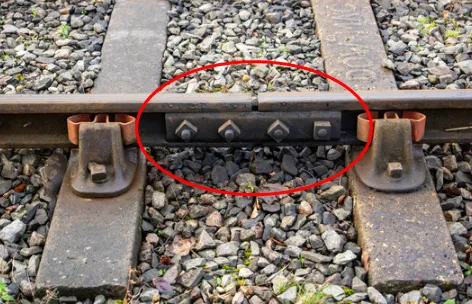
- Permits Expansion/Contraction: Provides space for rails to move due to temperature changes.
- Strengthens Connections: Resists shear forces and longitudinal/lateral loads.
- Compromise Joints: Specific joints connect different rail profiles.
Functions of a Rail Fish Bolt
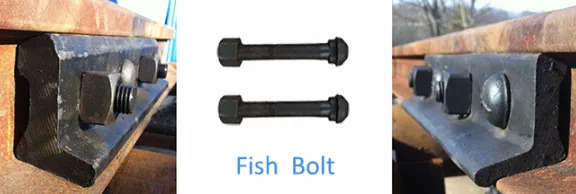
- Fastens Components: Securely connects the fishplates to the rails.
- Prevents Rotation: Often features an oval neck to prevent turning when torque is applied.

- Ensures Stability: Paired with spring washers to prevent loosening under vibrations.
- High Strength: Made of high-carbon or alloy steel to withstand heavy loads.
| Railway Fish bolt | ||||
| Grade | 4.6 | 5.6 | 8.8 | 10.9 |
| Material | Q235 | 35# | 45# | 40Cr |
| Mechanical properties | Tensile strength: ≥400Mpa | Tensile strength: ≥500Mpa | Tensile strength:≥800Mpa | Tensile strength: ≥1000Mpa |
| Yield strength:≥240Mpa | Yield strength:≥300Mpa | Yield strength:≥640Mpa | Yield strength:≥900Mpa | |
| Elongation:≥22% | Elongation:≥20% | Elongation:≥12% | Elongation:≥9% | |
| Cold bending: | Cold bending: | Cold bending: | Cold bending: | |
| 90 degree without crac | 90 degree without crac | 90 degree without crac | 90 degree without crac | |
| Surface | plain (oiled), Oxide black, Zinc, HDG, wax, bitumen, Dacromet, Sherardizing | |||
| Standard refers | UIC864-2 | |||
Founded in 2008, GNEE RAILWAY RAILWAYL is a leading global manufacturer and supplier of railway components, specializing in high-quality rail fish plates (joint bars/splice bars) with strong production capacity and global service capabilities.
Our rail fish plate portfolio is comprehensive and compliant with international standards including UIC, AREMA, BS, DIN, and GB, covering light rail (8kg-30kg), heavy rail (38kg-75kg), and crane rail (QU70-QU120) systems. We offer diverse types such as insulated joint bars, bulged fish plates, and compromise rail joints,with precise specifications (4-hole/6-hole, 24-inch/36-inch), ensuring excellent mechanical performance.We uphold strict quality control supported by ISO 9001:2015 certification, an in-house inspection center, and third-party audits by SGS and BV. Our one-stop service includes customization, production, packaging, and after-sales support, tailored to clients' project needs.
Click here to obtain the detailed product catalog of GNEE RAILWAY RAILWAYL.


