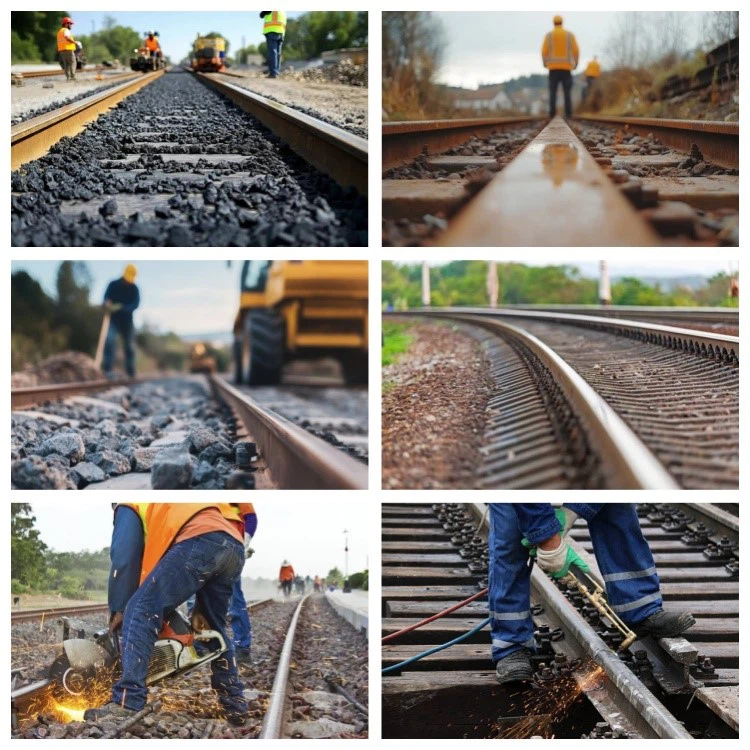
Classification and development of rails
Rails are the main components of railway tracks. Their function is to guide the wheels of locomotives and vehicles forward, bear the huge pressure of the wheels, and transmit it to the sleepers. Rails must provide a continuous, smooth and least resistant rolling surface for the wheels. In electrified railways or automatic block sections, rails can also be used as track circuits.
Rails, as the basic material for railway construction, have many types and different performances. Rails are an important part of the railway system and bear the weight of the train. Its quality directly affects the safety and stability of the railway system.
Rails, as a key component that carries the weight of the train, its quality is directly related to the safety and stability of the railway line. According to different classification standards, rails can be divided into ordinary rails, heavy rails, light rails and special rails.
Ordinary rails are suitable for ordinary railways, with low cost and wide use; while heavy rails are often used for lines carrying heavy-load trains, and their strength and wear resistance requirements are higher.

In addition, light rails and special rails also play an indispensable role in specific occasions. Light rail is commonly used in mining and forestry, and special rails such as conductive and crane rails are used in specific environments. Conductive rails are designed for underground railways and require good conductivity. They are made of high-quality low-carbon aluminum-killed steel. Crane rails are special cross-section rails with similar chemical composition and manufacturing process to railway rails. There are varieties such as QU70 and QU80.
Finally, we summarize the importance of rail selection and point out the development trend of railway rails in the future. Rail development needs to adapt to the needs of heavy load and high-speed development of railways. Today, when railway construction is becoming increasingly important, the choice of rails is not only related to the cost and progress of the project, but also directly affects the safety and operational efficiency of the railway line. Therefore, it is crucial for railway builders to have a deep understanding of the characteristics and applications of various rails. At the same time, with the advancement of science and technology and the continuous development of materials science, the performance of railway rails will be even better in the future, providing strong support for the prosperity and development of the railway industry.