Do you know about railway tracks?
Railway tracks are referred to as rails, rails, tracks, etc. They are mainly used on railways and work with switches to allow trains to travel without turning.
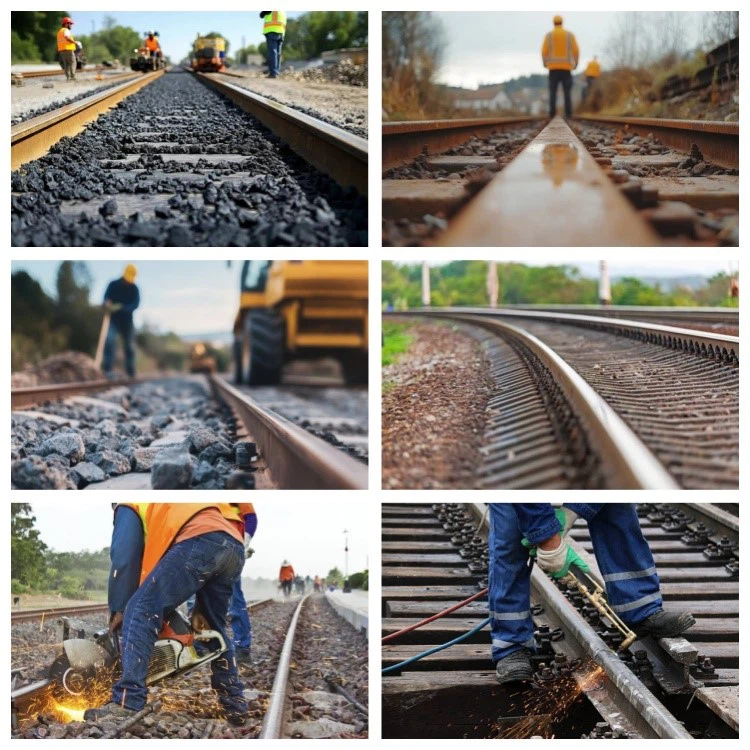
Railway tracks are usually composed of two parallel steel rails, which are fixed on sleepers, and ballast is under the sleepers. They are fastened by rail supports, fasteners, rail clamps, track splints, spring bars, rail spikes and other railway accessories.
Railway tracks are made of steel and can bear greater weight than other materials. Sleepers are also called sleepers, ash sleepers, or road sleepers. Their function is to distribute the weight of the rails and the pressure on the rails, and to maintain a fixed gauge to maintain the gauge of the rails. From the original wooden sleepers, they were changed to concrete sleepers.
The track bears a variety of vertical, lateral, and longitudinal static and dynamic loads. The load is transmitted from the rails through the sleepers and the roadbed to the roadbed. Through mechanical theory, the stress and strain generated by each component of the track under various load conditions are analyzed and studied to determine its bearing capacity and stability.

Track mechanics analyzes the stress and deformation of track structures under the action of locomotives and vehicles, as well as the impact of track structural diseases on track damage and train operation, providing a basis for designing track structures and formulating track management standards.
Tracks are composed of ballast, sleepers, rails, connecting parts, anti-climbing equipment and turnouts. The original rails were cast iron rails, and then developed into I-shaped rails. In the 1980s, the standard track gauge used by most railways in the world (see the geometry of railway tracks) was 1435 mm (4 feet 8½ inches). Narrower than this is called narrow-gauge railway, and wider than this is called wide-gauge railway (see railway engineering).
The ballast is laid directly on the roadbed surface, and the ballast is made of materials such as crushed stone, pebbles, and slag. Rails, sleepers, and ballast are materials with different mechanical properties, combined in different ways. Generally speaking, the bottom of the track is the ballast, which provides elasticity and drainage functions for the track. Rails can also be laid on a concrete base (quite common on bridges) or even embedded in concrete.
The sleepers are buried in the ballast bed, usually laid horizontally, and made of wood, reinforced concrete or steel.
The rails are fastened to the sleepers with connecting parts.