Railway Equipment-Rails
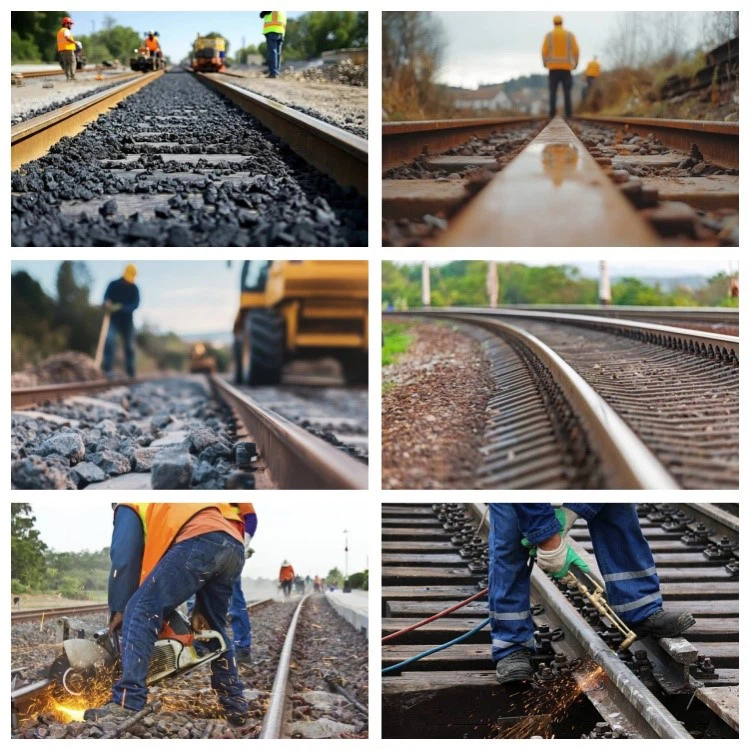
Railway accessories are the components of railway lines. The tracks here refer to rails, sleepers, connecting parts, ballast beds, anti-climbing equipment, rail supports and turnouts. As an integral engineering structure, the track is laid on the roadbed, plays a guiding role in the operation of trains, and directly bears the huge pressure of locomotives and their loads. Under the dynamic action of train operation, its various components must have sufficient strength and stability to ensure that the train runs safely, smoothly and uninterruptedly at the specified maximum speed.
Railway accessories are components of railway lines. The tracks referred to here include rails, sleepers, connecting parts, ballast beds, anti-climbing equipment, rail supports and turnouts. As an integral engineering structure, the track is laid on the roadbed, plays a guiding role in the operation of trains, and directly bears the huge pressure of locomotives and vehicles and their loads. Under the dynamic action of the train operation, its various components must have sufficient strength and stability to ensure that the train runs safely, smoothly and uninterruptedly at the prescribed maximum speed.
Railway equipment is an important railway equipment, and rails are the main symbol of railway equipment.
A-Rail height B-Bottom width C-Head width D-Waist thickness
(1) Classification. Rails can be divided into heavy rails and light rails according to the approximate weight per meter in kilograms:
① Heavy rails. According to the type of steel used, they are divided into: ordinary manganese-containing rails, copper-containing ordinary carbon steel rails, high-silicon copper-containing steel rails, copper rails, manganese rails, silicon rails, etc. There are mainly three types: 38, 43, and 50kg. In addition, there are 45kg rails used on a few lines, and 60kg rails are planned for use on lines with large traffic and high speed. GB2585-81 stipulates the technical conditions for 38-50kg/m rails in my country.
② Light rail. There are mainly different rail types such as 9, 12, 15, 22, and 30.
(2) Manufacturing and use. Rails are rolled from carbon killed steel smelted in open hearth and oxygen converter. Its purpose is to withstand the operating pressure and impact load of locomotives and vehicles.
(3) Manufacturers and importing countries. The rails currently used in my country are mainly produced by some domestic steel mills, such as Anshan Iron and Steel, Wuhan Iron and Steel, etc. In addition, due to the large amount of use, it is still necessary to import some rails and rail accessories that meet the physical and chemical properties required by my country's technical standards and are determined according to relevant foreign standard methods. Imported production countries include Japan, Germany, France, Britain, Kazakhstan, Australia, etc.
2. Dimensions and specifications
The length and other geometric dimensions and tolerances of the rails shall be specified in the relevant standards for light and heavy rails in "8".
3. Appearance quality
(1) The rails shall be straight after rolling, without significant bending and twisting. The local bending and twisting of light and heavy rails and their correction deformation, the inclination of the rail end face, etc. shall not exceed the provisions of the standards.
(2) The surface of the rails shall be clean and smooth, without defects such as cracks, scars, scratches, etc.; the end faces shall not have shrinkage marks and interlayers, etc. The defects allowed on the overall surface of light and heavy rails and the degree of their geometric quantities shall not exceed the provisions of the standards.