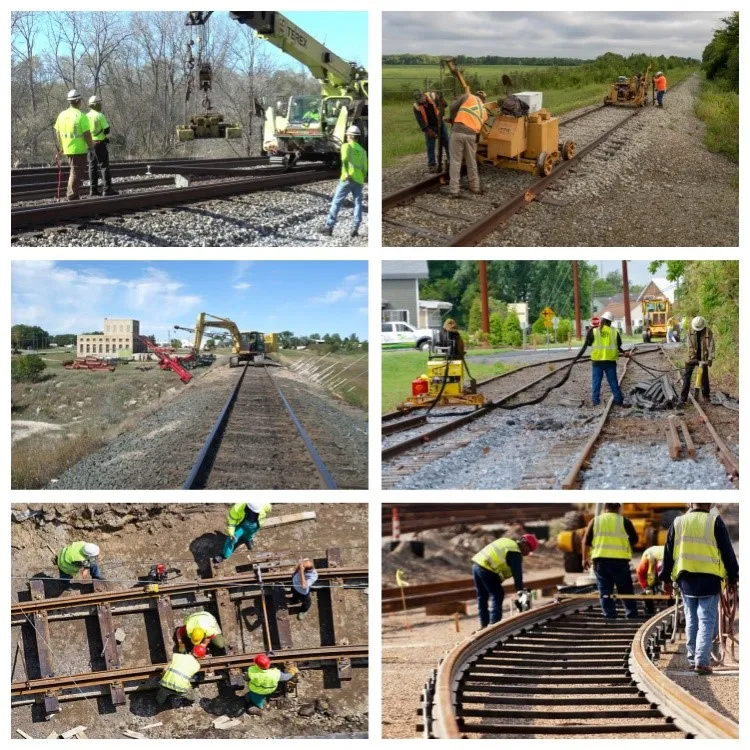
Railway accessories--Sleepers
It not only supports the rails, but also maintains the position of the rails, and also transfers the huge pressure transmitted by the rails to the roadbed. It must have a certain degree of flexibility and elasticity. It cannot be too hard or too soft. When the train passes, it can be deformed appropriately to buffer the pressure, but it must be restored to its original state as much as possible after the train passes. Sleepers include wooden sleepers and concrete sleepers.
1. Wood sleepers are sleepers made of wood. Also known as sleepers, anti-corrosion wooden sleepers, and oil-filled sleepers. Tough and elastic wood must be used to make wooden sleepers. Wooden sleepers can be divided into ordinary wooden sleepers, turnout sleepers, and bridge sleepers according to their uses. The standard length of ordinary wooden sleepers is 2.5 m, and its cross-sectional shape is divided into two categories, I and II, and is used on lines of different grades. The turnout sleepers used on turnouts have a wider cross-section than wooden sleepers, ranging from 2600mm to 4800mm, with a total of 12 types, each with a difference of 20mm in length. When used, they are selected in groups according to the actual width of the turnout. The cross-sectional dimensions of the sleepers used on bridges vary depending on the center spacing of the main beam (or longitudinal beam). Wooden sleepers have the advantages of good elasticity, easy processing, and convenient use. Since the establishment of railways, wooden sleepers have been the main type of sleepers. However, due to the material selection, the elasticity, strength and durability of wooden sleepers are not uniform, which will increase the wheel-rail dynamic effect, and a large amount of high-quality wood must be used. The service life of wooden sleepers is short, and there are many reasons for their failure, mainly decay, mechanical wear and cracking. Because wooden sleepers are easy to decay, they must be treated with anti-corrosion before they are put on the road. Wooden sleepers that have not been treated with anti-corrosion are called plain sleepers. China's wood resources are relatively scarce and expensive, and they have gradually been replaced by concrete sleepers on major trunk lines.
2. Concrete sleepers, including threaded spike structure, reinforcement, fasteners, gauge adjustment, height adjustment, characterized by: heightened shoulder concrete, thickened gauge baffle, thickened rubber pad, spiral ribbed steel bars arranged in a vertically staggered arrangement in the concrete sleeper, shear bars arranged at the end of the shoulder, the baffle seat and the grooves at both ends of the concrete sleeper shoulder coincide, and the gauge baffle is closely attached to the baffle seat.
3. Concrete sleepers, also known as concrete sleepers, of railway accessory sleepers have been widely used since World War II. The advantages of concrete sleepers are good stability, long service life, and low maintenance and repair costs; the disadvantages of concrete sleepers are heavy weight, poor elasticity and insulation performance, and a buffer insulation pad must be provided at the bottom of the rail.