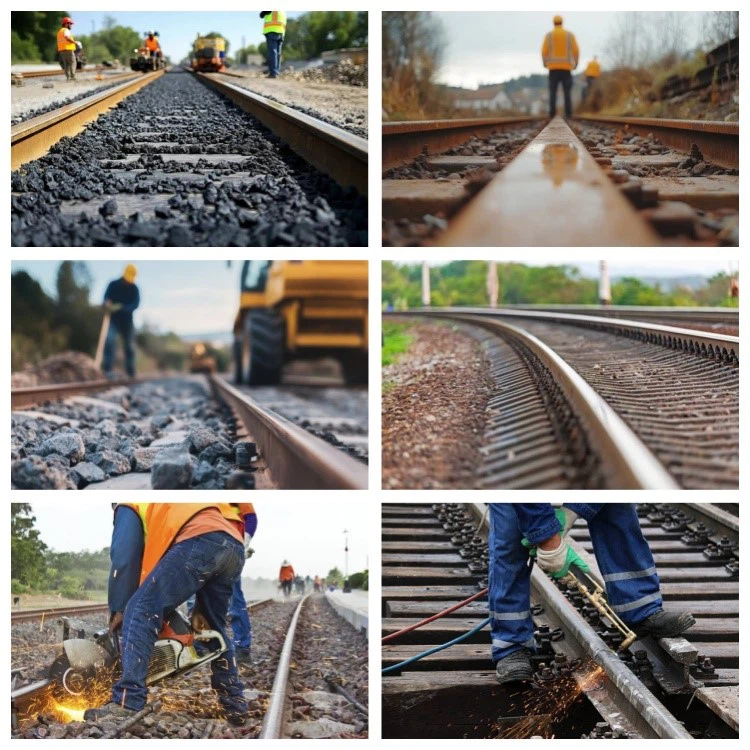
Railway track laying methods and track laying tools
There are many different ways to lay tracks on railways, and each method has its specific application scenarios and differences. Track laying tools refer to special tools or equipment used in the construction of railway track laying.
1. Track laying methods:
Railway track laying methods mainly include manual track laying, mechanical track laying, and special laying types.
2. Main track laying methods and their application scenarios
Manual track laying
Manual track laying is to use existing or laid lines to unload rails, sleepers and accessories to the vicinity of the construction section, and then lay them by manpower or simple machinery. This method is suitable for projects with small track laying projects such as auxiliary lines and dedicated lines.
Application scenarios:
When the construction area is narrow, the terrain is complex, or mechanical equipment is difficult to enter, manual track laying becomes the main choice. In addition, when the construction period is not tight and the budget is limited, manual track laying is also an economically feasible solution.
Difference: Compared with mechanical track laying, manual track laying is slower and more labor-intensive, but it is more flexible and adaptable.
Mechanical track laying
Mechanical track laying is to transport the rails assembled at the track laying base to the laying site by rail arranging vehicles, and then lay them on the pre-ballasted roadbed by track laying machines. This method is efficient and fast, and is suitable for large-scale railway construction.
Application scenarios: Large-scale railway construction projects such as major railway trunk lines, high-speed railways, and urban rail transit usually adopt mechanical track laying. These projects have strict construction period requirements and huge engineering volume, and mechanical track laying can significantly improve construction efficiency and quality.
Difference: Mechanical track laying requires professional machinery and personnel, and the initial investment is large, but once it is put into use, its efficiency and quality are better than manual track laying.
3. Main tooling products in track laying:
Locate: used to locate the position of the track foundation on the working surface to ensure that the sleepers and tracks can be accurately placed in the specified position.
Bogie: also known as track laying machine, its function is to rotate the sleepers and tracks along a certain curve or straight line to the specified position to ensure the accuracy and continuity of track laying.
Leveling frame: used to adjust the sleepers and tracks to ensure the flatness and stability of the tracks, which is crucial for the safety and comfort of train operation.
Fuel-fueled electric welder: During the track laying process, the rails need to be welded to form a continuous track. The fuel-fueled electric welder is a device used to weld the rails together to ensure welding quality and efficiency.
Tensile machine: used to tighten components such as steel strands connecting the railway to enhance the overall stability and tensile strength of the track structure.
Rail support frame:
When laying the integral track bed, the rail support frame is used to fix the track and adjust the track gauge and track elevation. It consists of main support rods, adjustment screws, base support plates and other components to ensure the accuracy and stability of track laying.
The above products are only part of the track laying tooling, and more types of equipment and tools may be used in actual construction.