

The steel rail, also know as rail track, railroad rail, is used to guide the train wheels far forwarding, by withstanding the enormous stress by the wheel when a train passes by, and transferring to the tie sleepers as well. The rail shall provide smooth and continuous rolling surface with least resistance.
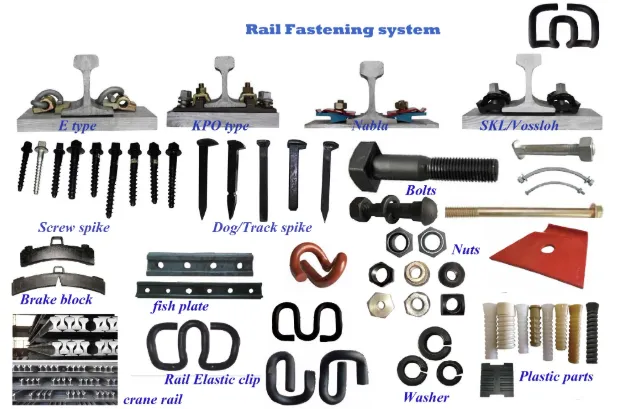
Rails constitute the most critical components in railway track systems, encompassing diverse types with varying weights and dimensions. All rail varieties feature hardened heads and flat bases. GNEE RAILWAY RAILWAYL supplies multiple rail specifications including 60kg/m, 75kg/m, and 50kg/m heavy rails, QU70, QU80, QU100 crane rails, and others. Concurrently, we provide track fasteners for securing rails to sleepers: dog spikes, screw spikes, resilient fastening clips, and rail clamps etc.
Steel Rail Sections looks like similar to steel profiles used for steel structure in buildings, their main functions in rail track are as follows:
- Rails provide a continuous and level surface for the movement of trains.
- Rails provide a pathway which is smooth and has very little friction. The friction between the steel wheel and the steel rail is about one-fifth of the friction between the pneumatic tyre and a metalled road.
- Rails serve as a lateral guide for the wheels.
- Rails bear the stresses developed due to vertical loads transmitted to them through axles and wheels of rolling stock as well as due to braking and thermal forces.
- Rails carry out the function of transmitting the load to a large area of the formation through sleepers and the ballast.


