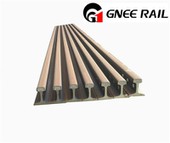
Rail pads are elastic polyurethane mats which are interposed between steel rails and railway sleepers to protect the sleeper top from wearing and impacting.
The starting stiffness of a rail pad is designed to not be high so that their relative deformation under the spring clip toe loads is greatly substantial. In this way, it can guarantees the rail pad maintaining in close contact with the rail despite of any vertical movements of the latter.
GNEE RAIL can provide railway pads made of various materials and can be customized according to customer requirements. If you have special customization requirements, please contact us.
Rail pads for Normal Railways
HDPE
| No. | Technical Parameter | Unit | Technical Requirement | Value |
| 1 | Density | g/cm3 | 0.95-0.98 | 0.95 |
| 2 | Tensile Strength | Mpa | ≥19 | 19 |
| 3 | Elongation | % | >80 | 150 |
| 4 | Melting Point | ℃ | 170-190 | 190 |
| 5 | Insulation Resistance | Ω | ≥1×10¹⁰ | 3.5 ×10¹⁰ |
| 6 | Hardness | A | ≥98 | 98(A) |
EVA: Polyethylene 80%, Vinyl Acetate 20%
| No. | Technical Parameter | Unit | Technical Requirement | Value |
| 1 | Density | g/cm3 | 0.95-0.98 | 0.95 |
| 2 | Tensile Strength | Mpa | ≥15 | 16 |
| 3 | Elongation | % | >500 | 550 |
| 4 | Melting Point | ℃ | 170-190 | 170 |
| 5 | Insulation Resistance | Ω | ≥1×10¹⁰ | 5.0 ×10¹⁰ |
| 6 | Hardness | A | ≥90 |
Rubber
| No. | Technical Parameter | Unit | Value |
| 1 | Stiffness | KN | 90-130 |
| 2 | Hardness Shore A | ℃ | 72-80degree |
| 3 | Electronic Resistance | Ω | ≥ 106 |
| 4 | Tensile Strength before Aging | Mpa | ≥12.5 |
| 5 | Elongation before Aging | % | ≥250 |

Elastic rubber plates for High-speed Railways

Height adjustment pads for High-speed Railways