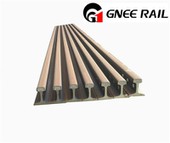
How are rail pads packaged and shipped?
Railway rubber pad is an important part in rail structure, which is the connex of rails and concrete structure parts in order to protect from vibrating and impacting. In addition, through it the railway signal system can be also in the state of electric isolation.
Railway pads working principle
The railway pad working principle is mainly based on the railway pad materials' elasticity and their structure design:
- When trains pass, railway pads will have an elastic deformation. This kind of deformation can absorb the trains' dynamic load, and reduce causing strict impact on the rails and the tie.

- What's more, the materials of railway pads, like rubber, EVA, or HDPE, all have a great capacity for absorbing and dispersing energy. When the train contacts the rail pad, the railway pads absorb and disperse the energy to decline the railroad track systems' integral shake and noise.

| Rubber Rail Pad | ||
| Technical Parameter | Unit | Value |
| Stiffness | KN | 90-130 |
| Hardness Shore A | ℃ | 72-80 degree |
| Electronic Resistance | Ω | ≥ 106 |
| Tensile Strength before Aging | Mpa | ≥12.5 |
| Elongation before Aging | % | ≥250 |
| HDPE Rail Pad | |||
| Technical Parameter | Unit | Technical Requirement | Value |
| Density | g/cm3 | 0.95-0.98 | 0.95 |
| Tensile Strength | Mpa | ≥19 | 19 |
| Elongation | % | >80 | 150 |
| Melting Point | ℃ | 170-190 | 190 |
| Insulation Resistance | Ω | ≥1×10¹⁰ | 3.5 ×10¹⁰ |
| Hardness | A | ≥98 | 98(A) |
| EVA: Polyethylene 80%, Vinyl Acetate 20%. | |||
| Technical Parameter | Unit | Technical Requirement | Value |
| Density | g/cm3 | 0.95-0.98 | 0.95 |
| Tensile Strength | Mpa | ≥15 | 16 |
| Elongation | % | >500 | 550 |
| Melting Point | ℃ | 170-190 | 170 |
| Insulation Resistance | Ω | ≥1×10¹⁰ | 5.0 ×10¹⁰ |
| Hardness | A | ≥90 | 92(A) |
- After the train passes, the railway pad will be restored to its original shape and state. That ensures the railway pad's durability and stability during long use.
Rail pads packaged and shipped
Rail pads are packaged in bulk, often stacked and secured on pallets or in durable crates, using protective wrapping like plastic film and cushioning (bubble wrap/foam) to prevent damage from shock, vibration, and weather during transport via truck or rail; they're clearly labeled with product details, weight, and quantity for logistical tracking.

Packaging Details
- Bulk Stacking: Pads are stacked together in large quantities.
- Cushioning: Wrapped in plastic or placed with foam/bubble wrap to absorb impacts and protect surfaces.
- Securing: Strapped, shrink-wrapped, or placed in reinforced cardboard boxes or crates to keep stacks stable and prevent shifting.
- Protection from Elements: Covered to shield from sun, rain, and moisture.
- Labeling: Packages clearly marked with model, quantity, weight, and handling instructions.
The use of railway rubber pads can greatly improve transportation capacity of rail vehicles and reduce the times of maintenance for railway crossing to avoid flameout traffic accident caused by them. Compared with other railway rubber pads,GNEE RAILWAY RAILWAYL's product service life can be up to 3 times longer than them. The tests have proved that the pressure of more than 80 tons can be stable without deformation for our products. Using high-tech production technology, GNEE RAILWAY's railway rubber pads choose good rubber as main raw material, are carefully developed and made with scientific formula.