

What are the key properties of a100 rail material for heavy-duty use?
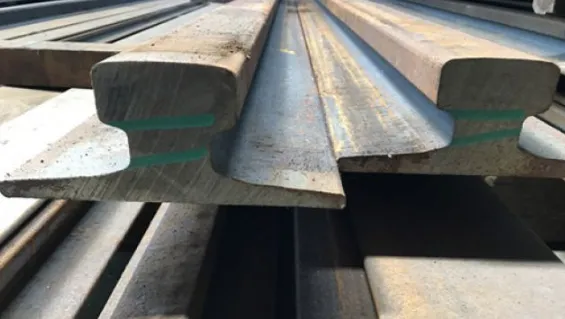
A100 rail material, adhering to the DIN 536-1:1991 standard, is engineered for heavy-duty industrial applications such as overhead gantry cranes, port terminals, and shipyards. Its primary key properties include high tensile strength, exceptional wear resistance, and a specialized profile designed to manage heavy, consistent loads.
Technical Specifications and Material Composition of A100 Crane Rail
The A100 Crane Rail Of DIN536 Standard is defined by its robust "A" shape, which features a significantly wider base than its height. This low web crane rail design is intentional, as it lowers the center of gravity and provides a massive contact surface for the supporting structure.
The chemical composition of A100 crane rail is primarily focused on a high carbon and manganese content. This chemistry facilitates the production of hot-rolled flat bottom rails with a pearlitic structure, which is essential for surface hardness. By maintaining strict control over sulfur and phosphorus levels, the rail achieves excellent toughness, preventing brittle fractures under the sudden impact loads common in gantry crane movements.
- Tensile Strength: Typically ranges from 690 to 1100 N/mm² depending on the specific steel grade (e.g., 700, 900, or 1100).
- Surface Hardness: Achieving a minimum of 260 HBW on the rail head to resist abrasive wear.
- Standard Compliance: Fully adheres to DIN536-1:1991 German standards for dimensional accuracy.
| Steel grades | Chemical composition | ||||||
| %C | %Mn | %Si | %P | %S | Max H ppm | Max O ppm | |
| 700 | 0,40 0,60 | 0,8 1,25 | 0,05 0,35 | Max 0,05 | Max 0,05 | – | – |
| 900A | 0,60 0,80 | 0,8 1,3 | 0,1 0,5 | Max 0,04 | Max 0,04 | – | – |
| 900 B | 0,55 0,75 | 1,3 1,7 | 0,1 0,5 | Max 0,04 | Max 0,04 | – | – |
| R200 | 0,40 0,60 | 0,7 1,2 | 0,15 0,58 | Max 0,035 | 0,008 0,025 | 3,0 | 20 |
| R260 | 0,62 0,80 | 0,7 1,2 | 0,15 0,58 | Max 0,025 | 0.008 0,025 | 2,5 | 20 |
Dimension of the A100 Crane Rail
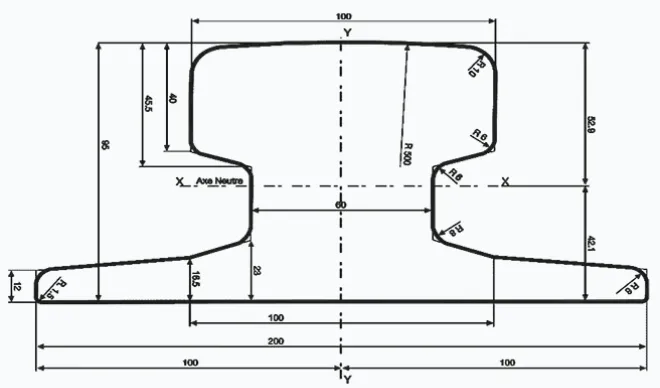
The dimension of the A100 crane rail is the most vital factor for compatibility with crane rail clips and pads. According to the DIN 536 A100 rail dimensions details, the head width is 100mm, while the base width extends to 200mm.
This 2:1 ratio between the base and the head ensures that the vertical force from the crane is dissipated across a wide area, protecting the underlying grout or steel girder from excessive fatigue.
| Type of Rail | Dimensions mm | Steel Grade | Weight(Kg/m) | |||
| Rail height/A | Bottom Width/F | Head Width/C | Web Thickness/t | |||
| A45 | 55 | 125 | 45 | 24 | 50Mn | 22.1 |
| A55 | 65 | 150 | 55 | 31 | 50Mn | 31.8 |
| A65 | 75 | 175 | 65 | 38 | U71Mn | 43.1 |
| A75 | 85 | 200 | 75 | 45 | U71Mn | 56.2 |
| A100 | 95 | 200 | 100 | 60 | U71Mn | 74.3 |
| A120 | 105 | 220 | 120 | 72 | U71Mn | 100 |
| A150 | 150 | 220 | 150 | 80 | U71Mn | 150.3 |
Comparative Standards for Global Heavy-Duty Crane Rails
While the type (type A) of crane rail is the European benchmark, many international projects may specify other regional standards. For instance, the American standard ASTM759 crane rail (such as CR104 or CR175) follows a different profile geometry compared to the DIN 536 A-series crane rails. In addition to the German standards, other common profiles include the Indian standard ISCR crane rail (ISCR100, ISCR120), the Japanese standard JIS crane rail (CR100), and the Chinese standard QU crane rail (QU100).

|
AMERICAN CRANE RAILS |
|||||||
|---|---|---|---|---|---|---|---|
| CR104 (MRS51)* | American Standard | 127,00 | 127,00 | 63,50 | 25,40 | 66,40 | 51,59 |
| CR105 (MRS52)* | ArcelorMittal Specification | 131,80 | 131,80 | 65,10 | 23,80 | 66,40 | 52,09 |
| CR135 (MRS67)* | American Standard | 146,05 | 131,76 | 87,30 | 31,80 | 85,80 | 66,97 |
| CR171 (MRS85)* | American Standard | 152,40 | 152,40 | 109,20 | 31,80 | 108,38 | 84,83 |
| CR175(MRS87B)* | American Standard | 152,40 | 152,40 | 108,00 | 38,10 | 110,30 | 86,80 |
|
SPECIAL CRANE RAILS |
|||||||
|---|---|---|---|---|---|---|---|
| MRS73* | ArcelorMittal Specification | 157,00 | 146,00 | 70,00 | 32,00 | 93,80 | 73,63 |
| MRS86* | ArcelorMittal Specification | 102,00 | 165,00 | 102,00 | 80,30 | 108,90 | 85,50 |
| MRS87A* | ArcelorMittal Specification | 152,40 | 152,40 | 101,60 | 34,90 | 111,30 | 86,80 |
| MRS125* | ArcelorMittal Specification | 180,00 | 180,00 | 120,00 | 40,00 | 160,20 | 125,00 |
| MRS140* | ArcelorMittal Specification | 150,00 | 220,00 | 120,00 | 80,00 | 178,00 | 139,80 |
| MRS192* | ArcelorMittal Specification | 157,20 | 229,00 | 140,00 | 128,30 | 244,50 | 192,00 |
| MRS221* | ArcelorMittal Specification | 160,00 | 220,00 | 220,00 | 154,00 | 282,10 | 221,40 |
| AS86* | ArcelorMittal Specification | 152,46 | 150,00 | 101,60 | 35,00 | 109,40 | 85,88 |
| CR73* | ArcelorMittal Specification | 135,00 | 140,00 | 100,00 | 32,00 | 93,40 | 73,30 |
| CR100* | ArcelorMittal Specification | 150,00 | 155,00 | 120,00 | 39,00 | 127,70 | 100,20 |
| CRS140* | ArcelorMittal Specification | 150,00 | 200,00 | 150,00 | 80,00 | 178,10 | 139,80 |
| SP100* | ArcelorMittal Specification | 150,00 | 150,00 | 100,00 | 38,00 | 113,40 | 89,05 |
| SP120* | ArcelorMittal Specification | 170,00 | 170,00 | 120,00 | 44,00 | 150,69 | 118,28 |
Although they may serve similar load capacities, the A100 Crane Rail remains unique due to its specific width-to-height ratio. GNEE RAIL provide technical consulting to help clients determine if the Profile rail A100 is a suitable replacement for other standards based on existing wheel flange clearance and load requirements.
FAQ
- What is the main advantage of the A100 profile compared to standard railway tracks?
The A100 rail features a much wider base and a lower height (low profile), which provides superior stability against the lateral forces generated by heavy cranes. Standard railway tracks are taller and thinner, making them prone to tipping or buckling under the specific torque of a crane's movement.
- Can A100 crane rails be welded together for a continuous track?
Yes, A100 rails can be joined using aluminothermic welding or flash butt welding. However, due to the high carbon content in the chemical composition of A100 crane rail, specific pre-heating and post-welding cooling procedures must be followed to prevent cracking in the heat-affected zone.
- How do I choose between the different steel grades for DIN 536 A100 rail?
The choice depends on the duty cycle and wheel load of your crane. Grade 700 is suitable for standard industrial use, while Grade 900 or 1100 (wear-resistant) is recommended for high-frequency operations like container terminals or steel plants where rail head wear is a primary concern.
- Are there specific accessories required for A100 rail installation?
Absolutely. Because of the A100's unique geometry, you must use compatible crane rail accessories, including weldable or bolted clips designed for "A" series rails and elastic pads that match the 200mm base width to ensure proper load distribution.
- What is the difference between A100 and QU100 rails?
While both have a 100mm head width, they follow different standards (DIN 536 vs. Chinese YB/T 5055). The height and base dimensions differ slightly, meaning they are not always directly interchangeable without checking the crane wheel flange and the existing fastening system's dimensions.
- Does the A100 rail require special surface treatment for corrosion?
In most indoor industrial environments, standard hot-rolled rails are sufficient. However, for coastal ports or chemical plants, GNEE RAIL can provide rails with specialized anti-corrosion coatings or suggest maintenance schedules to protect the DIN 536 A100 rail system from environmental degradation.


