

What is the maximum axle load for standard 136lb tracks?
The maximum axle load for standard 136RE (136 lb) track is typically rated for 39 tons (78,000 lbs), though it is most commonly operated within the 33 to 36-ton range for North American Class I heavy-haul freight.
The actual load capacity is not just a function of the rail weight itself, but a combination of the rail's structural properties, the track support system, and the speed of the traffic.
1. Nominal vs. Maximum Load Ratings
In modern railway engineering, load capacity is categorized by the "Gross Rail Load" (GRL) of the railcar.
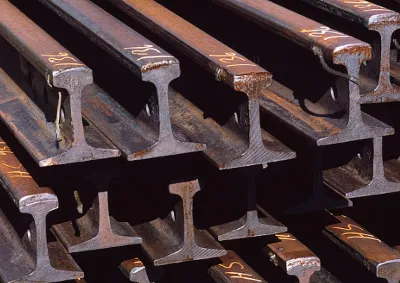
- Standard Heavy Haul (286,000 lbs GRL): This is the industry standard for 136RE track. It equates to an axle load of 35.75 tons.
- High Capacity (315,000 lbs GRL): 136RE is frequently used for these loads, which result in a 39.37-ton axle load. This is generally considered the upper limit for the 136RE profile before maintenance costs and rail fatigue (RCF) increase exponentially.
2. Factors Determining the Load Limit
The 136RE profile's dimensions allow it to handle these extreme weights due to several mechanical factors:
- Vertical Stiffness: The 7-5/16" height provides the stiffness necessary to distribute the point load of a 39-ton axle across multiple ties. If the rail were shorter, the deflection would crush the ballast and ties.
136re rail dimensions:
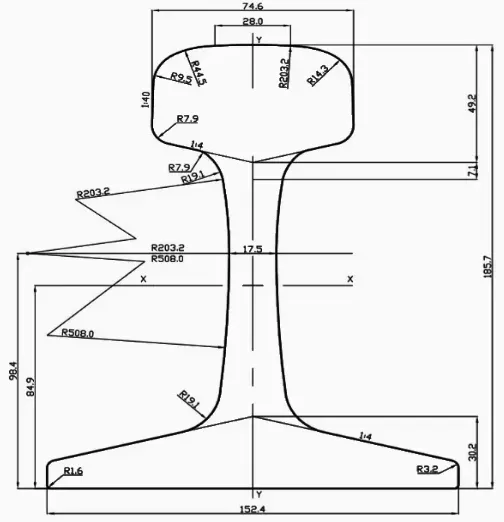
| Profile | Standard | Dimensions mm | Section S | Mass m | ||||
|---|---|---|---|---|---|---|---|---|
| H | B | C | D | E | cm² | kg/m | ||
| American standard | ||||||||
| 136RE (TR68) | AREMA | 185,70 | 152,40 | 74,60 | 49,20 | 17,50 | 85,90 | 67,50 |
- Contact Stress: As axle loads exceed 35 tons, the pressure at the wheel-rail interface can exceed the yield strength of standard carbon steel. To achieve the maximum 39-ton rating, Head-Hardened (HH) 136RE rail is typically required to prevent plastic deformation (mushrooming).
- Track Modulus: The rail's capacity is capped by the "foundation." On 136lb tracks, the ballast depth and tie spacing (usually 19.5 to 21 inches) must be optimized. Without a strong subgrade, even 136lb rail will fail under 39-ton loads.
FAQ
Q1: What is your minimum order quantity for 136RE rail?
A: For standard carbon grades, MOQ is 20 tonnes (approx. 300 meters of 25m length). For low alloy HH grade, MOQ is 50 tonnes. Smaller trial orders are possible – contact us to discuss your needs.
Q2: Can you provide mill test certificates showing yield strength and hardness?
A: Yes. Every shipment includes original mill test certificates with chemical composition (C, Si, Mn, Cr, etc.) and mechanical properties (yield, tensile, elongation, HBW) per AREMA 2019. Third-party inspection is also available.
Q3: Do you supply 136RE rail with pre-drilled holes for joint bars?
A: Absolutely. Many customers need pre-drilled holes for fishplates or custom bolt patterns. GNEE RAIL offers end-drilling, multiple-hole drilling, and custom lengths from 6m to 25m.
Q4: Which hardness grade should I choose for mixed traffic with passenger trains?
A: For mixed traffic including passenger trains (higher speeds but lower axle loads), low alloy HH grade (370 HBW) is still recommended because speed increases dynamic impact. Standard carbon IS grade (350 HBW) may work if passenger speeds are below 100 km/h.
Send your axle load, curve data, and required length – we will reply with a free quotation and technical datasheet within 24 hours. Talk to our engineer directly for a no-obligation consultation.


