


What is the length and width of the S20 Rail?
The standard DIN 5901 S20 rail profile features specific dimensional criteria engineered to optimize lateral tracking stability and structural weight efficiency for industrial narrow-gauge and crane networks. The geometric width across its distinct cross-sectional components is fundamentally standardized, while its linear length parameters are hot-rolled into uniform commercial increments to simplify international shipping and on-site assembly.
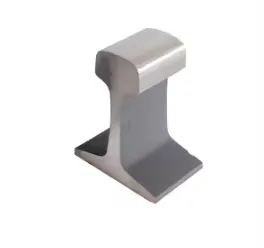
- Total Profile Base Width: The bottom flange footprint features a standardized width of 82.00 mm, providing an extensive horizontal anchoring base to distribute vertical loading forces across the ties.
- Running Head Width: The uppermost crown surface is rolled to a definitive width of 44.00 mm, delivering an optimized wheel flange contact zone that minimizes lateral friction wear.
- Standard Commercial Lengths: The track profile is primarily supplied in standard stock lengths of 6.00 meters and 10.00 meters, tailored to balance linear tracking continuity with easy container logistics.
- Total Vertical Height: This European light rail section features an absolute vertical height of 100.00 mm from the bottom base to the running crown, yielding high flexural rigidity relative to its mass.
| Size | Rail height(mm) | Bottom Width(mm) | Head Width(mm) | Web Thickness(mm) | Weight(kg/m) |
| S10 | 70 | 58 | 32 | 6 | 10 |
| S14 | 80 | 70 | 38 | 9 | 14 |
| S18 | 93 | 82 | 43 | 10 | 18.3 |
| S20 | 100 | 82 | 44 | 10 | 19.8 |
| S24 | 115 | 90 | 53 | 10 | 24.4 |
| S30 | 108 | 108 | 60.3 | 12.3 | 30.03 |
How Does the S20 Profile Width and Length Efficiency Compare to Alternative Rail Profiles?
Selecting the optimal track specification from the international catalog of DIN 5901 light rails involves balancing expected wheel loading limits against initial track procurement budgets. An optimized tracking section prevents early structural fatigue while keeping the upfront investment of the line layout within strict financial bounds.

- Compared to smaller light profiles, the S20 Mining Rail provides vastly superior lateral overturning resistance due to the wide balancing moment provided by its 82.00 mm base flange.
- When evaluated against heavier alternatives, the Din Standard S20 Steel Rail fulfills necessary flexural stiffness targets along its 10.00 mm center web while lowering overall per-mile mass tonnage requirements, meaning purchasing teams receive more usable track footage per purchased metric ton of steel.
This strategic engineering balance positions the S20 profile as a highly economical asset for secondary material loops and light industrial yards.
Advantages of selecting standard-length S20 rails
Selecting standard-length S20 rails (typically 5 to 12 meters) offers distinct advantages for industrial and light-rail networks. These include highly predictable mechanical performance, exceptional compatibility with standardized fastening systems, and streamlined logistics.
The main advantages of selecting standard-length S20 rails include:
- Standardized Compatibility: Because S20 rails strictly adhere to European specifications like DIN 5901, standard lengths are perfectly symmetrical with common fastening solutions, including fishplates, clamps, and baseplates.

- Simplified Logistics & Handling: Stock lengths between 5 and 12 meters are far easier to transport, load, and install without the need for specialized heavy-duty machinery.
- Cost-Effectiveness: Using prefabricated standard lengths reduces waste and cuts down on the expensive custom milling or specialty cutting required for custom-built modular rail networks.
- Predictable Load Capacity: Weighing roughly 19.8 kg/m, standard S20 rails provide a reliable balance between structural simplicity and dependable load-bearing capacity for frequent, light-to-medium industrial traffic.
FAQ
- What specific joint bar configuration matches the dimensional profile of the S20 steel rail?
The S20 steel rail matches perfectly with multi-hole mechanical fishplates engineered to mirror the exact internal fishing angles under the 44.00 mm head and above the 82.00 mm base. Securing these joint bars with standard high-tensile track bolts through pre-drilled central web holes forms a rigid mechanical connection, ensuring a flush running track surface that prevents vertical stepping during material transport.
- Does the 20 kg Light Steel Rail class support continuous field welding across its 10.00 mm web?
Yes, the controlled carbon-to-manganese chemistry utilized in our 20 kg Light Steel Rail class ensures excellent weldability using standard thermit kits or manual flash-butt welding equipment. This uniform metallurgy prevents the formation of brittle martensitic zones across the 10.00 mm center web, yielding a continuous welded rail (CWR) string with uniform tensile strength and high structural flexibility.
Get a Quote in 24 Hours
GNEE RAILWAY RAILWAYL provides a vast selection of international standard rails managed by dedicated technical coordinators who oversee your complete procurement timeline with meticulous after-sales verification, so engage our global commercial desk immediately to obtain competitive volume estimates or evaluate tailored track layout files.


